

























































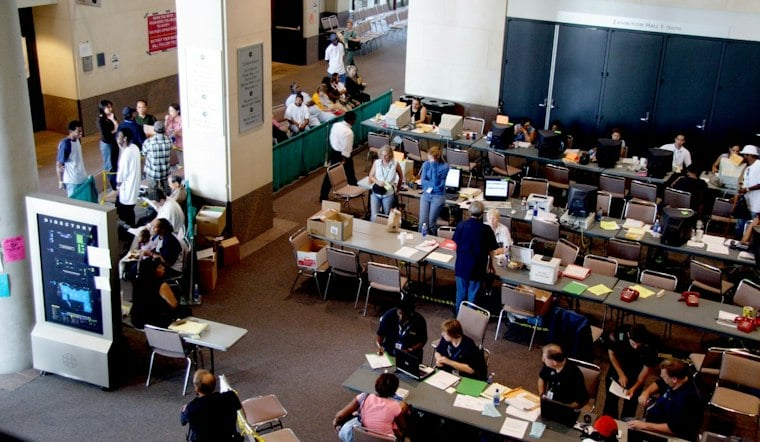
A man was found dead at Houston's new residential service center for homeless people in East Downtown on October 11, and more than a week later, neither the city nor the nonprofit running the facility will say what happened. A former resident of the center identified the man as 44-year-old Mark Estelle. The Harris County medical examiner's office listed his time of death as 10:24 p.m. that night.
According to Houston Public Media, Houston Fire Department first responders were dispatched to 419 Emancipation Avenue for a possible cardiac arrest involving someone who was non-responsive. The man was already dead when they arrived. A primary cause of death for Estelle has not yet been determined, and Houston Public Media reported it was unable to reach his family.
The Harris Center, which operates the facility and serves as the official mental health authority for Harris County, said through a spokesperson that it could not provide specific information about the death, citing state and federal confidentiality laws. Houston Housing Director Mike Nichols likewise declined to answer specific questions about the incident or the status of any ongoing investigation, though he said he remains confident in the Harris Center as an operator. Neither the city nor the Harris Center answered when staff last interacted with Estelle before he was found unresponsive.
A Curfew and an Emergency Call After Hours
Residents at the 222-bed facility are subject to a 10 p.m. to 6 a.m. curfew, and the emergency call that brought first responders to the building came after curfew had already taken effect on October 11. Beyond that timing, the station's report does not establish what led up to the call or who placed it.
The Harris Center holds what Houston Public Media described as a three-year, $39.1 million contract with the city to run the center, though a separate account from openminds.com describes the arrangement as a contract worth up to $39 million running through April 2029. The two outlets also differ on when the center actually opened its doors — Houston Public Media reported it opened in late May 2026, while openminds.com put the date at June 3, 2026.
A Shelter Built for Serious Medical and Mental Health Needs
The facility was designed to handle more than basic shelter. Houston Public Safety Director Larry Satterwhite said in April that residents would receive triage to identify significant conditions requiring emergent medical attention, and that the goal was to maintain a safe, healthy environment. Harris Center CEO Wayne Young said at the time that the center was ready to support residents' serious mental and physical health needs below the level of a hospital acute-crisis response.
Roughly 80 Harris Center employees staff the facility, the same report noted, and they are required to complete annual CPR and first-aid training and are expected to interact with residents daily. By October, Nichols said more than 420 people had been served at the center since it opened, with about 110 moving into what he called positive placements. He also reported that around 150 people had unknown outcomes after leaving without entering treatment or pursuing permanent housing, and that residents stayed at the facility for an average of more than 60 days.
Advocates Say Deaths in Transition Aren't Rare
Catherine Villarreal, vice president of public affairs for the Coalition for the Homeless of Houston and Harris County, said her organization was unfamiliar with Estelle's case and has no formal role at the facility. Still, she said deaths among people moving from unsheltered homelessness into residential settings are sad but not unusual — a reflection of just how fragile that transition can be for people with serious health needs.
That fragility shows up starkly in county data. Nearly 250 people died without a home in Harris County in 2022, according to the Houston Chronicle, a rate of roughly one death every 36 hours that year. Since 2011, the county's homeless population has fallen by more than two-thirds even as the number of deaths among people experiencing homelessness has climbed, with opioids — primarily fentanyl — and methamphetamine each tied to more than 50 deaths by 2022 after surging in 2020.
The county's broader homelessness numbers have otherwise held fairly steady. The 2026 Point-in-Time Count found 3,321 people experiencing homelessness across Harris, Fort Bend and Montgomery counties in February, essentially flat compared with 3,325 the year before, per the Coalition for the Homeless of Houston/Harris County. That count identified 2,051 people in shelters and 1,270 living unsheltered, and the coalition's report found that 85% of people who exit homelessness remain stably housed two years later.
Under Harris County Institute of Forensic Sciences procedures, the medical examiner determines a cause and manner of death only after reviewing available medical and investigative evidence, and a case can be classified as pending while toxicology or other studies continue. Medical examiner jurisdiction over a death also does not automatically mean a full autopsy will be performed. It remains unclear, based on available reporting, whether that process has concluded in Estelle's case.





