

























































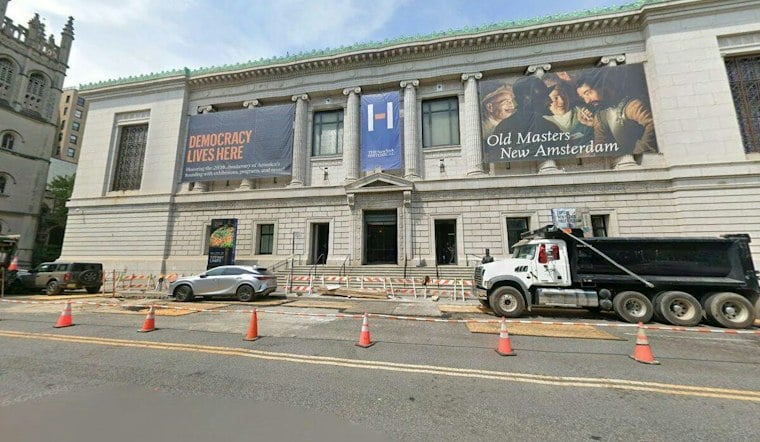
Opera stars, Italian diplomats and Manhattan's social set packed The New York Historical last Wednesday night for The Next Act, a benefit gala that doubled as a tribute to Arturo Toscanini, the Italian conductor who once called Riverdale home and whose weekly radio broadcasts from Rockefeller Center turned symphonic music into a national habit. The evening raised money for student scholarships while threading together Milan's famed La Scala opera house, a Bronx mansion, and a conductor who defied Mussolini decades before he became a household name in American living rooms.
The gala was staged by the Teatro alla Scala Association of America, the group's annual benefit performance gala, held October 7 at The New York Historical in Manhattan, according to amNewYork. The evening featured soprano Federica Lombardi and mezzo-soprano Samantha Hankey, and it carried the support of the Consulate General of Italy in New York, with sponsors including Armani, Brioni, Pomellato, Bellavista and Campari under a Milanese chic dress code, per the same amNewYork account. The association itself was founded in 2023 by Dr. Milena Adamian and Kirill Sheynkman after the pair relocated from New York to Milan, and it remains the only U.S.-registered tax-exempt entity officially recognized by Milan's Teatro alla Scala, according to Social Life Magazine.
Interviews throughout the evening were led by Joshua Barone of The New York Times and NBC correspondent Chloe Melas, the amNewYork report notes, as the group advanced what it describes as its mission of education, access and professional opportunity. A separate report from The Knockturnal notes the October 7 gala's corporate backing also extended to Eataly and Mapia, underscoring how deep the Italian business community's involvement in TASAA's New York operations runs.
A Scholarship Winner Gets a Shot at the 2027 Spotlight
Central to the fundraising push was the Arturo Toscanini Scholarship, which supports a student at Accademia Teatro alla Scala; this year's recipient is set to perform at the association's 2027 gala, per amNewYork's reporting. The association has also placed 126 students and graduates in a full staging of L'elisir d'amore, the same report states, pairing rising performers with hands-on professional experience inside one of opera's most storied institutions.
That mainstage work sits alongside a far larger outreach effort. An abbreviated adaptation of Gaetano Donizetti's L'elisir d'amore introduced more than 20,000 children to opera this year, reaching many kids from underserved communities, The Knockturnal reports. It is a dual mission that pairs five-figure luxury sponsorships with free arts access for schoolchildren who might otherwise never set foot inside an opera house.
The Conductor Who Defied a 19-Year-Old's Nerves — and Later, a Dictator
The gala's tribute leaned heavily on Toscanini's own improbable rise. At 19, he was summoned to conduct Verdi's Aida from memory while touring Brazil as a cellist in 1886, according to amNewYork, a career-launching moment that preceded his leading the 1896 world premiere of Puccini's La Bohème at Turin's Teatro Regio. He debuted at the Metropolitan Opera in 1908, the same year he worked alongside Gustav Mahler, and in 1910 he conducted the world premiere of Puccini's La Fanciulla del West at the Met with Enrico Caruso and Emmy Destinn in the leading roles, per the same account.
Toscanini went on to lead the New York Philharmonic from the late 1920s until 1936. His politics proved as consequential as his baton: his break with Mussolini came after Mussolini became prime minister in 1922, and on May 14, 1931, he was assaulted by Fascist Blackshirts at Bologna's Teatro Comunale after refusing to conduct the regime's anthem, Giovinezza, before a memorial concert for composer Giuseppe Martucci, according to Classical-Music.com. Years later, on December 26, 1936, he conducted the inaugural concert of the Palestine Symphony Orchestra in Tel Aviv without accepting a fee, supporting an ensemble that violinist Bronislaw Huberman had formed to rescue European Jewish musicians fleeing Nazi persecution, according to PBS.
From Studio 8H to a Bronx Villa
Back in New York, NBC assembled an ensemble expressly for Toscanini, with broadcasts originating from Rockefeller Center's Studio 8H and carrying symphonic music into homes across the country, amNewYork reports. The network's orchestra, created in 1937 under NBC president David Sarnoff, gave Toscanini weekly national exposure until his retirement in 1954, a corporate and technological partnership that Social Life Magazine notes helped turn him into a household name across 20th-century America.
After World War II, Toscanini returned to Milan to help reopen La Scala. He spent his final years at Villa Pauline, a 28-room estate in Riverdale that he purchased in 1946, and he died there on January 16, 1957, according to Forgotten New York.
The conductor's imprint on New York extends well past Riverdale and Rockefeller Center. Brooklyn's Public School 216 in Gravesend carries his name as P.S. 216 Arturo Toscanini, a civic honor Hoodline has previously reported on in coverage of a nearby residential development. And decades after Toscanini led the New York Philharmonic, Meredith Willson — the eventual composer of The Music Man — performed as a flutist in that same orchestra under his baton during the 1920s, a connection Hoodline noted in its coverage of a recent touring production of the musical.
Teatro alla Scala's own 2026–2027 season opens December 7, the feast day of Milan's patron saint Ambrose, with Giuseppe Verdi's Otello conducted by Myung-Whun Chung, according to OperaWire. For the scholarship students funded by this month's Manhattan gala, that Milan stage — and the 2027 benefit performance still to come — represents the next act the evening's name promised.





