

























































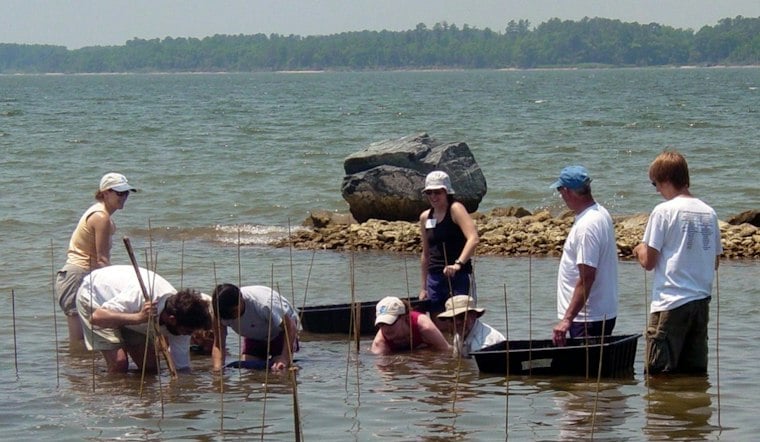
Crews are placing roughly 1,669 tons of stone per acre into the waters of Maryland's Hooper Strait Oyster Sanctuary, the foundation for a new 70-acre oyster reef backed by $10 million in federal funding. The project, now underway on the state's lower Eastern Shore, is an oyster restoration build in the Chesapeake Bay region.
According to Seafoodnews, NOAA's Office of Habitat Conservation awarded the funds to the Maryland Department of Natural Resources in 2024, with the money flowing through the Infrastructure Investment and Jobs Act. The agency has said the investment will create more than 70 acres of oyster reef habitat in the sanctuary. Murtech, a veteran-owned Maryland marine contractor, is handling construction and placing the stone base acre by acre.
The construction plan centers on a stone base for the reef. Murtech is carrying out the work, placing stone acre by acre.
Why Stone Instead of Shell
That shift reflects a broader shortage of natural oyster shell across the region. Instead of shell, the reef base is amphibolite stone onto which spat-on-shell can settle or recruit naturally, a key operational change noted in state procurement documentation tied to the Maryland Board of Public Works. The approach lets young oysters attach and grow on the rock just as they would on traditional shell substrate.
Hooper Strait Sanctuary is on Maryland's lower Eastern Shore, where a new large-scale reef restoration project is underway.
Part of a Bigger Bay-Wide Push
The Hooper Strait build follows a broader restoration effort in which partners have restored more than 2,400 acres of healthy reef across 10 selected tributaries and a bonus tributary, according to the Chesapeake Bay Program.
Regional partners have a goal of restoring at least 2,000 additional acres by 2040. That goal puts the Hooper Strait build in the context of broader Bay-wide restoration.
What Oysters Do for the Bay
The ecological case for reef restoration rests on the oyster's filtering power. A single adult Eastern oyster can filter up to 50 gallons of water per day, removing algae, suspended sediment, and excess nutrients, according to NOAA Fisheries. Oyster filtration also helps remove nutrients from the water.
The Bay's seafood industry is an important part of the regional economy, and its watershed is home to communities connected to that fishery.
That scale makes the historical decline of the Bay's oyster population all the more striking. Overfishing, disease, and sedimentation threaten oyster populations. Chesapeake Bay oyster populations are about 1–2 percent of historical levels.
Sanctuary Protection Still Helps Watermen
Oysters on the new reef are protected from harvest and may populate nearby public fishery areas.
Nonprofit partners have long supported that cycle of restoration. The Oyster Recovery Partnership, founded in 1994, has planted more than 14 billion oysters across 3,000 acres of rebuilt reef and operates the nation's largest shell-recycling network, collecting shell from approximately 200 restaurants, according to the Oyster Recovery Partnership. The group receives support from Maryland's natural resources department and the University of Maryland Center for Environmental Science's Horn Point Laboratory.
The Hooper Strait build adds to broader Chesapeake restoration efforts. Construction at Hooper Strait remains underway, with Murtech continuing to place stone across the sanctuary's waters acre by acre.





