

























































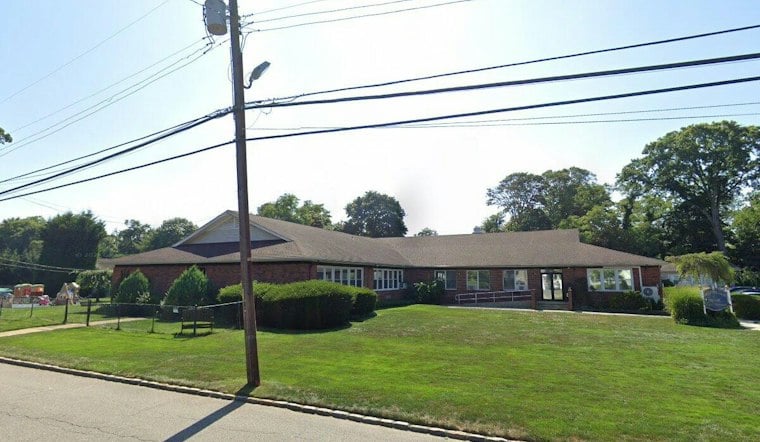
Grace Episcopal Church in Massapequa is asking the Town of Oyster Bay for permission to turn part of its front lawn along Merrick Road into a sprawling new cemetery, a plan that would add more than 700 ground-level burial plots and a maintenance shed to property that currently borders single-family homes. The request comes as the parish's centuries-old burial ground has room for just 14 more burials.
The permit application, filed with the town, proposes 715 to 716 new plots along Merrick Road plus a maintenance shed at 23 Cedar Shore Drive, according to News 12. The expansion site sits on the front lawn of the church's main campus, directly adjacent to residential homes. As CBS News New York reports, the church sits at the corner of Merrick Road and Cedar Shore Drive, and the new plots would use flat, ground-level markers instead of upright headstones, with landscaping and arborvitae planned as a visual buffer.
Tom Abbate, the church's zoning attorney, has framed the expansion as a matter of faith obligation. Burial, he said, is an important component of Christian faith, and the church needs to provide it to its faith-based community, per CBS News New York's reporting. Abbate requested that Wednesday's public hearing before the Town of Oyster Bay Planning Advisory Board be adjourned so church leaders could first meet with a local civic association, a delay the board granted, the station's report notes.
A Cemetery Running Out of Room
The push for new ground comes after more than a century of squeezing burials into a small plot. Grace Episcopal Church's existing cemetery and columbarium, which surround the original Old Grace Church building, have been managed by the parish's wardens and vestry since 1892, according to the church's own account of its history. Standard plots there were designed to accommodate two interments stacked vertically, a density measure that has nearly run its course now that only 14 burials remain possible, per CBS News New York.
That older cemetery carries significant local history. Major Thomas Jones, the 18th-century landowner and whaler for whom Jones Beach is named, died in December 1713 and was originally buried on his Fort Neck estate before being reinterred at the Floyd-Jones family cemetery on the Old Grace Church grounds in 1836, according to Wikipedia. Old Grace Church itself was built in 1844 on land donated by the Floyd-Jones family and served as Massapequa's main place of worship until 1960, when the current, larger Grace Episcopal Church went up directly across Merrick Road, per the Historical Society of the Massapequas. The original church was later deconsecrated in 1981 and handed over to the Massapequa Historical Society.
Neighbors Push Back on Front-Lawn Plan
For residents along Cedar Shore Drive, the scale of the proposal is the sticking point. Local residents have expressed strong opposition, arguing that adding over 700 burial plots to a church front lawn is excessive and would permanently alter the residential character of the neighborhood, the station's report states. The surrounding area is made up almost entirely of single-family detached homes.
Nearby residents are also concerned about increased burial activity, funeral services, and the proposed cemetery's proximity to their homes, per CBS News New York. Denise Strothman, a resident quoted in that report, said she understands both the church's desire for more graves and her neighbors' reluctance to live across the street from an expanded cemetery. Not everyone in the area opposes the project, however; Micha Mott has voiced support for the proposal, according to the same CBS News New York report.
A Multi-Step Town Approval Process Ahead
Before any shovels hit the ground, the church must clear a formal municipal review. Town of Oyster Bay land-use regulations require religious institutions seeking to expand cemetery operations to undergo site plan review by the Planning Advisory Board and obtain special permit approval from the Town Board, per town regulations. Site plan reviews examine grading, drainage, buffering, traffic flow, and neighborhood compatibility before any recommendation moves forward.
The Planning Advisory Board evaluates land-use and special permit requests before sending formal recommendations to the Town Board, which is why Wednesday's hearing was adjourned at the church's request rather than decided outright, per News 12's reporting. The public hearing will not resume until the local civic association has met to discuss and review the plan, according to CBS News New York.
Part of a Wider Burial Space Squeeze
Grace Episcopal Church's predicament is not unique on Long Island or across the state. A 2022 industry report by the New York State Association of Cemeteries found that over 100 non-profit cemeteries across New York have faced abandonment or severe financial distress in recent years due to limited land capacity and rising operational costs, according to Forest Lawn. When non-profit cemeteries default, local municipalities are legally required to assume maintenance costs, adding pressure on parishes to keep their grounds solvent.
Even as burial demand remains, fewer Americans are choosing it. Industry statistics compiled by the National Funeral Directors Association show traditional in-ground burials accounted for just 34.5 percent of U.S. end-of-life decisions in 2025, with national cremation rates topping 60 percent, as reported by Forbes. Regional planning analyses have also found that major cemeteries across New York City and Long Island have largely reached full plot capacity, forcing some facilities to reconfigure roads, walkways, and open green space to carve out new graves, according to Untapped New York. Repurposing an active church lawn, in that sense, fits a pattern already seen elsewhere in land-constrained parts of downstate New York.




