

























































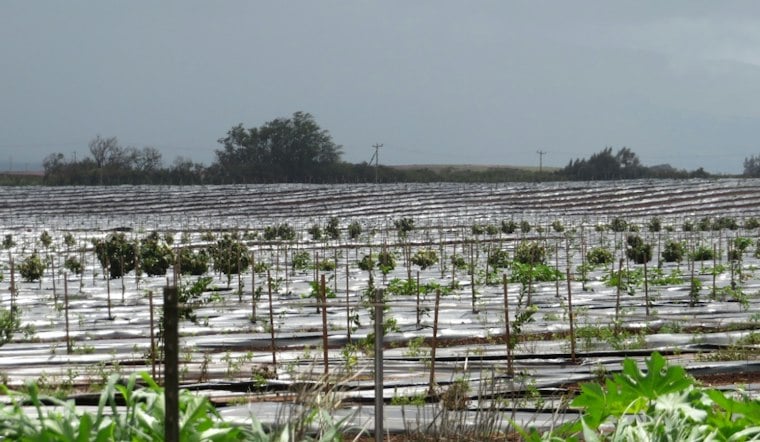
Mahi Pono has planted 3,000 acres of limes across Central Maui, but the company still cannot sell a single one of those limes to buyers on the U.S. mainland. The culprit is not a market problem or a quality issue — it is a federal quarantine system that dates back more than a century and treats Hawaiʻi-grown produce as a biosecurity risk requiring individual, crop-by-crop approval before it can cross the Pacific.
A Quarantine Rooted in 1912
The barrier traces back to the Plant Quarantine Act of 1912, according to the Hawaii Food Industry Association, which describes the resulting framework as effectively a default ban on exporting any fresh fruits or vegetables from the entire state unless the USDA has specifically approved that commodity. Getting that approval, the association notes, can in some cases take years and may come bundled with additional pest-mitigation requirements before a single crate can ship out. The association estimates the quarantine impacts Hawaiʻi-based farms to the tune of $760 million annually — a striking figure given that the state's total agricultural sales were just $673 million in 2022.
Mahi Pono's limes illustrate exactly how that plays out on the ground. The Maui-based agribusiness has been working through USDA export approvals since 2023, per the same association report, and in the meantime has found a workaround: it has been able to export limes with little issue to Canada, even as the mainland U.S. market remains off-limits. According to Alaska Airlines, Hawaiian Airlines and Horizon Air, more than 80,000 pounds of Maui limes fly out of Kahului to Seattle each week before continuing on to Canadian buyers, reaching those markets in about three days by air rather than the up to two weeks it would take by sea.
Wasabi Growers Face a Similar Wait
On the Big Island, Volcano Wasabi is caught in a comparable holding pattern. The grower says on its own website that it can currently ship wasabi rhizomes and leaves only within Hawaiʻi as it awaits approval from USDA APHIS to ship those plant materials to the continental United States. That wait lines up with a related federal process: the USDA Animal and Plant Health Inspection Service has been seeking public comment on a proposal that would allow interstate movement of fresh wasabi leaves and rhizomes from Hawaiʻi to the mainland.
Federal regulations also shape how Hawaiʻi produce can move once it clears the quarantine hurdle. Rules in the Electronic Code of Federal Regulations restrict transloading of Hawaiʻi consignments except under extenuating circumstances, and only when an inspector determines the action would not meaningfully raise the risk of introducing plant pests or diseases, with APHIS inspectors available to supervise. Separate USDA APHIS guidance on shipping and mailing food from Hawaiʻi notes that certain fruits must be treated at a USDA-approved facility and packed in boxes that are properly marked and stamped before they can leave the islands.
Irradiation and Treatment as a Partial Fix
Some Hawaiʻi crops have found a path around the quarantine through irradiation, which the Hawaii Food Industry Association says has facilitated the export of Hawaiʻi-grown papayas and sweet potatoes — though irradiated food must carry radiation-treatment labeling under FDA rules. That treatment route is not free or simple for every grower, and it illustrates the broader reality that farmers must often alter their product, build new processing capacity, or accept a smaller market just to get around the default export restriction.
Hawaiʻi lawmakers have moved to shore up the state's side of the biosecurity equation separately from the federal approval fight. Under Act 230, state general fund appropriations for biosecurity were set to rise from $6.2 million to $9.2 million, according to a statement from the Office of Gov. Josh Green. Separately, state agriculture data compiled by the Hawaiʻi Department of Agriculture put the farm-gate value of Hawaiʻi's vegetable and melon crops at an estimated $97.1 million in 2024, up 33 percent from 2022 — though that figure comes from a lower-confidence source and should be read alongside, not in place of, the broader $760 million quarantine-impact estimate.
For now, growers like Mahi Pono and Volcano Wasabi remain stuck navigating a system built more than a hundred years ago, waiting on federal sign-off crop by crop while shipping what they can to the markets that will already take it.





