

























































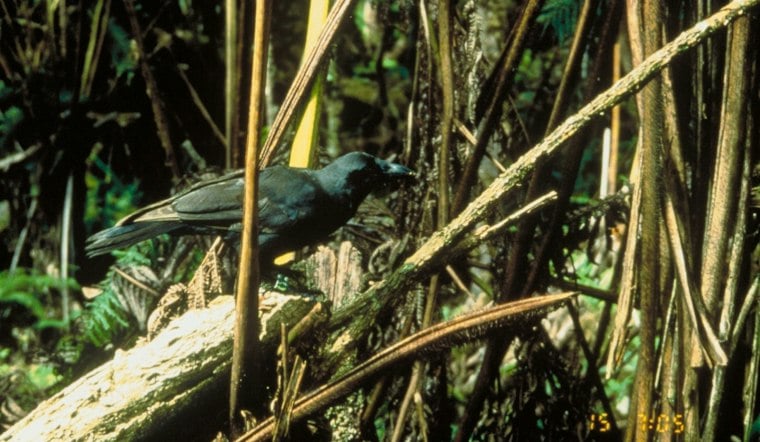
Nearly two years after five juvenile ʻalalā were released in the forests above Haleakalā, all five remain alive in the wild. The Maui cohort is the first attempt to reintroduce the endangered Hawaiian crow outside Hawaiʻi Island. Hawaii News Now reports that the birds are foraging, defending territory and showing other signs of adapting; their survival is a milestone, but successful breeding remains unresolved.
Survival is a milestone, not yet a self-sustaining population
The five birds—three males and two females—were released in November 2024, after being raised in captive breeding centers, according to Maui Now’s report on the release. The field team still maintains supplemental feeding stations, while the birds also find native fruits, insects, spiders and small vertebrates, Hawaii News Now reports. That mix of managed support and foraging is part of the experiment; the birds’ continued presence alone does not show whether a population can persist without intervention.
A pair has built nests in two consecutive nesting seasons, with the female sitting on the nest and the male guarding it, but the attempts have not produced chicks, according to Hawaii News Now. The report says territorial behavior led planners to reconsider an initial idea to add two more birds to the Maui flock. Whether the pair will reproduce successfully—and what conditions would support that—is still unknown.
A second island, a separate chapter
The Maui effort comes after a long decline in the wild population. The Maui Forest Bird Recovery Project reports that numbers had fallen to 76 by the 1970s and 13 by 1992; the last wild pair was seen in 2002. More than 110 ʻalalā are now in captivity, the ʻAlalā Project says—a separate managed-care population, not an addition to the five free-flying Maui birds.
There is also a release precedent on Hawaiʻi Island, the species’ original range, though it is not the same site or cohort. The state Department of Land and Natural Resources reported that a December 2016 attempt there was halted after winter storms and ʻio predation; in September 2017, it released six young ʻalalā at Puʻu Makaʻala Natural Area Reserve. The experience provides historical context, not a direct measure of how the Maui release will fare.
What the Maui trial may inform
Project partners are evaluating possible additional releases, including potential sites on Maui, while planning for renewed reintroductions on Hawaiʻi Island, Hawaii News Now reports. The five birds’ foraging, territorial behavior and nesting offer observations for that work, but the lack of chicks so far leaves a central recovery question open. For now, the Maui milestone is that all five released birds remain in the forest nearly two years on—not that the species has yet returned to a self-sustaining wild population.





