

























































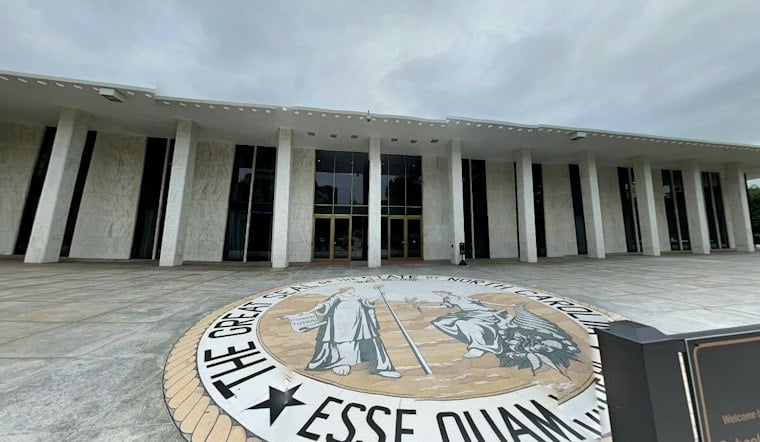
A North Carolina lawmaker is drafting legislation that would bar corporations and nonprofit associations doing business in the state from anonymously spending money to support or oppose political candidates, parties and ballot referendums. Rep. Laura Budd, a Democrat who represents Mecklenburg County, says the goal is simple: if an organization wants to influence elections, it has to put its name on the check.
Budd is drafting the legislation now and plans to file it on the first day of the filing period when the General Assembly returns for its new session in January 2027, according to WCNC. The proposal would restrict corporations and nonprofit associations operating in North Carolina from anonymously spending to support or oppose candidates, parties and referendums, and it would hand the state attorney general authority to pursue penalties against organizations that violate the restrictions. Budd discussed the proposal in an exclusive interview with WCNC Charlotte's Flashpoint.
What Penalties Could Look Like
The draft legislation outlines a range of potential consequences for noncompliance, per the same account: tax penalties, suspension of a company's ability to do business in North Carolina, and even forcing an organization to shut down entirely. Budd framed the choice bluntly, saying organizations doing business in North Carolina must choose between operating as a business and being involved in politics.
“Put your money where your mouth is. Put your name on it,” Budd said, according to the station's report. She added that political spending buys influence, face time, and an outcome — and argued that unequal political spending silences voters. Budd said the proposal aims to increase transparency in political spending and would give voters a more equitable voice.
A Stark Contrast in NC's Current Rules
Under current North Carolina law, individual donors face real limits on what they can give directly to candidates. The seed report describes individual campaign contributions as capped at $6,800 in the primary and $6,800 in the general election, while the North Carolina State Board of Elections describes the limit as $6,800 per election, effective January 1, 2025 — accounts that differ slightly on how the cap is structured. By contrast, corporations may make unlimited independent expenditures, which are not direct campaign contributions; that distinction underpins Budd's push for new restrictions. The state elections board also notes that corporations, business entities, labor unions, professional associations and insurance companies are generally barred from contributing directly to political committees under N.C.G.S. § 163-278.19, though the board's guidance on independent expenditures and electioneering communications points to exceptions involving referendum committees and independent expenditures.
Dark Money Is Not Required to Disclose Donors
“Dark money” generally refers to election spending and contributions by nonprofits and shell companies that are not legally required to disclose the identities of their donors, according to the Brennan Center for Justice. The Associated Press has reported that dark-money groups are not required to disclose their donors, a loophole that critics say lets corporations and wealthy interests steer campaigns from the shadows.
The scale of that spending has grown dramatically. The Brennan Center found that dark-money groups, nonprofits and shell companies poured more than $1.9 billion into the 2024 federal election cycle, nearly double the previous record of $1 billion set in 2020, and the organization cautions that figure likely understates the true scale because some undisclosed spending cannot be reliably tracked. The same analysis found that organizations that did not disclose their donors gave about $1.5 billion to super PACs in 2024, and that non-disclosing groups spent $242 million on ads. Separately, KTVU FOX 2 cited OpenSecrets figures showing reported independent expenditures by outside groups grew from $144 million in 2008 to $4.21 billion in 2024. Since the Citizens United ruling, dark-money groups have spent at least $4.3 billion on federal elections, per the Brennan Center.
North Carolina Would Follow Hawaii's Lead
Budd's proposal is modeled after a similar law recently passed in Hawaii, which became the first state to enact legislation banning corporations and dark-money groups from spending unlimited amounts on politics, according to KTVU FOX 2. Hawaii's governor signed the bill, which restricts corporate election spending. The law applies equally to companies founded and based in Hawaii and those that operate in the state but are registered elsewhere, and it imposes stricter disclosure requirements and limits on certain forms of corporate and nonprofit political spending, according to political.org. Hawaii's law is scheduled to take effect July 1, 2027, per KTVU FOX 2.
North Carolina would not be alone in following Hawaii's example. Similar legislation has been introduced in at least 14 other states, though none of those bills have advanced very far, according to the Associated Press. In Montana, volunteers have been gathering signatures for a proposal called the Transparent Election Initiative, in hopes of putting it before voters in November.
What Comes Next
For now, Budd's bill remains in draft form, with the formal filing not expected until the General Assembly's filing period opens in January 2027. Her Flashpoint interview laying out the proposal was slated to stream Sunday at 11 a.m. on the WCNC Charlotte app and remain available on demand afterward. Whether the measure gains traction among colleagues in Raleigh, where similar dark-money proposals nationally have largely stalled, remains to be seen.




