

























































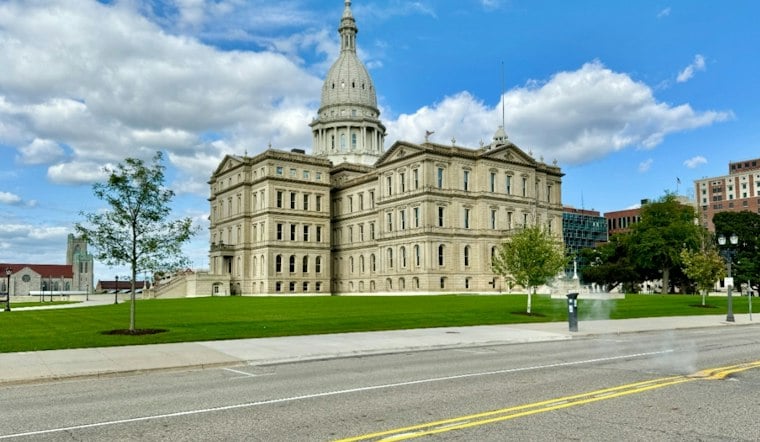
Dozens of Michigan cities are gearing up for a weekend of rallies with a different goal than past demonstrations: not just marching, but getting people to actually cast a ballot. No Kings 4: Vote Early events are set for Saturday across the state, with organizers hoping to turn months of protest energy into early voter turnout ahead of the November 3 general election.
The Michigan Freedom Coalition initially announced 75 events, but that number had grown to 78 by the time organizers spoke at a Tuesday news conference, according to Michigan Advance. Rallies are planned in Grand Rapids, Lansing, Traverse City, Bay City and Saginaw, along with Muskegon, Battle Creek, Canton and Ferndale. The push is the fourth nationwide mobilization under the No Kings banner, following mass demonstrations in June 2025, October 2025 and March 2026 organized by a coalition that includes Indivisible, MoveOn, the ACLU and Public Citizen, according to Wikipedia.
From Protest to the Ballot Box
Ryan Bates, executive director of End Gun Violence Michigan, moderated Tuesday's press conference and described the shift as moving from protest to voter power. The same report notes Bates said voters should act to protect democracy and freedom, framing the choice bluntly as the voting booth over staying home.
Organizers insist the events themselves will stay out of electoral politics. No Kings gatherings will be nonpartisan and won't feature political candidates, the report states, though elected officials may appear in their official capacities to focus on voters rather than individual campaigns. National guidelines for the day, laid out by Indivisible, require all gatherings to be strictly nonpartisan, mandate nonviolent de-escalation, prohibit candidate-specific signs and ban weapons of any kind, including legally permitted firearms.
A Mother's Reason for Organizing
Emily Busch, affiliated with the Michigan Freedom Coalition, said the movement responds to perceived threats to democratic institutions, civil liberties and economic security under the Trump administration. Per the same account, she cited immigration enforcement, restrictions affecting universities and news media, government data collection, health care costs and trade policies as driving factors, and she urged Michiganders to attend No Kings: Vote Early events.
Busch's involvement in political organizing traces back to a day no parent wants to live through: her son was inside Oxford High School during the November 30, 2021, mass shooting that killed four of his classmates. That history, cited in the organizers' report, underscores why turnout work carries personal weight for some of the volunteers behind Saturday's events.
Young Organizers Who Can't Yet Vote Themselves
Eliza Sokoli, a senior at Oakland Early College in Farmington Hills, founded the Teen Action Network, a youth-led chapter of the Indivisible movement. She said she wants to make her voice heard for those who will vote, pointing to student debt, unaffordable college and rising prices as the stakes facing the next generation. Sokoli is not yet 18 and cannot vote in the 2026 election herself, according to the report.
Her work fits a broader strategy: organizers say they want to reach people who have not participated before, including newly eligible young voters, rather than targeting voters based on past election choices. The report states No Kings organizers are not endorsing candidates and are not targeting voters based on prior voting history.
Michigan's Early Voting Rules, Explained
Michigan's early voting window owes its existence to Proposal 22-2, which voters approved by roughly 60% in November 2022 and which requires at least nine consecutive days of statewide early in-person voting, according to Ballotpedia. Statewide early in-person voting runs from October 24 through November 1 this cycle, though some communities may begin earlier. The online or mail voter registration deadline falls on October 19, while residents can still register in person at their city or township clerk's office through Election Day with proof of residency.
Angela Davenport, executive director of the Voting Access for All Coalition, said misinformation and a lack of accurate information can prevent eligible residents from voting. That includes confusion over who is allowed to cast a ballot: Michigan residents on probation or parole retain their voting rights, and people held in county jails awaiting arraignment, trial or sentencing remain eligible to vote. Only those currently serving a sentence in jail or prison are barred, and under state law, voting rights are automatically restored immediately upon release, allowing registration without additional steps, per the Michigan Department of Civil Rights.
Youth Turnout Has Been a Michigan Strength
The emphasis on young voters isn't incidental. Michigan led the nation in youth voter turnout among 18- to 29-year-olds during the 2022 midterms, posting a 37.6% turnout rate according to Tufts University's CIRCLE research cited by the Michigan Secretary of State. That momentum carried into 2024, when youth turnout reached 58%, the largest four-year increase in the country, and 18- and 19-year-olds tied for national leadership at 55%.
State law gives that trend an administrative boost: 16- and 17-year-olds can automatically preregister to vote when they get a driver's license or state ID, with their voter status activating once they turn 17.5. Michigan voters also set a state record in the 2022 midterms, with 58.9% turnout and 4,500,400 total ballots cast, the highest midterm participation in state history, according to the Secretary of State's office.
Why the Timing Matters Now
The turnout push also lands against a shifting national map. The Democratic Congressional Campaign Committee expanded its battleground list to 66 target districts this month, explicitly adding Michigan's 1st Congressional District as a competitive focus for 2026, Hoodline previously reported on targeted districts. Early voting kicked off in Michigan earlier this month alongside high-profile campaign visits, as Hoodline detailed in its coverage of Obama's Detroit trip, while some local clerks have faced their own ballot-distribution struggles, as seen in Antrim and Presque Isle counties.
Organizers say the nationwide No Kings effort includes thousands of events this weekend, with Michigan voters able to request and complete absentee ballots through their local clerks in the meantime. Proposal 22-2 also requires election authorities to count absentee ballots from military personnel or overseas citizens as long as they are postmarked on or before Election Day. For organizers like Bates, Busch, Davenport and Sokoli, the goal Saturday is the same across all 78 Michigan stops: convert turnout at a rally into turnout at the polls before November 3.





