

























































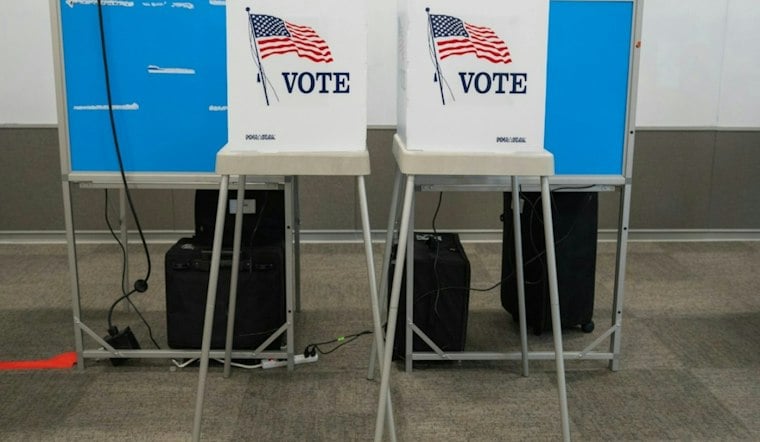
House Democrats' campaign arm announced it has added eight additional districts to its Districts in Play list, pushing the Democratic battlefield for 2026 deep into territory Republicans have long considered safe. The total now stands at 66 districts, and the expansion reaches into states including Kansas, Michigan, North Carolina, New Jersey, Oklahoma, Texas, Virginia and Washington.
The Democratic Congressional Campaign Committee says the newly targeted seats are Kansas's 2nd, Michigan's 1st, North Carolina's 13th, New Jersey's 2nd, Oklahoma's 5th, Texas's 9th, Virginia's 6th and Washington's 5th, according to the DCCC. As The Washington Post reports, Democrats believe November's elections could deliver upset wins even in districts that have historically leaned heavily Republican.
Republicans currently hold a 220-215 majority in the House, meaning Democrats need a net gain of just three seats to reclaim control. Per Inside Elections, the nonpartisan ratings outlet currently projects a Democratic gain of seven to 15 seats this cycle. Inside Elections rates every race on the newly expanded target list as Solid Republican except Texas's 9th District, which it rates Likely Republican, Roll Call reports.
A Battlefield Nearly Double Its Old Size
The DCCC said the expansion brings the committee deep into traditional Republican territory and that its list of Districts in Play is now nearly double what it was at the end of the 2024 cycle, a point the committee's own release emphasizes directly. The DCCC also pointed to primary turnout as evidence of momentum, saying Democratic voter participation outpaced Republican turnout in primaries by more than 3.5 million votes and that early voting data showed Democrats with an edge among voters casting ballots.
The committee has described its approach for 2026 as an aggressive and disciplined strategy built on strong recruits, financial backing and a clear message intended to carry Democrats past the 218 seats needed for a majority. Texas's 9th District was added separately from the other seven, with the DCCC crediting Democratic victories in special elections across Texas this cycle for putting the seat in play. DCCC Chair Suzan DelBene characterized TX-09 as a district Trump carried by 20 points, saying new polling shows it is now competitive.
Roll Call reports that Donald Trump carried the newly targeted districts by margins ranging from 11 points in Washington's 5th District to 24 points in Virginia's 6th District in 2024, underscoring just how far into Republican territory the expanded map now reaches.
Virginia's 6th District Becomes a Test Case
Among the new additions, Virginia's 6th District has drawn particular attention because of how competitive the race has become on paper. Author and former journalist Beth Macy is challenging fourth-term Republican Rep. Ben Cline in a district that has been in Republican hands for more than 33 years, according to The Guardian. Macy campaigned in Clifton Forge in late July as part of her bid for the seat, with campaign imagery from the trail credited to photographer Matt Eich.
Democrats hope Macy can pull off an upset despite a setback outside her own campaign's control: Virginia's state supreme court struck down a voter-approved redistricting plan that would have helped the party, the Guardian notes. Macy is running in the district as currently drawn rather than under a more favorable map Democrats had hoped for.
A Fundraising Gap That Favors the Challenger
Money has become one of the more striking storylines in the race. Beth Macy has raised nearly $1.7 million as of currently available data, ahead of Cline's roughly $1.4 million, according to WVTF. Political scientist Alex Keena told the station that Macy outraising the incumbent by almost a quarter-million dollars is somewhat unusual, since incumbents typically hold the fundraising advantage.
The two campaigns' donor bases look markedly different. Cline has brought in about $600,000 from industry and lobbyist groups, including the American Israel Public Affairs Committee, tobacco company Altria Group, SpaceX and Dominion Energy, the station's report shows. Macy, by contrast, has raised $445,000 from small donors who each gave less than $200, nearly ten times what Cline collected in that category — a grassroots fundraising gap that Democrats are citing as evidence their expanded map is more than wishful thinking.




