

























































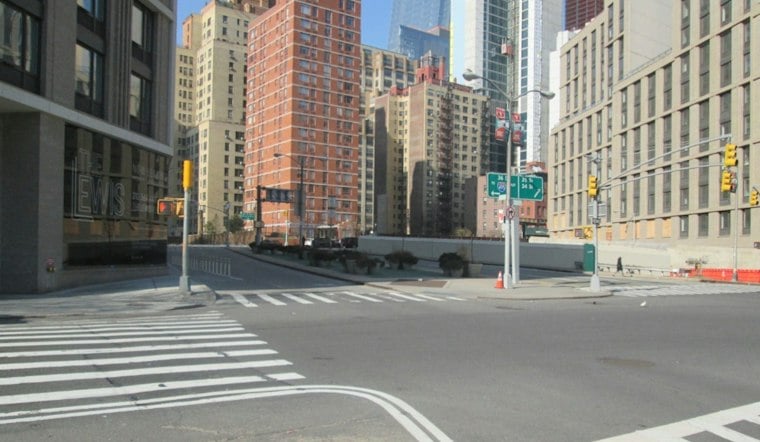
Vijay Bharadwaj, 26, was crossing W. 34th Street with the light, inside a crosswalk at Dyer Avenue in Midtown, on June 23 when a right-turning driver struck him and fled the scene. He suffered a hip fracture, lacerations, bleeding and a cut near his right eye that required stitches, and he was unable to walk for six weeks afterward. Roughly three months later, the NYPD closed his case.
Bharadwaj's ordeal, first reported by Streetsblog New York City, illustrates a gap between what crash victims are told and what actually happens to their cases. The crash report filed afterward did not mention that the vehicle had been turning before impact or that Bharadwaj was in the crosswalk at the time, details central to how the collision unfolded. The NYPD did not route the case through its Collision Investigation Squad, the unit that handles the department's most serious crash cases.
Det. William Lleras, who worked the case out of the NYPD's 10th Precinct, initially told Bharadwaj the investigation would succeed. “This is an open-and-shut case. We'll definitely find the guy,” Lleras said, according to Bharadwaj. The detective told Bharadwaj he had identified the car's make, model and year, but said he was unable to get further without more information, and Lleras said he used all resources available to precinct-level detectives. Bharadwaj said he texted Lleras repeatedly over two months without a response before learning the case had been closed.
Why The Case Stalled
An NYPD spokesperson said investigators could not discern a license plate or a more distinct characteristic of the vehicle without additional video and additional camera angles. That explanation sits inside a much larger pattern: the NYPD's Collision Investigation Squad investigates only fatal crashes and a small share of those involving serious injuries, according to Streetsblog's reporting. The unit has the capacity to handle roughly 200 to 250 crash investigations a year, and as of early September it had investigated 179 cases in 2026 — 140 fatalities and 39 crashes involving serious injuries. Those detailed reports, per the same account, often take six months to a year to complete, though the NYPD has told reporters elsewhere that the reports are generally finished within six months.
The squad's caseload per detective has also shrunk. Detectives are on pace in 2026 to close out fewer than eight cases apiece, compared with an average of 16 cases per detective back in 2013, the outlet reported. Citywide, the NYPD conducted 263 collision investigations in 2025, down from 335 the year before. It isn't a new complaint: in 2015, the NYPD told the City Council it was investigating only 1 percent of serious and fatal crashes.
A Different Model In Chicago
The contrast with Chicago is stark. Crash specialists there examine almost all collisions resulting in major injuries, not just a fraction of them, the report notes. Chicago's police department is roughly a third the size of the NYPD's, yet it staffs its crash unit with 53 officers — 22 more than New York's equivalent squad. In 2024, Chicago officers investigated 3,733 crashes, including 144 fatal crashes and 461 serious crashes. A fatal crash investigation takes a Chicago officer roughly 80 hours on average, a workload rate that, Streetsblog calculated, would let a single New York investigator complete roughly 23 investigations a year.
Under NYPD policy, the Highway District Collision Investigation Squad is tasked with investigating vehicle collisions that result in a critical injury or fatality, according to the department's own FAQ for critical and fatal injury collisions. Separately, New York City Council legislation defines a serious vehicular crash as one involving a motor vehicle and a pedestrian, cyclist, motorist or other person that results in significant injury or death, per legislation text filed with the New York City Council.
Left To Cover His Own Recovery
In the absence of an identified driver, Bharadwaj has leaned on New York State's Motor Vehicle Accident Indemnification Corporation, which has provided him some financial assistance to cover his injuries and recovery therapies. He said what he wants now is closure, and he questioned whether the NYPD treats cases seriously only after a victim dies. Streetsblog's reporting does not resolve why, beyond the spokesperson's stated lack of video and distinguishing vehicle detail, the case could not move forward.




