

























































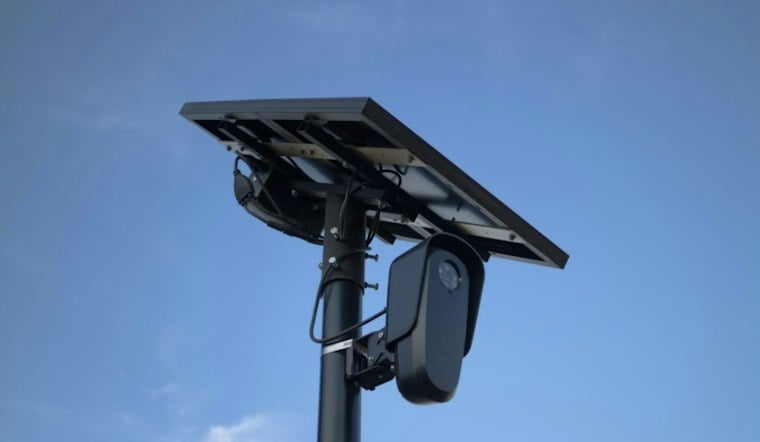
Mill Valley has suspended all of its Flock automated license plate readers and live-feed surveillance cameras, which had tracked vehicles passing through the Marin County city since early 2025. The cameras were switched off Sept. 9 after months of resident objections at city council meetings about data collection, retention and sharing.
Mill Valley was the last municipality along Marin's Highway 101 corridor to contract with Flock, signing a two-year agreement in February 2025, according to the Marin Independent Journal. The city’s cameras did not use facial recognition; the system typically collects and analyzes license plate numbers and vehicle makes for police and other public safety agencies, the outlet reported.
The Data-Sharing Questions Behind the Shutdown
At a Sept. 8 city council meeting, resident Margaret Fisher raised concerns about a contract category labeled “other.” She told officials that other agencies had accessed Mill Valley's Flock data thousands of times under that category, according to the Marin Independent Journal. Fisher urged the city to remove or pause the cameras unless Flock could provide stronger contractual safeguards.
City officials had previously said Mill Valley limited data sharing to a small number of agencies and maintained data-sharing agreements only with state and local police. Residents' concerns also reflect broader questions about Flock's data practices: the company has been found to share tracking and profiling data with federal agencies, including immigration enforcement.
Contract Assurances Have Not Resolved the Dispute
After the cameras were switched off, city officials met with Flock representatives to seek legally binding terms covering data ownership and whether information could be sold, shared or used beyond its original purpose, according to the Marin Independent Journal's account, attributed to city official Caroline Joachim. Flock reportedly said Mill Valley owned its data and acknowledged the city's request that it not be used for machine-learning purposes.
Joachim said those assurances were insufficient without changes to Flock's terms of use, which she said the company had revised without Mill Valley's consent. Flock spokesperson Dan Haley said in an Aug. 21 company blog post that the update was intended to strengthen customer protections; the Marin Independent Journal reported that the revised terms do not apply to all customer agreements. Flock spokesperson Andrew Smith told the paper the company was following up with the city and that discussions were ongoing.
The City’s Retention Figures Differ
Before the shutdown, Mill Valley had reduced retention to one week for its six license plate readers and 72 hours for its two live-feed video cameras, according to the Marin Independent Journal. The city's Flock Safety page, however, says ALPR data is retained for 30 days and automatically deleted afterward. Hoodline could not reconcile the difference between the two city-linked accounts.
City official Todd Cusimano said Mill Valley remains committed to public safety while balancing privacy, transparency and accountability. Joachim added that technology capabilities are evolving quickly, and that the city must keep improving its ability to protect data and privacy — a task she said is complicated by the difficulty of coordinating data use and sharing among Marin's municipal, county, state and federal agencies.
Regional Scrutiny of Flock Intensifies
Mill Valley's decision comes as other Marin agencies review their use of Flock and data-sharing rules. The Central Marin Police Authority announced in August that it would not renew its Flock contract. That month, the Marin County Board of Supervisors adopted a policy governing how digital information is shared internally and externally; county agencies were already reevaluating their use of Flock cameras, The Press Democrat reported.
The Electronic Frontier Foundation has raised concerns about the Marin County Sheriff's Office, citing Point Reyes Light reporting that audit logs showed the office shared Flock ALPR data with out-of-state and federal agencies 254,131 times in November 2024. The EFF said the sharing occurred despite a settlement requiring the sheriff's office to stop sending license plate and location data to agencies outside California. ALPR systems generally capture vehicle images and upload location information to a searchable, shareable database, the organization explained. Flock says on its trust page that its cameras do not use facial recognition technology.
What Prior Oversight Covers
The Marin County Sheriff's Office settlement is separate from Mill Valley's camera program. According to the ACLU of Northern California, a June 1, 2022 settlement required the sheriff's office to stop sharing license-plate and location information with agencies outside California; it did not govern Mill Valley's separate system. A separate California oversight example comes from Fresno, not Marin: the California State Auditor records the Fresno Police Department's response to a recommendation on ALPR image-sharing procedures as fully implemented, with a completion date of May 2021.
Residents Seek Stronger Limits
Residents who opposed the cameras welcomed the shutdown. Justice Rosen urged the city to cover the cameras, warning that Flock could potentially reactivate them remotely. He also said the system had unacceptable error rates, claiming his own car had been mismatched to other plates during the contract period.
Rosen urged the city council to declare Mill Valley a surveillance-free town. Resident Jeremy Revitch argued that the city should examine how surveillance technologies work rather than simply replacing Flock with another vendor.
Part of a Broader Bay Area Reckoning
Mill Valley's reversal fits a pattern playing out across the region. Richmond, Santa Cruz, El Cerrito, Los Altos Hills and several Santa Clara County cities have all pulled back or canceled their Flock contracts over privacy and data-sharing concerns, according to KQED, while Mountain View ended its use of the technology entirely. San Francisco's own Flock contract faces renewal in February 2027, and KQED reported that a September Reuters poll found 47% of American adults did not want the cameras in their communities, compared with 38% who supported them. Flock has since lowered its recommended data-retention period to seven days, per the same report.
The debate is not confined to California. In Missouri, the Maries County Commission terminated its Flock agreement this week after a company representative failed to show up for a scheduled public meeting, according to ABC17NEWS, which noted that neighboring Pulaski County terminated its own contract in August following a community forum, even as Jefferson City renewed its agreement the same month. Columbia is set to hold its own public hearing on the matter Nov. 9. In San Diego, a city council committee was weighing a resolution this week that would terminate the police department's citywide Flock contract and delete all stored data, according to the Times of San Diego.



