

























































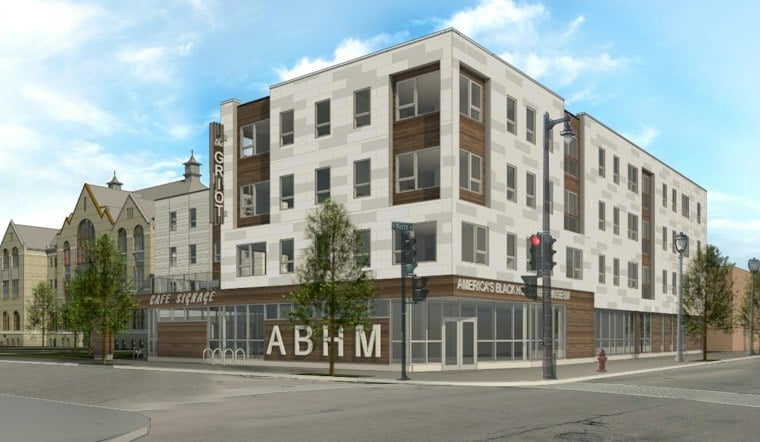
For more than four decades, Alonzo Robinson Jr. designed churches, grocery stores, public buildings and shopping plazas across Milwaukee and its suburbs as Wisconsin's first Black registered architect, yet his name was routinely left off the official record of his own work. Now a temporary exhibition at America's Black Holocaust Museum is trying to fix that, pulling his contributions out of the archives and into public view through a six-panel display running through November 7.
The exhibition, titled Honoring Alonzo, spotlights Robinson's life, his design philosophy, and the Milwaukee projects that defined his career, according to WUWM. Robinson earned his Bachelor of Architecture degree from Howard University in 1951 after serving in the U.S. Navy during World War II, and he was licensed as Wisconsin's first Black registered architect in 1956 after passing the state exam, according to The Dig at Howard University. After graduating, he worked as a naval architect designing ships before being recruited directly by the Milwaukee City Bureau, the same account notes, a path that eventually led him to open his own practice, Alonzo Robinson Architect & Son.
Over his four-decade career, Robinson designed more than 100 structures across Milwaukee and the surrounding suburbs, including public municipal facilities, commercial storefronts and churches such as Pilgrim Rest Baptist Church, built in 1964, according to a NOMA conference session. He was known for affordable architectural work for community members who couldn't afford large firms, and the article notes that one grocery store owner, identified only as Jim, said Robinson enabled him to build his Fast & Friendly store at a cost he could actually afford.
A Fire Department Building That Erased Its Own Designer
Robinson's most visible public commission, the Milwaukee Fire Department Administration Building at 711 W. Wells Street, was commissioned in 1962 at a cost of $507,000 and features his signature modernist curvilinear design along with custom artistic stairwell railings, per Howard University's account. Building plans listed Robinson as “designer in charge,” but for years his name was absent from the building's official groundbreaking record. His son, Kim Robinson Sr., said his father's name appeared on the original building drawings, and Kim Robinson Sr. went searching through archives for photos of his father at the groundbreaking, only to find him missing from that history.
Kim Robinson Sr. led the effort to rename the building after his father, and the Milwaukee Common Council approved the change in 2021. During a November 30, 2021 dedication ceremony, Milwaukee Fire Chief Aaron Lipski delivered a public apology to the Robinson family, acknowledging that Robinson's exclusion from official building records was a painful racial slight rather than a clerical error, according to the Milwaukee Fire Department. The building now carries a historical marker dedicated to Robinson.
Central City Plaza's Narrow Escape From The Wrecking Ball
Robinson also served as lead designer for Central City Plaza at Sixth and Walnut, a project commissioned by the Central City Development Corporation, a Black development group organized by Milwaukee civil rights leaders to combat urban renewal and the displacement it caused for Black residents. Completed in 1973, Central City Plaza was built in the New Formalist architectural style, featuring distinctive circular porthole windows and restrained archways, and it became Wisconsin's first shopping center that was Black-owned, operated and designed, according to AIA Wisconsin. The plaza was sold several years after opening due to financial challenges, the WUWM report notes.
In early 2025, the plaza came close to demolition when the Salvation Army sought to tear it down, but a community preservation campaign intervened and the property became a designated historical site that same year. The campaign later received national recognition, winning an Advocacy Citation of Merit at the 2025 Modernism in America Awards from Docomomo US, per the Milwaukee Courier. Kim Robinson Sr. credited Docomomo and NOMA with helping bring the attention needed to preserve the plaza. In 2026, the National Trust for Historic Preservation featured Robinson's body of work in a national spotlight on its cultural and architectural importance to Wisconsin's built environment, the same report notes.
A Legacy Still Underrepresented Industry-Wide
Robinson's story sits against a backdrop that hasn't shifted much since his era. According to 2026 demographics data from the National Council of Architectural Registration Boards, Black or African American architects continue to represent only 2% of all licensed architects in the United States, a proportion that has remained flat for years, per NCARB. Kim Robinson Sr. has said stories of Black community contributors should be shared so young people know their history, a sentiment that underpins why the museum chose to mount the exhibition now.
America's Black Holocaust Museum, which is hosting Honoring Alonzo, was founded in 1988 by lynching survivor and civil rights activist Dr. James Cameron. The museum closed in 2008 following the Great Recession and reopened its physical facility in Milwaukee's Bronzeville district in February 2022, according to America's Black Holocaust Museum. The exhibition closes November 7, and the museum plans to host a panel discussion before it ends.





