

























































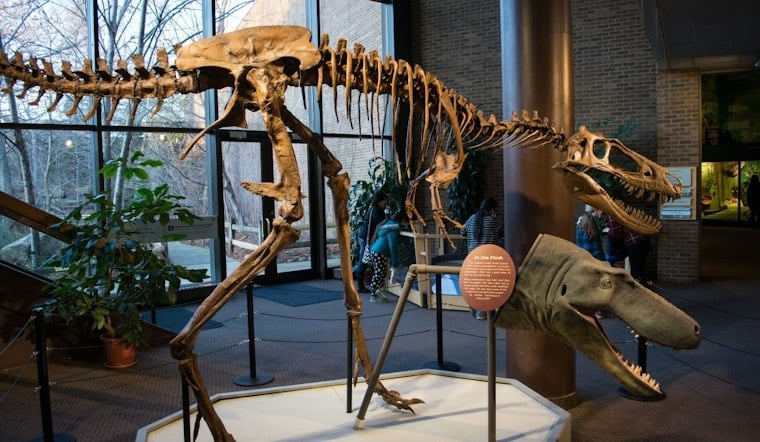
Sotheby’s is offering Jodi, a nearly 20-foot-long Nanotyrannus skeleton from Montana’s Hell Creek Formation, at auction on October 27 with an estimated price of $6 million to $9 million. The mounted specimen stands approximately 6.5 feet tall and measures 19.6 feet long. It is one of only three known Nanotyrannus skeletons, a small relative of Tyrannosaurus rex whose status as a distinct dinosaur was supported by research published in 2025.
According to Sotheby’s, the specimen is classified as Nanotyrannus cf. lancensis and dates to roughly 67 million years ago, during the Maastrichtian age. Montana rancher Jodi Pierson discovered it in 2019 on land she owned; the skeleton bears her name. Its discovery and excavation were featured in the 2020 documentary series Dino Hunters. Jodi went on public display at Sotheby’s New York location in the Breuer building ahead of the sale, the New York Post reported.
A Former Museum Landmark
Jodi is being displayed in a building with a history as a New York museum. According to The Metropolitan Museum of Art, Marcel Breuer’s Whitney Museum of American Art building was constructed from 1963 to 1966 at the corner of 75th Street and Madison Avenue, designed to offer visitors a personal, intimate museum experience.
A Nearly Complete Skeleton With Conflicting Tooth Counts
Sotheby’s describes Jodi as consisting of approximately 191 fossil bone elements and touts it as the finest and most complete Nanotyrannus skeleton currently available, with a virtually complete skull boasting 53 bones. The auction house’s own materials put the tooth count at roughly 50, matching a separate account from the same display event, published by twincities.com, which describes the skeleton as almost 70 percent complete with a jaw containing roughly 50 teeth. Sotheby’s says the skeleton is offered with full documentation certifying its condition, authenticity, and legality of ownership.
Settling a Decades-Old Dinosaur Debate
The sale arrives just as the scientific community appears to have settled a question that has lingered since 1942, when the so-called Cleveland skull — long treated as the center of the Nanotyrannus debate — was first discovered, according to the Cleveland Museum of Natural History. For decades, many paleontologists argued that the skull, now housed at the Cleveland Museum of Natural History, belonged to a juvenile T. rex rather than a separate species, a dispute the Cleveland Museum of Natural History notes has persisted since the genus was named in 1988.
A study published in Nature in October 2025 concluded that Nanotyrannus was distinct from Tyrannosaurus and placed it outside the tyrannosaurid family. The researchers identified two species, N. lancensis and the newly described Nanotyrannus lethaeus. They based their conclusions in part on growth rings in the bones, which indicated that the specimens they examined were adults rather than young T. rex.
Further confirmation came from the famous Dueling Dinosaurs fossil, a specimen depicting a Nanotyrannus and a Triceratops locked in combat that was unearthed in 2006 roughly 8 miles from where Jodi was later found, as reported by The Associated Press. Researchers concluded that fossil contains a fully grown Nanotyrannus lancensis, not a juvenile T. rex, according to the North Carolina Museum of Natural Sciences, which notes that multiple tyrannosaur species inhabited the same ecosystems in the final million years before the asteroid impact that ended the Cretaceous. Separately, the Cleveland Museum of Natural History examined the Cleveland skull and determined that it represented a skeletally mature adult.
A Smaller, Faster Hunter That Shared T. rex's World
Nanotyrannus and Tyrannosaurus coexisted within one million years of the end-Cretaceous extinction, with researchers identifying at least two ecologically distinct tyrannosauroid genera occupying Maastrichtian North America at the same time, per the Nature study. An adult Nanotyrannus measures about 18 feet long — roughly half the length of an adult T. rex — and the New York Post reports it has more than 150 key differences from its larger relative, including longer forelimbs, bigger hand claws, and more and differently shaped teeth.
Cassandra Hatton, a vice chair at Sotheby’s, told the New York Post that Nanotyrannus coexisted with T. rex while occupying a distinct ecological niche, hunting faster prey than its bulkier cousin could catch. Hatton has also argued that professional dinosaur hunters helped establish Nanotyrannus’s existence as a legitimate scientific category, the Post reports. The findings, according to National Geographic, may also prompt a sweeping re-analysis of how T. rex itself grew and developed.
Scientists Push Back on Private Sales
The Society of Vertebrate Paleontology has called for significant fossils such as Jodi to be held and displayed by museums or research institutions rather than sold into private hands, according to the New York Post. The organization’s president, Stuart Sumida, a biology professor at California State University San Bernardino, argued that private ownership can limit both research and public access. Sumida also rejected Hatton’s account of fossil hunters’ role, calling it a “blatant lie,” the Post reported.
The debate carries real stakes because so few Nanotyrannus skeletons exist. Beyond Jodi, the only other two known skeletons are the nearly 100-percent-complete specimen nicknamed Bloody Mary, housed at the North Carolina Museum of Natural Sciences and not for sale, and a third skeleton located at the Burpee Museum of Natural History in Rockford, Illinois, as noted by The Associated Press.
Following a Blockbuster Fossil Market
Jodi’s sale comes on the heels of eye-popping numbers in the fossil auction world. Sotheby’s sold a T. rex fossil for a record $50.1 million this summer, per the same twincities.com account of the upcoming sale. That followed the 2024 sale of the Stegosaurus fossil known as Apex, which Sotheby’s sold for $44.6 million after seven telephone bidders chased it to that record-breaking price. Whether Jodi approaches those sums, or whether a museum ultimately steps in to acquire it, remains to be seen when the gavel comes down later this month.
Fossil Rules, Ethics and a Museum Precedent
Jodi’s reported discovery on privately owned land is distinct from the federal rules governing public lands. The Bureau of Land Management says fossil collection on lands administered by the Interior and Agriculture departments generally requires a permit, with limited exceptions for some common plant and invertebrate fossils. That summary addresses federal lands; it does not establish the rules for private property in Montana. Separately, the Society of Vertebrate Paleontology’s ethics code says it does not condone the sale or purchase of scientifically significant vertebrate fossils unless a transaction brings them into, or keeps them within, a public trust. A past auction shows one way a significant fossil entered a museum collection: the Field Museum says it acquired SUE the T. rex at a 1997 public auction, after a five-year custody battle, with support from corporate partners and private donors. That history is a precedent, not an indication of who will acquire Jodi.





