

























































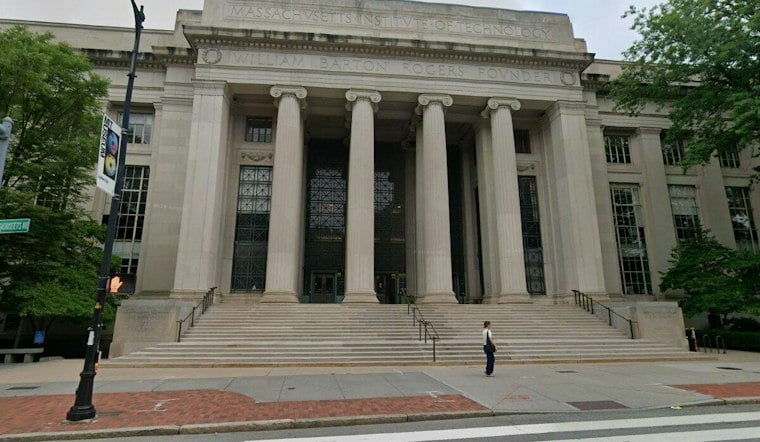
Three tenured MIT professors spent an hour on Tuesday sticking rhinestones and googly eyes onto eight surveillance cameras inside campus buildings, including several perched along the Infinite Corridor. It was the fifth time the group has staged what they call a bedazzling session, a glittery rebuke of the university's sprawling camera expansion and its openness to adding artificial intelligence to the system.
The protest, reported by Cambridge Day, comes as MIT works through a camera buildout that has added more than 500 new devices across academic buildings, residence halls and outdoor areas since November 2025. MIT says it now has roughly 4,600 security cameras on campus total, according to the MIT Executive Vice President and Treasurer's office, which says the new installations were meant to close coverage gaps that became apparent during investigations into theft, vandalism and property destruction. Installation of the new cameras and supporting infrastructure began in November 2025 and was completed in September 2026.
A Fifth Round of Rhinestones and Googly Eyes
Other MIT students and employees have joined the professors in decorating cameras, though per Cambridge Day's reporting, those participants declined to be identified or speak on the record. One MIT community member began independently bedazzling cameras after reading about the organizers' effort, telling Cambridge Day that the decorations make surveillance visible and give people some say in how they're watched.
MIT has removed the camera decorations repeatedly, and during one outing, MIT Police told the group to stop; the group complied, per the same report. Associate professor Marah Gubar said junior faculty, students, staff and postdocs feel nervous about joining the demonstrations because they are less protected than tenured faculty from MIT's newer disciplinary rules governing protests.
Those rules, formalized after the 2024 pro-Palestinian encampment at Kresge Oval, include restrictions on where demonstrations can occur and a ban on unauthorized space takeovers, according to Cambridge Day's reporting.
What the New Cameras Can Reportedly Do
The scale and cost of MIT's buildout have drawn separate scrutiny. The Tech reported that MIT is spending more than $3 million on the new cameras, with Siemens proposing deployment of 521 cameras across academic buildings alone for nearly $2 million, a mix of 501 single-lens and 20 quad-lens devices. The student paper described the new systems as having artificial-intelligence capabilities, including the ability to identify people and objects in real time and assess loitering, crowds, face masks, clothing color, gender and age if those features are enabled.
MIT's own FAQ page offers a narrower account, stating plainly that the university does not currently use AI to monitor or analyze security-camera footage, though it is exploring whether limited AI use would be prudent, including reviewing footage more efficiently during investigations and identifying serious safety events in real time. MIT also says it does not use facial-recognition technology and is not considering it for future use, and that its cameras do not record audio, since Massachusetts law bars recording audio without the knowledge of those being recorded.
The MIT Faculty Newsletter, which first detailed the decorating campaign, reported that cameras point toward some faculty members' offices and bathroom entrances, and raised the possibility that nearby microphones could pick up office conversations — a concern distinct from the university's position on the cameras themselves.
Pilot Program and an Advisory Group Without Veto Power
MIT has already run a trial of outside AI tools. The university completed a time-limited pilot with Ambient.ai that used staged scenarios to explore real-time alerts for specific safety events, and the Faculty Newsletter reported MIT is exploring adding Ambient.ai capabilities more broadly. MIT says the pilot concluded before Tuesday and that all pilot data was purged from Ambient.ai's portal.
To weigh in on any future AI use, MIT convened an advisory group of faculty, staff, students and postdocs that began meeting at the start of the 2026 academic year. The group can advise MIT on potential AI applications for the cameras, but Cambridge Day reports it does not have decision-making authority or the power to reconsider the camera expansion itself.
Faculty voices in the dossier framed the stakes in personal terms. History professor Tanalís Padilla said surveillance will have a chilling effect on campus creativity, silliness and hacking, while Catherine D'Ignazio, associate professor of urban science and planning, said cameras are not an assurance of safety for many women, people of color, trans and nonbinary people, international students and undocumented people. The surveillance network has prompted broader concerns about tracking and profiling among some MIT faculty and students, the outlet reported.
Part of a Wider Pattern at Universities
MIT's buildout is not happening in isolation. The Tech described the expansion as part of a broader trend of universities bolstering their surveillance infrastructure, noting that the University of Pennsylvania's outdoor camera network grew by roughly 20% over the five years before a February 2026 report, and that Brown University announced imminent camera-network expansions after a December shooting on its campus that killed two people.
Elsewhere, the trend has sparked open conflict. At Cal Poly, students and community members marched from Dexter Lawn to the administration building, with roughly 30 people demanding removal of the school's 17 Flock Safety cameras, according to Government Technology. In Illinois, five of the state's 12 public universities still contract with Flock, including the University of Illinois Chicago, which has a two-year, $110,300 Flock agreement and separately agreed in December 2025 to pay Volt Inc. $3.5 million over three years for AI-powered detection of weapons, crowd formation and unattended objects, per the Chicago Sun-Times. The Pulitzer Center has reported that civil-rights advocates and student activists nationally worry such systems could chill student speech and activism.
For now, MIT Police retain limited archived-footage access, and MIT's policy allows footage to be shared with state and local law enforcement investigating crimes captured on camera, according to the university's video surveillance policy. Footage is generally kept for 30 days unless it's tied to a specific investigation or legally required to be retained longer. Whether the rhinestones stay up any longer than that remains to be seen — MIT has taken the decorations down before.



