

























































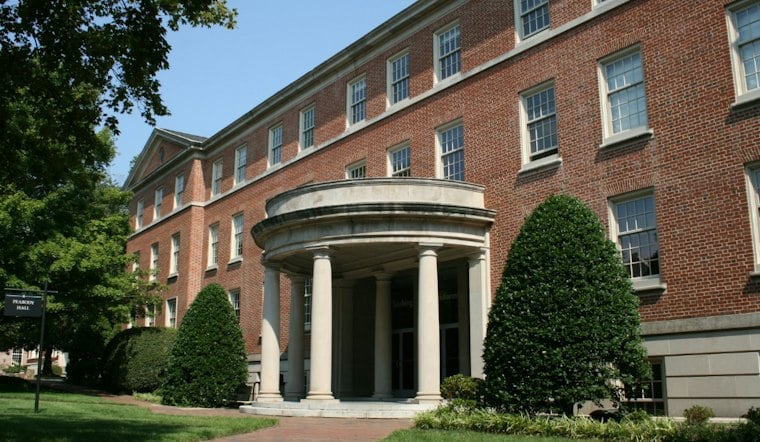
Mold is spreading across ceilings, doors, furniture and HVAC units inside the Wilson Hall Annex at UNC-Chapel Hill, according to a September 2026 inspection report, and at least one instructor says the building's air has made him physically ill. Biology instructor Morgan Korzik developed post-nasal drip, sneezing, coughing, shortness of breath and skin rashes that he attributes to time spent in the annex, and he now takes daily medication to manage the symptoms.
The inspection found mold present on furniture, doors, ceilings, pipe insulation and inside HVAC units throughout much of the 1965 building, according to the Raleigh News & Observer. Korzik told the paper his symptoms feel worse in rooms that are hot, humid, or have visible mold on surfaces, and he said university health clinic doctors supported his own determination that mold exposure was to blame. He is not alone — he said other students and faculty in Wilson Hall have reported similar symptoms, and some people now wear masks routinely while working in certain rooms.
Biology instructor Eric Hastie said mold in the building increased following heavy summer rains, and he moved his office and classes out of the Wilson Hall Annex at his first opportunity. He described the working conditions there as both a health concern and a morale issue, and estimated that a few thousand students learn in Wilson Hall each week. Arianna Smith-Barnes reported a potent mildew smell inside the building, and said a professor held office hours at an alternative location in 2025 specifically to avoid it.
Failing Systems in a 60-Year-Old Building
The inspection report described the annex's HVAC systems as failing, with rusted and disassembled fan coils, and inspectors said they could not determine which fan coils still worked at all. The building has at least two rooms with active water leaks and no built-in dehumidification, so UNC placed dehumidifiers throughout the annex — though the inspection report described their coverage as sporadic. Inspectors also noted the 57,000-square-foot building contains asbestos in pipe insulation, floor tiles and elsewhere, and advised consulting campus safety officials before disturbing any asbestos-containing materials.
The same report found that about 59 percent of annex spaces were rated poor amid significant indoor air quality concerns, and noted that old, outdated materials and equipment are stored alongside active teaching and work spaces. Korzik said the biology department has received no administration update since the report came out. Staff have tried limiting entry into affected rooms, but that has left the department with limited usable office, classroom, teaching lab and research lab space, according to the same account.
A Decade of Delayed Repairs
This is not a new problem. The Daily Tar Heel reported back in 2016 that Wilson Hall Annex was slated for renovation, with a plan expected to cost $31.5 million and finish by 2019 — a project that was never completed. UNC now describes the project's status as reprioritized, per the News & Observer, though a university spokesperson said the Wilson Hall project remains a priority within the university's long-range capital planning process, and that growing demand for biology majors — the department now counts more than 3,600 enrolled majors — underscores the project's importance.
At a UNC Board of Trustees meeting in September, the university listed replacement of Wilson Hall Annex among projects under consideration for its six-year capital improvement plan and identified it as a priority for state funding, according to Chapelboro. That outlet also reported that UNC-Chapel Hill is facing significant deferred maintenance on academic and residence halls even as it plans to expand capacity, and that the flagship campus received $21.6 million from the UNC System's $200 million repair pool over the prior two years — third behind UNC Charlotte's $61.8 million and N.C. State's $42 million.
Hastie questioned the university's plans to expand and build new facilities while Wilson Hall remains in its current condition, noting that planning a massive project involves many considerations. Hastie said, “I don't want my students in that building,” and Korzik himself told the paper he hopes extensive renovations or construction of a new building will finally happen.
A Campus-Wide Pattern
Wilson Hall's troubles echo a broader maintenance crunch across UNC's campus. Carolina Alumni has reported the university has more than $850 million in deferred maintenance. A UNC facilities official told the publication that classroom and academic buildings were in desperate need of investment, even as research buildings were in great shape. A 2021 report estimated almost $6.4 billion in needed renovations.
Mold has surfaced elsewhere on campus too. UNC Media Hub reported that Carolina Housing received 484 work orders mentioning mold between August 2018 and May 2019, and more than 1,000 students were expected to move out of off-campus housing during mold removal at Granville Towers. UNC's Bingham Hall, meanwhile, has been shuttered since 2020 because of mold linked to ventilation issues, with the university estimating $15 million would be needed just to reopen it, per Carolina Alumni.
UNC's own guidance says moisture control is the key to controlling mold and recommends responding to water infiltration within 24 to 48 hours, maintaining indoor relative humidity below 60 percent where possible, according to the North Carolina moisture-management and mold-remediation guidelines. Dampness and mold have been associated with respiratory symptoms, worsening asthma, respiratory infections, allergic rhinitis, bronchitis and eczema.





