

























































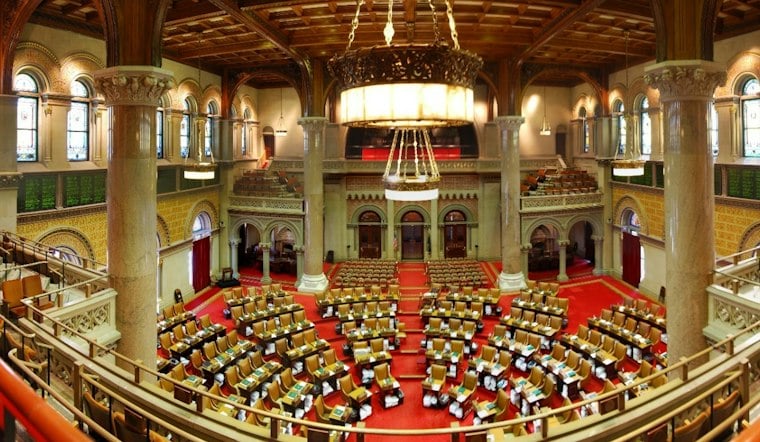
Republican Marc Molinaro, a former congressman, and Democrat Janet Tweed, a Delhi physical therapist, are vying to represent New York's 102nd Assembly District, a rural swath of the Catskills region stretching across parts of Albany, Schoharie, Otsego, Delaware and Greene counties. Both are seeking to replace Republican incumbent Chris Tague, who is giving up the seat to run for state Senate.
The matchup, reported Wednesday by Spectrum News, pits a seasoned statewide political figure against a local health care worker making her third run at elected office in four years. Molinaro previously served three terms as Dutchess County executive and also held posts as a county legislator, mayor and member of the state Assembly representing the 103rd district, according to the same report. He went on to represent New York's 19th Congressional District, winning the seat in 2022 before losing reelection in 2024, as Spectrum News reported in February. He most recently served as administrator of the Federal Transit Administration before stepping down to return to state politics.
Tweed's Path Back to the Ballot
Tweed, for her part, works as a physical therapist at a rural critical access hospital and has served on the Delhi town board before joining the village's board of trustees, per the Spectrum News report. She ran unsuccessfully against Tague for the Assembly seat in 2024, a contest in which she finished 77 votes ahead of Mary Finneran in the Democratic primary before losing the general election to the three-term incumbent, according to WAMC. That earlier campaign centered on affordable health care, abortion rights, infrastructure and environmental and agricultural sustainability, the station reported at the time.
This cycle, Tweed cleared a tougher primary field, defeating Mary Finneran and Thomas Boomhower to win the Democratic nomination on June 23, WAMC reported. She has cast herself as the candidate with deeper roots in the district, saying it needs a rural voice represented by someone who actually lives there and has local government experience. The station also reported that Tweed pitched herself to primary voters as someone who will fight for infrastructure and health care funding in the largely agricultural district.
Rural Hospitals Take Center Stage
Both candidates have named affordability and access to resources, including utility costs and health and mental health care, as top priorities heading into the general election. Molinaro has argued that state policy is driving health care providers out of rural communities, and he has pointed to what he describes as an imbalance in how the state distributes money collected from upstate counties. “When the state needed to shore up downstate, at-risk, urban hospitals they took the sales tax revenue from upstate counties and sent it down there. I want our money back,” he said, according to Spectrum News.
Tweed has focused her pitch on a different fix: passing the New York Health Act, which she has identified as her most important priority. She argues the measure would provide single-payer universal health care to New Yorkers and ultimately save patients and consumers money, per the Spectrum News report. The candidate reiterated that goal to NEWS10, telling the station her first priority if elected would be helping pass the act.
Why Rural Health Care Is the Flashpoint
The stakes behind that debate are well documented. A state comptroller audit found health care staffing shortages across 16 rural New York counties, citing gaps in primary care doctors, pediatricians, OB-GYNs, dentists and mental health professionals, according to NEWS10. Those counties averaged just four primary care physicians for every 10,000 residents, less than half the statewide ratio of 8.1 and further below the national average of 8.4, the outlet reported. The same audit found that more than 305,265 New Yorkers in those counties, nearly 41% of the population there, are considered underserved in mental health care.
The financial picture for rural hospitals is similarly strained. A 2025 analysis cited by the station found that more than one-third of New York's rural hospitals were at immediate risk of closure, with 62% reporting financial losses in 2023-2024 despite Medicaid funding. That backdrop helps explain why both Molinaro and Tweed have made rural health care funding a centerpiece of their campaigns rather than a side issue.
Looking Ahead to November
Molinaro has framed his campaign around collaborative problem-solving in Albany, saying the challenges facing “our friends, our neighbors, our communities can be solved when people work together,” as the two confront what he calls the real problems coming out of the state capital, per Spectrum News. Election Day for the 102nd Assembly District race is November 3, 2026, when voters across the district's Catskills communities will decide who replaces Tague in Albany.


