

























































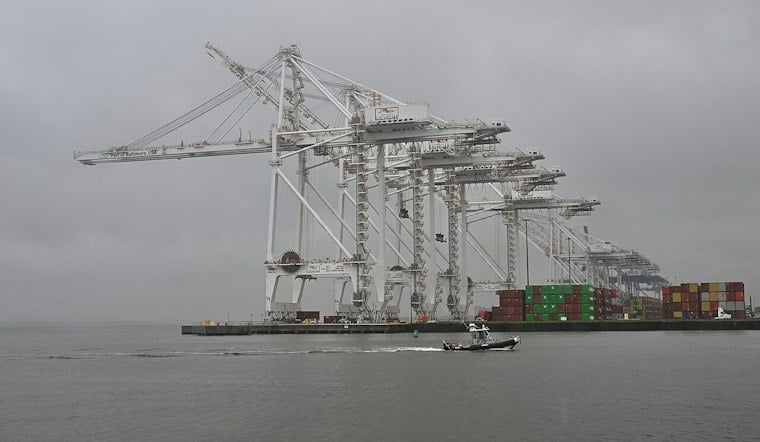
Gov. Wes Moore signed an executive order creating the Maryland Maritime Task Force, a new state body charged with chasing federal and commercial growth opportunities for an industry that already pumps more than $10.2 billion into Maryland's economy each year and supports 115,000 jobs. The task force will be co-chaired by U.S. Rep. Sarah Elfreth and Maryland Commerce Secretary Harry Coker Jr., and it arrives as the state tries to capitalize on a wave of maritime investment already underway around Baltimore.
According to WCBM, the task force aims to identify and pursue growth opportunities in the maritime sector while coordinating state agencies and local businesses around a shared plan. As reported by WMAR-2 News, membership will draw from state agencies, the Port of Baltimore or Port of Baltimore Alliance, maritime businesses, research and training organizations, and labor or trade groups. The group may also partner with the U.S. Navy, Coast Guard and Army Corps of Engineers, along with outside subject matter experts, per WCBM.
What the Task Force Is Actually Supposed to Do
Beyond simply convening stakeholders, the task force will study ways to expand and diversify Maryland's maritime industry, identify barriers facing businesses, and recommend potential incentives, the station's report notes. It will also identify hurdles facing businesses or agencies seeking national maritime projects and propose solutions, while boosting state and federal advocacy tied to international engagement, workforce training and grant programs.
One specific forward-looking task stands out: the group will prepare Maryland to pursue a Maritime Prosperity Zone designation if Congress creates that federal program, per the same account from WMAR-2 News. No timeline for when or whether Congress might act on that program was included in the available reporting.
Elfreth and Coker Frame the Stakes
Elfreth said Maryland is uniquely positioned to lead the maritime industry because of its location, infrastructure, industrial base and workforce demand, and that the task force will build on the state's maritime history to create a successful future for the industry, according to WCBM. She also thanked Moore for convening the effort to help guide the Port of Baltimore and the broader maritime industry.
Coker said the task force will attract investment, advance innovation, expand skilled-career pathways, and strengthen the economy and national security, per the same source. Maryland's maritime leadership, the outlet notes, is tied not just to the Port of Baltimore but to maritime research and training sites such as the Seafarers Harry Lundeberg School of Seamanship and the Maritime Institute of Technology and Graduate Studies, along with major federal facilities in Montgomery County and Baltimore.
A Backdrop of Billion-Dollar Projects
The task force isn't launching into a vacuum. WMAR-2 News reports that Anduril Industries has invested $3.7 billion in a Baltimore County shipyard project slated to support up to 14,000 jobs, while the Coast Guard has an upgrade project valued at $1.5 billion at Curtis Bay. Maryland Department of Transportation Secretary Katie Thomson called the port an economic engine and the heart of Maryland's maritime economy, noting that in 2025 it handled its most containers ever, its most ship calls ever, and more farm and construction machinery and forest products than any other U.S. port.
That momentum is tied in part to infrastructure upgrades already in motion. The Howard Street Tunnel project, completed at a cost of $495 million, allowed the port to begin handling double-stacked containers on rail, according to Thomson, and WMAR-2 News reports the new rail capacity is expected to expand business and create thousands of jobs. Elsewhere in WMAR-2 News's reporting, the tunnel's reconstruction — described there as costing more than $466 million — enabled double-stack rail clearance linking the port to Midwestern markets and the wider East Coast network, with the added rail service expected to support more than 13,000 direct and indirect jobs and add roughly 160,000 containers annually.
Boating, Fishing and the Bay Economy
Maryland Department of Natural Resources Secretary Josh Kurtz said the state's boating and fishing industries generate over $700 million in annual added value to the state economy, representing the largest sector of Maryland's roughly $10 billion outdoor recreation economy, per WCBM. Those industries draw tourists from around the world to the Chesapeake Bay and tidal rivers, the outlet reports, and Kurtz said Maryland will work with statewide partners to expand the maritime economy through maritime enterprise zones.
WCBM also traces the state's maritime roots back further, noting that Maryland's maritime heritage includes Captain Lambert Wickes of Kent County, Frederick Douglass's work in Baltimore shipyards while enslaved, and leaders educated at the U.S. Naval Academy. The article was originally published on Fox 45 by Sinclair Media Group.



