

























































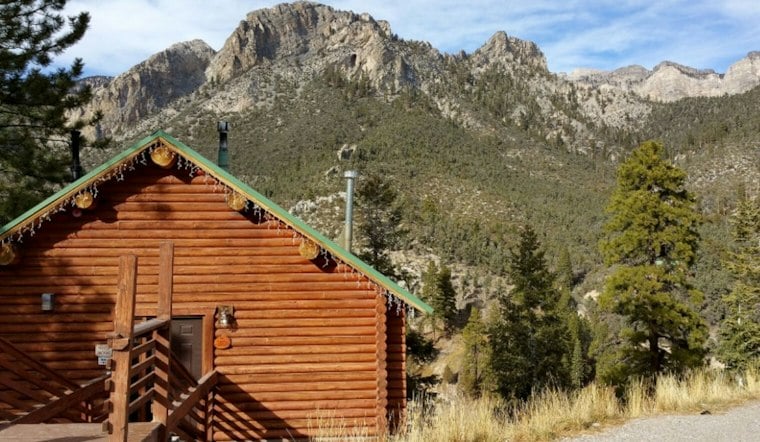
The first snow flurries of the season dusted Mount Charleston as cooler air finally broke months of triple-digit heat across the Las Vegas Valley, though the flakes didn't stick to the ground. For a resort that lives and dies by snowfall totals, even a flurry that melts on contact is enough to get hopes up for what could be a big winter ahead.
A Tease of Winter on the Mountain
According to KTVN, the Las Vegas Valley experienced a noticeable cooldown after a long stretch of scorching summer heat, and visitors up at Lee Canyon couldn't help but notice the whiplash between the desert floor and the mountaintop. Visitor Valerie Watson described flash floods in Las Vegas as shocking on their own, adding that it could be 90 degrees in the valley while it's 40 degrees up at Lee Canyon. She also said the shift between valley and mountain conditions can happen within a matter of hours, a contrast other visitors at the resort echoed as well.
Brooklyn Cruz, project manager at Lee Canyon, called the early snowfall fantastic and said it gives us a lot of hope for this season, per the station's report. That optimism is tied to more than just a few stray flakes, though — Lee Canyon officials are anticipating an El Niño weather pattern this year that could bring above-average snowfall to the area, the outlet notes.
Chasing a 215-Inch Benchmark
Lee Canyon typically averages about 129 inches of snow each winter, but the resort's last El Niño season delivered 215 inches, according to the same account. Cruz said the resort hopes to top that 215 number this time around. Whether this year's pattern actually produces that kind of snowfall remains to be seen, since an El Niño setup doesn't guarantee where or how much snow ultimately falls.
The Climate Prediction Center's ENSO advisory has pointed to a strong-to-very-strong El Niño remaining likely through January–March 2027, with better than an 83% chance, per the Climate Prediction Center.
New Lift, New Terrain on the Way
Behind the scenes, Lee Canyon is building its new Wild West Bowl chairlift, which officials say will open access to five new ski runs and roughly 40 additional acres of skiable terrain. Powder reports the lift is designed to span 2,200 feet and climb 650 vertical feet, carrying up to 1,800 passengers per hour — and it will mark the resort's fourth new lift in three years. Lee Canyon operates inside the Humboldt-Toiyabe National Forest under a special-use permit from the U.S. Department of Agriculture Forest Service, according to the resort's own mountain statistics page, with a base lodge sitting at 8,660 feet and a summit reaching 11,289 feet.
Resort visitor Daniel Valenciana said visitors are ready for the winter season and expect it to be great, the station's report adds. Lee Canyon plans to begin daily winter operations on Nov. 20, weather permitting — a date later than the November 2 opening in the winter preceding the Review-Journal's October 2025 report, which the paper noted was the resort's earliest start in 13 years.
How This Season Stacks Up Historically
Measurable snow at Mount Charleston doesn't typically show up this early. The Review-Journal reports the average first measurable snowfall for the area lands around Nov. 13, while the earliest on record came on Oct. 3, 1986, when just 0.4 inches fell. The Spring Mountains average around 79 inches of snow in a given winter season, well below the 129-inch average Lee Canyon itself reports.
Recent seasons show just how much that number can swing. The 2022-23 winter was Lee Canyon's snowiest on record at 266 inches, while 2023-24, the resort's last El Niño year, brought 215 inches. Just last October, the mountain picked up as much as 4 inches of snow during a storm, with Lee Canyon's base area recording 6 inches at the time, the Review-Journal reported. Whatever this winter brings, Lee Canyon's team is clearly hoping the early flurries are a sign of bigger totals to come.





