

























































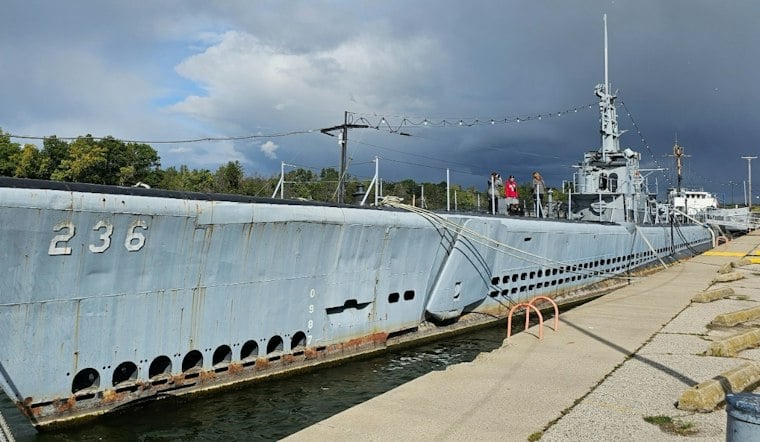
The USS Silversides, the World War II submarine that has called Muskegon home since 1987, is slated to make its return crossing of Lake Michigan sometime between Oct. 29 and Nov. 4, but the exact day hinges on the weather and whether the vessel clears five separate benchmarks first. The 312-foot sub has spent the past three months in Wisconsin undergoing a $3.5 million preservation project, its first full dry-dock overhaul in decades.
Five Checks Before the Tow Home
Before the Silversides can be towed back into the Muskegon Channel, it must pass a float test, an incline and stability test, ballasting, final touch-ups, and tow preparations, according to MLive.com. The outlet reports that the return window is slated for Oct. 29 to Nov. 4, but the journey home will be weather-dependent, leaving the exact departure date uncertain. The sub made the 113-mile journey across Lake Michigan to Sturgeon Bay, Wisconsin, in July, where it was taken to Fincantieri Bay Shipbuilding for the work.
Valkor Energy Services carried out the preservation project, which included replacing steel in the hull and removing invasive zebra mussels, the report notes. Protective coatings applied during the work are designed to protect the Silversides for the next 15 to 20 years, according to the museum. The same outlet reported in July that the submarine had not been in dry dock for more than 50 years, though a separate account from the museum described the work as the sub's first full dry-dock preservation in 70 years — the two figures were not reconciled in available reporting.
A Years-Overdue Overhaul
The timing wasn't exactly ahead of schedule. Submarines typically need dry-dock repairs every 25 to 30 years, but for the Silversides, it had been 50 years, according to Wisconsin Public Radio. That outlet also reported the project is partly funded by a $775,000 Save America's Treasures grant from the U.S. Department of the Interior, while MLive separately reported the grant at $750,000 from the National Park Service, alongside donor and sponsor support — the two figures were not reconciled in available reporting. Any money raised beyond the $3.5 million project cost will go into an endowment for the submarine's next dry dock, per the MLive report.
The Silversides served in World War II from April 1942 to July 1945 and ranks third among WWII submarines in ships sunk, with 30 Japanese flags painted on its side representing the enemy vessels it sank across 14 patrols. Its July crossing from Muskegon to Wisconsin was made under tow by two 100-foot tugboats from Basic Towing Inc. of Escanaba. The submarine, now 85 years old, has served as a floating museum in Muskegon since 1987.
A Comparable Sub Across the Lake
The Silversides isn't the only WWII-era sub drawing museum visitors around the Great Lakes. The USS Cobia, housed at the Wisconsin Maritime Museum in Manitowoc, is also available for overnight stays, much like the Silversides, according to Smithsonian Magazine. The Muskegon museum building itself has remained open to visitors throughout the submarine's absence.
While the Silversides waits out its final checks in Wisconsin, Muskegon is left watching the lake for word of its homecoming. The submarine's presence in the city traces back decades, the product of a push by local residents who are reported to have started a campaign in 1985 to bring it to their home port before it reached its permanent berth in the Muskegon Channel in August 1987.





