

























































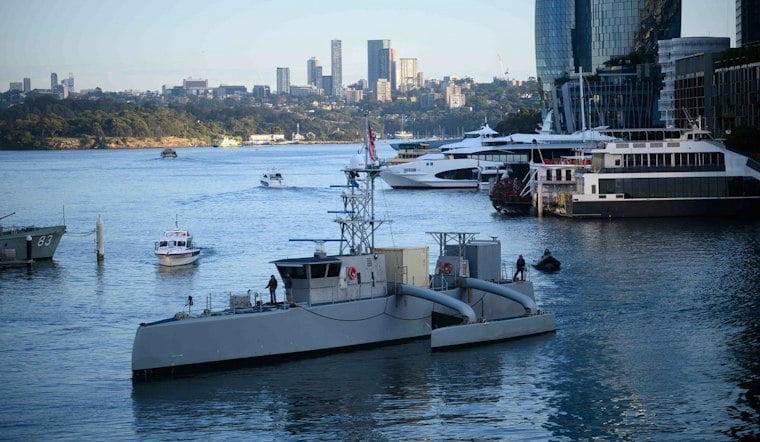
A 145-ton, crewless warship is sailing alongside the USS Theodore Roosevelt as the carrier strike group makes its way toward the Middle East, marking the first time in Navy history that a large unmanned surface vessel has deployed operationally with a carrier strike group. Acting Navy Secretary Hung Cao confirmed the milestone on October 14, calling the robotic vessel a force multiplier for the fleet.
The vessel is the Seahawk, a medium-displacement unmanned surface vessel built by Leidos, and it is currently deployed with the Theodore Roosevelt (CVN-71) carrier strike group, according to InsideDefense.com. The outlet reports that Roosevelt is the first carrier strike group to embark on an operational deployment alongside a large-size unmanned surface vessel. Cao described the capability bluntly, saying, “This is a force multiplier; imagine having more guns out there,” per the same report.
The Theodore Roosevelt carrier group left its San Diego home port in late September headed for the Middle East, according to The Straits Times. As detailed by Business Insider, the Nimitz-class carrier is sailing across the Pacific and is expected to enter the Middle East alongside its strike group of surface warships. Hung Cao, the acting Navy secretary, made his remarks about the deployment at the Association of the United States Army’s annual meeting and exposition in Washington, D.C., Business Insider reported.
What the Seahawk Can Actually Do
The Seahawk itself is a 145-ton, 42-meter surface vessel, the Straits Times reports, built with a composite trimaran hull and a fuel capacity of 14,000 gallons at full load, according to Naval Today. It is designed to operate over extended distances for months at a time without a crew or routine maintenance, the outlet notes. Naval Today also reports that Seahawk supports autonomous navigation and perception, letting it operate with limited human intervention, and that its collision-avoidance systems comply with international maritime rules for preventing collisions at sea.
This is not Seahawk’s first outing with the Roosevelt strike group. The vessel previously operated alongside the strike group and took part in the Rim of the Pacific exercise over the summer, InsideDefense.com reports. In April, Seahawk officially transitioned from an experimental vessel and entered the Navy fleet, the same outlet notes — a shift that Leidos has framed as part of a broader push to move autonomous systems from testing into regular service. In a September statement, Leidos said Seahawk is operating alongside crewed naval forces as the first medium unmanned surface vessel to deploy operationally with a carrier strike group, calling it a milestone in moving these systems from experimentation to the U.S. Navy fleet.
A Carrier Group Built Around Robotics and Firepower
The strike group Seahawk is riding with, Carrier Strike Group 9, centers on the Theodore Roosevelt and includes Carrier Air Wing 11, the USS Chosin, USS Paul Hamilton, USS Decatur and USS Carl M. Levin, according to Army Recognition. The outlet reports that Seahawk is accompanying the group as Theodore Roosevelt moves west across the Pacific, and that the Navy is still evaluating how future medium unmanned surface vessels could support missions such as distributed sensing, communications relay, surveillance, electronic warfare, or additional payload carriage.
NATO allies are likewise integrating naval drones and autonomous vessels into their own operations. Business Insider reports that small, speedboat-style sea drones have already played a crucial role in conflicts around the world in recent years — Ukraine has used explosive-packed sea drones against Russia’s Black Sea fleet and has armed others with additional drones, guns and missiles. American forces have used a Corsair unmanned surface vessel to rescue a downed Apache helicopter pilot and gunner, and unmanned underwater vehicles to remove mines.
Why Bigger Drones Matter for Carrier Groups
The Seahawk’s operational deployment alongside the Theodore Roosevelt illustrates how a medium unmanned surface vessel can accompany a carrier strike group. Autonomous ships may eventually take on other naval missions as the technology matures.
Business Insider notes that U.S. forces currently have two carrier strike groups and an amphibious ready group in the Middle East, with the amphibious group alone made up of three large flattops, several additional surface warships and dozens of fighter aircraft. The outlet also reports that U.S. forces resumed a naval blockade against Iranian ports on July 14 and disabled four commercial vessels said to be sailing in violation of it over a three-month period, and that a U.S. fighter jet struck a cargo ship after it left an Iranian port on October 10.
A Navy Betting Big on Unmanned Systems
The Seahawk’s deployment fits into a broader Navy effort to move unmanned systems into service.
The Navy’s unmanned-systems effort involves funding and procurement.





