

























































Nebraska's wide-open prairies are getting an $18.8 million lifeline aimed at pushing back one of the state's quietest but costliest invaders: the eastern red cedar tree. The U.S. Department of Agriculture's Natural Resources Conservation Service is delivering the multi-year funding through a program called Growing and Expanding Nebraska's Grassland Cores, announced earlier this month, with the goal of keeping working rangeland intact for both cattle and the wildlife that depend on it.
The announcement came on October 5, according to the Rainwater Basin Joint Venture, which is coordinating the effort alongside federal and state partners. The initiative targets proactive conservation practices, including brush management, prescribed burning, and grazing deferment, across more than 90,000 acres of core grasslands statewide, the organization notes. The Omaha World-Herald, which later detailed the award, reported that the broader conservation initiative — which includes the Nebraska Natural Resources Conservation Service, Nebraska Game and Parks, and other public and private partners — will support management practices on roughly 100,000 acres of grassland statewide, according to the Omaha World-Herald.
A Tree That's Quietly Costing Nebraska Millions
Eastern red cedar isn't native in the way most people think of prairie plants — and it's spreading fast. The species creeps across Nebraska grasslands at a rate of roughly 30,000 acres a year, according to the Rainwater Basin Joint Venture, resulting in an estimated $76.9 million in annual losses to forage and hay production, and more than $150 million in total economic impact once beef production losses are factored in. That kind of encroachment doesn't just shrink pastureland — it also raises wildfire risk as dense cedar stands build up fuel loads across the landscape, per the World-Herald's reporting.
The math matters because cattle are central to Nebraska's identity and economy. Cattle outnumber human residents four to one in the state, powering an agricultural economy that generates $6.5 billion in annual cattle sales across thousands of family ranches, the same Rainwater Basin Joint Venture report states. Every acre lost to cedar thickets is an acre that can no longer feed livestock.
Birds That Can't Tolerate Even a Little Shade
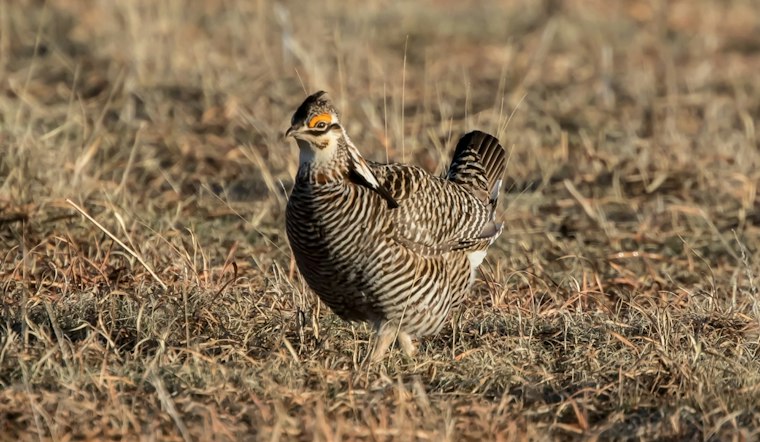
Cattle aren't the only ones losing ground. University of Nebraska-Lincoln research shows that most grassland bird species begin abandoning native habitat once eastern red cedar canopy cover exceeds 10%. The Greater Prairie-Chicken is far more sensitive still, avoiding areas with as little as 2% to 5% tree cover. That bird's springtime courtship ritual — a flamboyant display of stomping, pinnae feather erection, flutter jumping, and booming calls performed at ancestral breeding grounds, as described in the World-Herald's coverage — has become a modest tourism draw in parts of the state, even as the habitat it depends on keeps shrinking.
Nebraska's own state bird isn't faring much better. Grassland bird populations have declined by 53% since 1970, while Western Meadowlark populations have declined 25% over 55 years. Both species rely on the same open, tree-free grasslands that cedar encroachment is steadily converting into woodland.
Where the Money Will Go
The new funding will focus implementation within core grassland areas identified under the Great Plains Grassland Initiative, prioritizing projects in Nebraska's Central Loess Hills and tracts adjacent to recent brush management efforts, per the Rainwater Basin Joint Venture. Landowner participation in the program is voluntary, and grants will be available to eligible Nebraska landowners through 2030, according to the World-Herald's reporting. Program sign-ups are managed through the Rainwater Basin Joint Venture's website.
Some of the financial incentives are already established at the regional level. A $25-per-acre incentive is available for cooperative landowner burn units over 1,000 acres, intended to support large-scale prescribed burning. Those payments are meant to offset some of the cost and coordination burden that comes with organizing controlled burns across multiple properties.
A Global Spotlight on Rangelands
The timing lines up with a bigger international push. The United Nations declared 2026 as the International Year of Rangelands and Pastoralists, highlighting that rangelands cover nearly half the Earth's surface and support global food security and biodiversity. The United Nations declared the designation for 2026, a detail the World-Herald's coverage also noted in framing Nebraska's grasslands within that worldwide context.
Nebraska's award also isn't happening in a vacuum nationally. On October 8, the USDA announced it was issuing $1.8 billion in nationwide Conservation Reserve Program payments for 2026, accepting nearly 1 million new acres into Grassland CRP to support working rangeland grazing. That puts the Nebraska-specific grant inside a much larger wave of federal dollars currently flowing into conservation programs built around grazing land rather than cropland.
Whether voluntary sign-ups can keep pace with 30,000 acres of cedar spread every year remains an open question tied to how many ranchers are willing to take on the labor and safety demands of prescribed fire. For now, the conservation initiative — which includes photography of the Greater Prairie-Chicken and Nebraska meadowlark contributed by Brady J. Karg, as featured in the World-Herald's report — is betting that enough landowners will sign on to make a dent before the prairie gives way to woodland for good.





