

























































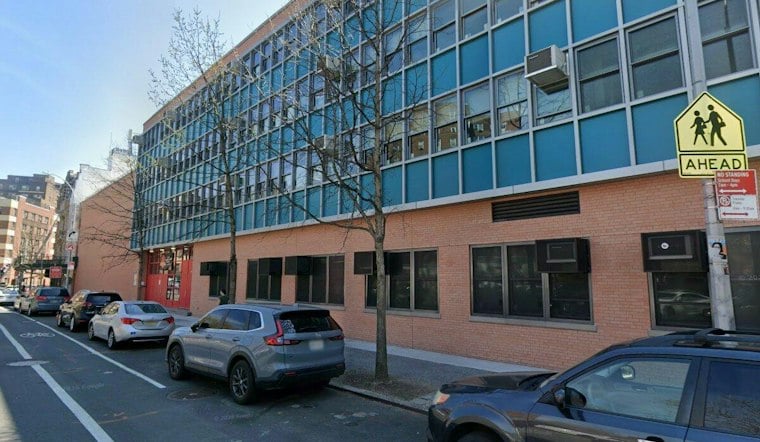
At P.S. 134 Henrietta Szold School on Manhattan’s Lower East Side, a new mural offers students and neighbors a way to encounter the women’s suffrage movement in a public space. More than 100 adults and students gathered for its dedication this past weekend. The 37-foot by 83-foot artwork, titled “Still Our Fight,” depicts 16 suffragettes and female leaders whose work helped lead to the 19th Amendment. It is located at 293 East Broadway.
Artist Sam Kirk designed the mural and painted it with a team of six female artists, according to amNewYork. The work is part of Monumenta's National Suffrage Mural Series, which began with projects in Chicago. An accompanying key names each figure, and a QR code directs viewers to more information about the women depicted.
Chicago’s Earlier Suffrage Murals
The Chicago work provides a precedent, but it took a different form. Columbia College Chicago reports that On the Wings of Change, featuring ten local suffrage leaders, was installed at 33 Ida B. Wells Drive in October 2021. In 2023, the college scheduled a dedication at 623 S. Wabash for murals completing a separate three-work suffrage series. The Chicago project was a corridor series; the New York mural brings 16 figures to a single school wall.
A Deliberate Choice of 16, Out of Hundreds
Neysa Page-Lieberman, Monumenta's Artistic Director and co-director of the National Suffrage Mural Series alongside public historian Michelle Duster, said hundreds of suffragists played a role in winning the vote for women, even though the project settled on just 16 to portray. The mural, she said, features New York suffragettes who not only worked locally for women's right to vote but also helped pass the national amendment. Page-Lieberman also said the series was initially intended to focus solely on Chicago before expanding into a broader national effort, a shift she credited in part to the musical Suffs, which has music, book, and lyrics by Shaina Taub, for helping launch and expand the mural initiative.
Duster, whose great-grandmother was suffrage leader Ida B. Wells, said the Lower East Side was an ideal location for the mural. Among the figures included is Laura Cornelius Kellogg, a member of the Oneida nation. Michelle Schenandoah, a member of the Oneida and founder of Rematriation, said Oneida women traditionally held authority and a voice in government, a tradition the mural's inclusion of Kellogg nods to.
Filling a Gap in Public Art
The push behind the mural reflects a wider imbalance in how women are represented in public spaces. Monumenta has reported that less than 5% of public art depicts women or women-centered historical events, and Central Park itself has just one statue depicting a woman out of nearly 170. That scarcity is part of what has fueled the mural series' expansion beyond its Chicago origins, where the Wabash Arts Corridor's three-mural suffrage project is regularly included on walking tours, according to the Chicago Sun-Times.
The school became involved after Monumenta contacted the Henry Street Settlement, which reached out to principal Robert Perales. He said art belongs in neighborhoods and at the school, and welcomed the mural as a memorial to heroic figures that can remind students of the courage women showed in resisting unfairness.
Voices From the Dedication
Artist Danielle Mastrion said passersby stopped to ask questions during the painting process, often surprised to learn the entire team behind the mural was made up of women. Liv Novotny said women's suffrage is more recent than many people assume and deserves continual celebration, while Pelumi Ayeni said the mural carries a message to remember history and keep fighting. Sam Kirk, for her part, said she was committed to seeing the project through to completion.
Danyel Fulton, who played Ida B. Wells on the national tour of Suffs, said the mural opens up a broader conversation about how hundreds of suffragists worked together to secure voting rights. City Council Member Christopher Marte said art can inspire future leaders and artists for generations to come. Gale Brewer, co-chair of the City Council's Women's Caucus, called P.S. 134's mural New York City's best. Pam Elam, president of Monumental Women, said the project aimed to honor history while also moving it forward.
Timing and What Comes Next
The dedication landed just a day before New Yorkers began early voting, a coincidence of timing that underscored the mural's message about the long road to the franchise. The U.S. Congress passed the 19th Amendment on June 4, 1919, and amNewYork reports that three-quarters of state legislatures had ratified it by August 18, 1920 — the amendment prohibits denial or abridgment of voting rights on account of sex by the United States or any state.
Monumenta's series isn't stopping in New York. Additional murals are slated to go up in Portland, Los Angeles, Salt Lake City, Kansas City, and Austin, Texas, continuing a project that began with Chicago's Wabash Arts Corridor murals and the broader effort, as Monumenta puts it on its own site, to go city by city to commemorate women's suffrage and document women's activism through large-scale public art, according to Monumenta.





