

























































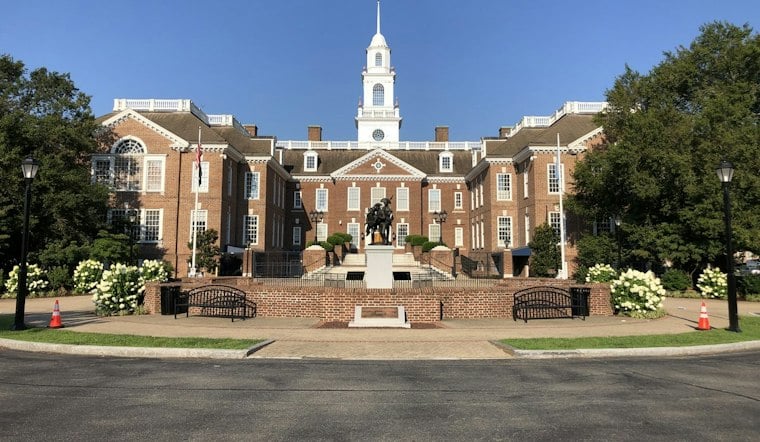
New Castle County Council voted down an ordinance Tuesday that would have brought the county's marijuana business zoning rules in line with state law, with council members casting the measure as an overreach from Dover. Ordinance 26-105 failed after seven council members recorded as “not voting,” three voted no, one voted yes, one voted present, and one member was absent.
The vote, detailed in a roll-call breakdown reported by Citizen Portal, effectively blocked New Castle County from adopting Delaware's new standard for how far marijuana retailers must sit from schools, child care centers, libraries and substance abuse treatment facilities. As Delaware Online reported, the council did not align the county's zoning code with state law and instead described the mandate as an overreach from Dover.
Councilman Calls Out Dover Over Land Use
During the meeting, Councilman Kevin Caneco argued state lawmakers lack the local knowledge to dictate zoning decisions, according to Delaware Public Media. He said state lawmakers in Dover “have no idea what they're doing with land use” and pushed his colleagues to send a strong message against state preemption. At the center of the dispute is Senate Bill 75, which lowered the required buffer between retail marijuana facilities and sensitive sites from the 1,000-foot setback New Castle County had established down to 500 feet.
That 1,000-foot buffer was not arbitrary. When Delaware legalized recreational cannabis in April 2023 through House Bills 1 and 2, the state initially gave counties broad authority to regulate where marijuana businesses could locate, and New Castle County used that authority to enact its stricter zoning code in December 2024, per the same outlet's reporting. State lawmakers later moved to override that local standard, arguing it was choking off a legal industry the state had just created.
A Veto, an Override, and a Supreme Court Ruling
Governor Matt Meyer, who previously served as New Castle County Executive, vetoed Senate Bill 75 in August 2025. He warned that stripping local governments of land-use authority without offering a state-local partnership or support eroded democratic rights and local control, according to the State of Delaware News. The General Assembly overrode that veto at 3:26 a.m. on July 1, 2026, following a January 2026 Senate vote and an early-morning House vote on the session's final day, as documented by Spotlight Delaware.
Lawmakers pushing the override leaned on a May 2026 Delaware Supreme Court decision confirming that the General Assembly holds ultimate constitutional authority over local zoning powers, Spotlight Delaware reported. That ruling gave state legislators the legal footing to argue New Castle County's resistance, however loud, could not ultimately stop the zoning change from taking effect statewide.
Stalled Dispensaries, Missed Tax Revenue
The fight over buffer distances has real financial stakes for the state. Delaware launched adult-use recreational marijuana sales on August 1, 2025, but tax revenue reached only $4.4 million through February 2026, far short of initial annual projections of $42 million, with local zoning delays cited as a contributing factor, according to Spotlight Delaware's reporting. The Delaware Office of the Marijuana Commissioner awarded 125 cannabis business licenses via lottery in late 2024, yet zero non-medical retail dispensaries had opened statewide as of early 2026 because of real estate and zoning obstacles, per 420 Property.
That bottleneck is part of why state lawmakers forced the issue. New Castle County's December 2024 zoning code, with its 1,000-foot buffers, became an obstacle legislators pointed to when relaxing the standard to 500 feet statewide under Senate Bill 75.
Fears of a Broader Precedent
Not every council member framed the fight purely in cannabis terms. Councilwoman Janet Kilpatrick raised concerns during the meeting that overriding local marijuana zoning could set a dangerous precedent, warning it might prompt alcohol retailers to demand similar state overrides of county regulations, Delaware Public Media reported. Her comment widened the debate beyond dispensary setbacks into a broader question about how much authority counties retain over any kind of local land use once the state decides to intervene.
For now, New Castle County's rejection of Ordinance 26-105 stands as a symbolic act of defiance rather than a legal victory, since the state's authority over zoning was already affirmed by the courts. Delaware Public Media noted that the vote raises open questions about potential court challenges and continued regulatory friction between state and local authorities, questions that remain unresolved as both sides stake out their positions.





