

























































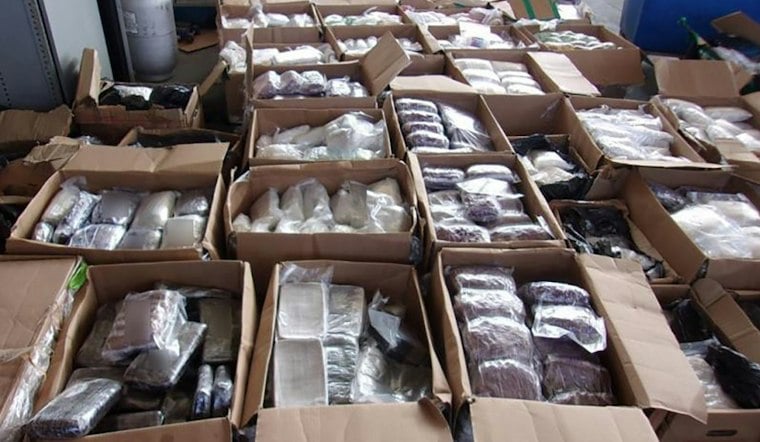
A 35-year-old New Haven man was sentenced Tuesday to 12 years and 7 months in federal prison for his role in a counterfeit pill ring that federal officials say was responsible for the largest seizure of fake pills in Connecticut history. Emanuel Payton will also serve five years of supervised release once his prison term ends.
U.S. District Judge Alvin W. Thompson handed down the sentence in Hartford federal court, according to the U.S. Department of Justice. Payton had earlier pleaded guilty to conspiracy to manufacture, distribute, and possess with intent to distribute controlled substances, and according to the New Haven Register, he has been detained since his arrest. The sentencing capped a case that began with a tip about a pill press hidden inside a rented garage.
Payton was one of seven Connecticut residents charged in September 2024 after a joint investigation by the DEA Tactical Diversion Squad and the U.S. Postal Inspection Service, per the Justice Department. The indictment also named Kelldon Hinton, Heshima Harris, Marvin Ogman, Shawn Stephens, Arnaldo Echevarria, and Cheryle Tyson, according to the U.S. Drug Enforcement Administration. Prosecutors say Payton regularly visited the garage lab to pick up hundreds of pills at a time for redistribution.
A Garage Lab Disguised as a Pharmacy Pipeline
Federal investigators opened their probe in June 2023 after receiving a tip that Kelldon Hinton was running a pill press out of a rented garage on Tyler Street Extension in East Haven, a space he referred to in text messages as his lab, the New Haven Register reported. Over the next 15 months, agents used physical and electronic surveillance, undercover purchases, parcel seizures, and trash pulls to build the case, the paper noted.
The pills were counterfeit versions of oxycodone, Xanax, and Adderall, and contained methamphetamine, protonitazene, dimethylpentylone, and xylazine, the animal tranquilizer known as tranq, according to CBS News. The Justice Department says protonitazene, a Schedule I synthetic opioid in the nitazene class, is roughly three times more potent than fentanyl.
CBS News also reported that Hinton sourced raw synthetic chemicals, controlled substances, and industrial pill press parts directly from suppliers in China and other foreign countries. Those materials fed an operation capable of producing drugs at an industrial scale inside a residential garage.
Record Seizure Spanned Two Towns
When agents raided the East Haven garage in September 2024, they found roughly one million counterfeit pills weighing nearly 100 kilograms, along with 300 grams of cocaine, two large pill presses, manufacturing equipment, and drug ledgers, the Register reported. One of the seized presses was capable of churning out 100,000 pills an hour.
A separate court-authorized search of a storage unit Hinton rented at a West Haven facility turned up hundreds of thousands of additional narcotic pills weighing nearly 100 kilograms, according to the same account. U.S. Attorney Vanessa Roberts Avery described the discovery as Connecticut's single largest seizure of counterfeit pills, the Register noted. Federal officials have separately called it among the largest in New England, per FOX 61.
Hinton shipped more than 1,300 packages to customers across the country through the U.S. Postal Service between February 2023 and February 2024, the Register reported, distributing counterfeit pills to Payton and other Connecticut associates along the way. He sold the pills through dark web marketplaces before the parcels moved through the mail to buyers nationwide.
Co-Defendants Face a Range of Sentences
Payton's sentence lands heavier than that of co-defendant Shawn Stephens, a 35-year-old West Haven man who pleaded guilty to drug conspiracy charges and was sentenced in June to 8 years and 1 month in federal prison plus three years of supervised release, FOX 61 reported. Hinton, identified by investigators as the operation's primary operator, has also pleaded guilty and is awaiting sentencing.
Connecticut regulators have since moved to close a gap in state law that synthetic opioids like protonitazene had been exploiting. In March, the Connecticut Department of Consumer Protection designated nitazenes, along with bromazolam and kratom, as Schedule I controlled substances under state law, according to CT.gov. The agency gave businesses until late March to surrender or destroy any non-compliant inventories, making unauthorized possession, manufacture, or distribution of the substances a state felony.



