

























































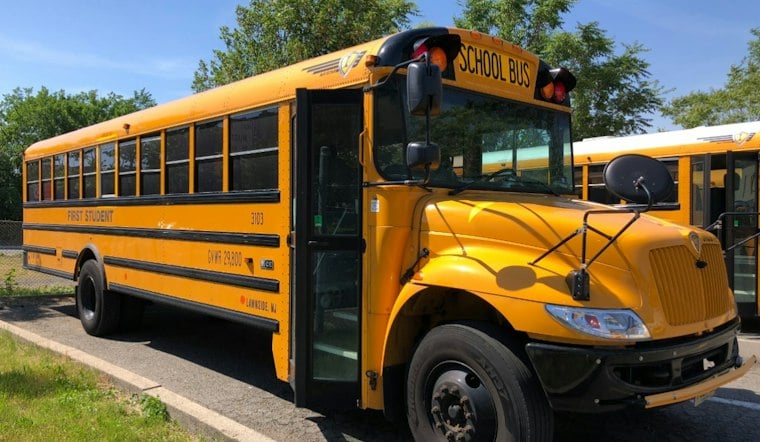
Two New Jersey Assembly members want to make sure the adults running your kid's classroom, nursing office or school bus are actual people, not algorithms. Assemblywomen Heather Simmons and Rosaura Bagolie introduced Assembly Bill 5529 on September 17, a measure that would require public-school employees and contractors providing district services to be human beings rather than AI systems or automated substitutes.
The bill, as reported by Shore News Network, would apply across traditional public schools, charter schools and renaissance school projects statewide. It targets jobs that involve regular contact with students, naming teachers, substitute teachers, principals, superintendents, teaching aides and child-study-team members among the covered roles. The legislation also lists school psychologists, counselors, nurses, physicians, librarians, bus drivers, bus aides, security officers, administrative personnel and maintenance employees, and its reach extends to individuals providing school services under contracts with local boards of education.
At its core, the bill would require a human being to hold a position such as teacher or school bus driver even in cases where automated technology is capable of performing those functions. Per the outlet's reporting, it would also prevent a district from designating an AI system as its nurse, psychologist or guidance counselor in place of an actual employee. The bill's sponsors said the measure affirms that interactions between students and school personnel should be conducted by humans rather than AI or automated decision systems.
What the Bill Does Not Touch
Notably, the proposal stops short of regulating the technology itself. It would not establish restrictions on specific AI software products or rules for how emerging technology can be used to support employees who remain in their jobs, the Shore News Network report notes. It also does not expressly prohibit teachers from using AI instructional tools, administrators from using automated software, or school nurses from relying on medical technology — and it leaves open the question of whether districts could still reduce staffing by applying AI to administrative tasks that don't directly replace one of the named, designated roles.
Simmons represents parts of Cumberland, Gloucester and Salem counties, while Bagolie represents communities in Essex and Passaic counties. The bill was referred to the Assembly Education Committee and, as of the reporting, has no recorded committee vote. A companion measure, Senate Bill 4795, has been identified in the upper chamber. To become law, the legislation would need approval from both chambers and the governor's signature, after which it would take effect immediately.
A Patchwork of District-Level Policy So Far
The Trenton proposal lands amid a broader, largely unregulated push by schools nationwide to figure out what role AI should play around students. States and the federal government have been mostly hands off on the issue, according to NPR, which reports that school districts and individual educators across the country are experimenting with AI in classrooms — from lesson planning and student-progress tracking to feedback chatbots and even humanoid robots. A Stanford review of more than 800 academic papers found that research into how schools can use AI to help students while avoiding harm remains extremely limited, per the same NPR report.
Some districts have already hit friction. Wichita Public Schools delayed a large-scale rollout of student-facing AI tools because officials couldn't determine how to measure success, NPR reported. In New York, a planned AI-powered humanoid-robot experiment was put on hold after teachers, parents and state education leaders raised concerns, including over student-data privacy. And in Dayton, the district's spending shows how quickly these contracts can scale: Dayton Public Schools paid the ed-tech company SchoolAI $72,600 last academic year for multiple tools, including a social-emotional chatbot called Jordan, then renewed the contract for $78,650 this year.
New Jersey's Own Guidance Still Taking Shape
New Jersey has been building its own framework separate from the new bill. The New Jersey School Boards Association developed a model policy meant to guide districts on AI use, addressing student safety, academic integrity, compliance with legal requirements, and privacy protections. The state's Department of Education has separately advised local education agencies to begin dialogues with stakeholders before incorporating AI systems into classrooms, offering high-level starter questions for those conversations.
The department has said its AI guidance webpage will be updated regularly as the technology evolves, with staff from its Office of Innovation meeting with educators to gather feedback on how AI is actually being used in schools. That ongoing, informal process stands in contrast to what Assembly Bill 5529 would do: write a hard line into state law that the people standing in front of — or driving, or nursing, or counseling — New Jersey's public-school students have to be people.





