

























































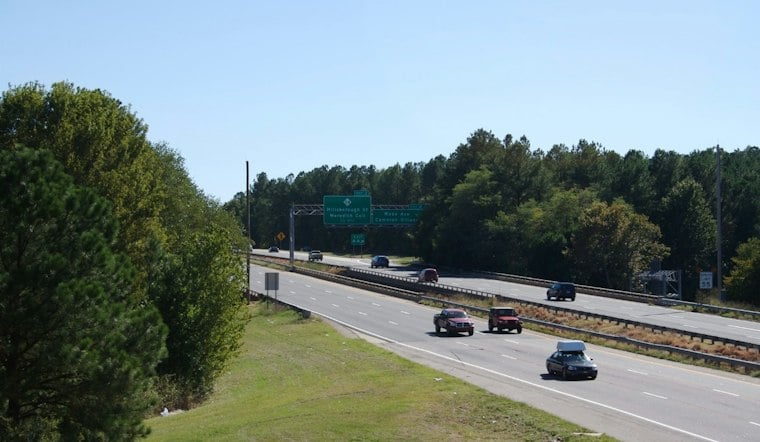
Drivers cruising a long-dark stretch of Raleigh's I-440 Beltline are noticing something new overhead: light. A four-mile section of the highway now glows at night, with tall masts rising at interchanges and shorter poles lining the median in between, ending decades of darkness along one of the city's busiest commuter routes.
According to the Raleigh News & Observer, the newly lit section runs a four-mile stretch between Lake Boone Trail and Cary. That description marks a shift from earlier reporting: a 2022 News & Observer report said the lighting project then underway was slated to run between Wade Avenue and Cary as part of the Beltline widening, with lights shining down from tall masts at the interchanges and from rows of shorter poles along the highway. NCDOT's own project page for the I-440 and Blue Ridge Road improvements has said construction was underway between just south of Walnut Street in Cary and north of Wade Avenue in Raleigh, according to the agency's website.
The lights are part of a larger overhaul of the Beltline’s oldest section. NCDOT describes the corridor between just south of Walnut Street in Cary and north of Wade Avenue as a four-lane bottleneck between six-lane sections, with congestion expected to increase. The $346.2 million project includes widening the road to six lanes, replacing pavement and bridges, and upgrading interchanges, as outlined on NCDOT’s I-440 project page.
Whatever the precise endpoints, the lighting represents a notable change for a highway that has carried traffic largely in the dark since it was first built starting in the 1960s and widened in the 1990s. NCDOT lit the Wade Avenue, Western Boulevard and Jones Franklin Road interchanges, with light poles at those interchanges standing at least 80 feet tall, according to the News & Observer. The masts are usually located 50 feet or more from the pavement, while shorter poles are used where exit and entrance ramps meet the travel lanes.
Why NCDOT Chose Continuous Lighting Over Gaps
NCDOT placed lights in the median along the entire Beltline stretch specifically to avoid rapid changes between light and dark, per the News & Observer's reporting. Greg Hall, who leads NCDOT's lighting and electrical design team, explained the thinking behind that approach. “For this corridor, it was better to provide continuous lighting all the way through rather than take drivers through that dark-light, dark-light, dark-light rapid transition,” Hall said.
Hall also framed the broader push for more highway lighting as a response to how Raleigh and the surrounding region have changed. “The state certainly has become more urbanized over the last 20, 25 years,” he said, adding that the growing use of lights partly reflects population growth and changing resident expectations. “Safety is the overall benefit that we're looking for when we install lighting,” Hall said.
NCDOT typically installs highway lights only as part of a major construction project, and the agency conducts a study to determine whether lighting is warranted at a given interchange or highway section under state and federal guidelines, which favor lighting on busier roads. The Federal Highway Administration has said lighting can reduce nighttime injury crashes by 28% on rural and urban highways and nighttime crashes at intersections by up to 38%, though that figure comes from national data rather than a locally measured effect.
NCDOT’s lighting rules make the decision more specific than simply favoring busy roads: the agency weighs average daily traffic, roadway geometry, operations, environmental conditions and crash history. For freeways, its manual describes a cost-effectiveness calculation that compares need and traffic-related benefits with annualized cost; it also allows a short stretch between warranted interchanges to be considered for lighting to reduce abrupt transitions. The state’s roadway design manual says the NCDOT Roadway Lighting Committee makes the final determination.
A Patchwork of Lit and Unlit Interchanges
The Beltline's lighting remains uneven. The Poole Road and Interstate 87 interchanges are lit, while the New Bern Avenue, Capital Boulevard, Six Forks Road and Glenwood Avenue interchanges are not. NCDOT has planned one additional Beltline construction project in the foreseeable future, with work planned at Wake Forest Road starting in late 2029.
Other recent and upcoming projects elsewhere in the Triangle show the same pattern of lighting arriving alongside construction rather than on its own. NCDOT recently installed lights at the new I-40 interchange with Airport Boulevard and also installed lights when it rebuilt the Aviation Parkway interchange. Further out, the I-40 widening project is expected to bring lights to three interchanges in Orange County: N.C. 86, New Hope Church Road and Old N.C. 86, according to the News & Observer's reporting.
At the Hillsborough Street interchange, NCDOT agreed to use shorter poles specifically to reduce the impact on Meredith College's nearby astronomy observation deck, the same report noted. Hall said NCDOT designs its lighting to minimize light beyond the highway right-of-way and avoid shining into nearby yards or homes, a consideration that becomes more delicate as development presses closer to major roads.
Bird Advocates Flag Separate Concerns About Light
Not everyone welcomes more nighttime glow along the region's highways. John DeLuca, conservation director for Audubon North Carolina, said highway lighting attracts and disorients birds, and that birds are more likely to collide with buildings when highway lights sit near high-density development. Building collisions are one of the leading causes of bird mortality in the country, DeLuca said, though he did not comment on the safety benefits of the Beltline's new lights specifically.
The concern is not limited to buildings: the U.S. Fish and Wildlife Service says artificial light can draw night-migrating birds from as far as five kilometers, where they may circle, lose energy and face a greater risk of colliding with structures. Cloudy or foggy conditions can heighten the problem by making birds fly lower. The agency recommends using light only when and where needed, and points to spring and fall migration as periods of particular concern, as described in its guidance on nighttime lighting and bird collisions.
The National Audubon Society urges cities, businesses and building managers to limit or turn off lighting where possible, particularly during spring and fall bird migration. Raleigh already participates in Lights Out for Bird Migration twice a year, according to the city's own announcement, and Wake Audubon has been planning additional Lights Out Wake activities. NCDOT, for its part, has worked with the U.S. Fish and Wildlife Service to reduce light pollution at stream and river crossings in western North Carolina to avoid disrupting endangered bats, a separate effort from the Beltline project.
For now, the newly lit stretch of I-440 stands as one more example of how lighting decisions in the Triangle tend to ride along with road construction rather than arrive as standalone upgrades. NCDOT's calculus, as described by Hall and the agency's own guidelines, weighs traffic counts, roadway design, cost-effectiveness and environmental impact before a single pole goes up — meaning many of the region's darker corridors may stay that way until their own construction projects come due.





