

























































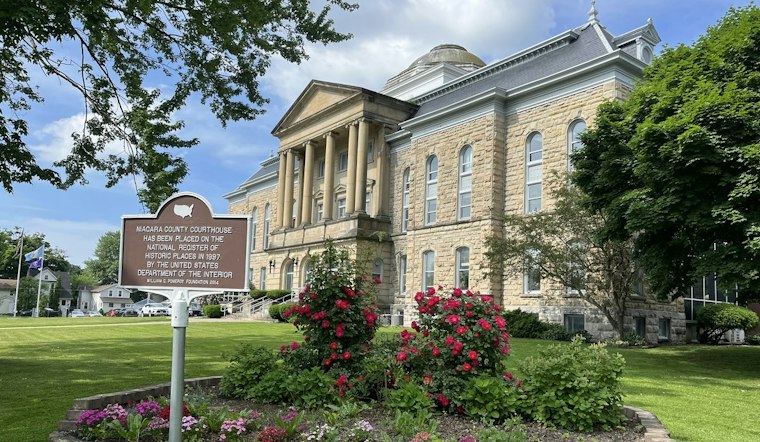
Niagara County lawmakers voted 9-4 on Tuesday to authorize a potential lawsuit against New York State, taking aim at a law that restricts local officials from sharing certain voter information with federal immigration authorities. The vote fell along party lines, with Republican legislators backing the resolution and Democratic lawmakers opposed, while two legislators were absent from the vote.
The resolution, detailed by Spectrum News 1, authorizes County Attorney Claude Joerg to pursue litigation challenging the state law. County officials argue the law prevents local Board of Elections employees from sharing voter information with federal immigration investigators.
Joerg told the station that federal immigration investigators are looking into eight people he says voted in Niagara County elections, and that federal authorities have requested records tied to those local voters. He said he could not confirm whether any illegal voting cases had actually been confirmed. Niagara County election commissioners said representatives from the Department of Homeland Security visited their office seeking voter information, describing the inquiry as part of an ongoing investigation, though they declined to discuss specific details while that investigation remains active.
What the State Law Actually Restricts
General Municipal Law § 996-a restricts disclosure of certain personal information to federal immigration authorities, but the statute also includes exceptions for voter registration and other election-related matters. Joerg argued the law puts county officials in a difficult position when responding to federal investigators, saying it prevents them from providing identifying information including names, addresses and dates of birth.
New York Attorney General Letitia James issued election guidance addressing voter intimidation and conduct at polling places, according to the New York Attorney General.
Immigration attorney Lauren Desrosiers disputed Joerg's interpretation of the law and questioned whether Niagara County has grounds for a successful challenge, per the Spectrum News 1 report. She said election law and voter registration are specifically exempted from Section 996-a, raising the possibility that the exact records county officials say they cannot share may already fall outside the law's restrictions.
A Federal Push Tied to a March Executive Order
The Niagara County dispute unfolds against a federal backdrop set by President Trump's Executive Order 14399, issued March 31, 2026, which directed the Department of Homeland Security to compile citizenship lists and instructed the Justice Department to prioritize investigating noncitizen voter registration, according to the Federal Register. Niagara County election commissioners said DHS representatives visited their office seeking voter information as part of an ongoing investigation.
Federal law treats noncitizen voting and false citizenship claims differently. Under 18 U.S.C. § 611, noncitizen voting in a federal election is a Class A misdemeanor punishable by up to one year in prison and a $100,000 fine, while knowingly making a false claim of citizenship to register or vote is a separate federal felony under 18 U.S.C. § 1015(f), carrying up to five years in prison and a $250,000 fine, according to the U.S. Department of Justice. Separately, under the federal Immigration and Nationality Act, a noncitizen who votes unlawfully or falsely claims citizenship can face deportability, and the conduct may be considered in assessing good moral character for naturalization, per guidance from U.S. Citizenship and Immigration Services.
Nationwide, federal prosecution data cited by Reuters shows prosecutors charged 129 people under the federal noncitizen voting statute between 1996 and mid-2026. Separately, DHS has investigated alleged voter fraud across multiple states in 2025 and 2026. Academic research offers a different lens on scale: a Brennan Center for Justice study analyzing 23.5 million votes across 42 jurisdictions identified just 30 suspected instances of noncitizen voting, or roughly 0.0001% of ballots cast, according to the Migration Policy Institute.
Not the County's First Clash With Albany
Niagara County and Joerg have been here before. In August 2019, the county legislature authorized Joerg to file a state court lawsuit challenging New York's Driver's License Access and Privacy Act, known as the Green Light Law, citing election integrity and potential noncitizen voter fraud concerns, according to the Olean Times Herald. That earlier fight set a template for the current standoff between county officials and state leaders over immigrant-related protections.
Joerg said the county's concern is election integrity rather than the broader immigration debate, and he said before Tuesday's vote that he preferred resolving the dispute without litigation. The vote itself did not mean a lawsuit had been filed, only that Joerg now has authorization to pursue one. Republican gubernatorial candidate Bruce Blakeman has separately advocated for greater cooperation between local law enforcement and federal immigration authorities, while Hochul has supported restrictions on such cooperation.
Spectrum News 1 requested comment from Hochul's office and from Attorney General James's office; neither had responded by the station's reporting deadline. The dispute arrives with New York's midterm elections less than two weeks away, adding urgency to a legal fight that for now remains a threat rather than a filed case.



