

























































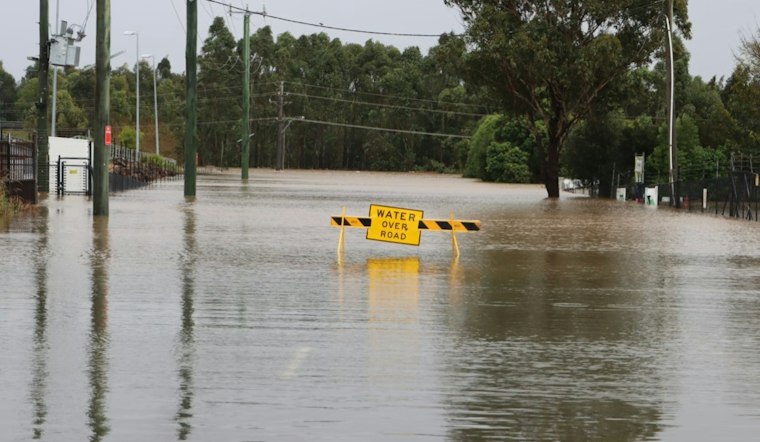
Monica Seybold says the bank of the creek behind her Nicasio property is now level with her land, so when the water rises, it simply spreads out across her yard. She owns a little over three acres, and she says floods now cover roughly half of it. With a wet winter potentially on the way, she and her neighbors are warning that the unincorporated Marin County community could flood badly if Marin Water does not dredge the creek soon — and the agency says that is not happening this year.
Marin Water is evaluating a plan to remove approximately 50,000 cubic yards of sediment and vegetation across 3,150 linear feet of Upper Nicasio Creek and 1,200 linear feet of Halleck Creek, according to Baird Maritime. That is roughly equivalent to 5,000 ten-yard dump-truck loads of material, and the district would also need recurring maintenance removals of up to 10,000 cubic yards every five to 10 years just to keep pace. The proposed dig depths vary by location — up to two feet of sediment near Nicasio Reservoir, two to four feet behind Nicasio Elementary School, and as much as six feet closer to the town center — according to the Point Reyes Light, since Nicasio and Halleck Creeks converge directly behind the school.
The problem has been building for decades. Nicasio Reservoir was built in 1961 as an asset of the Marin Municipal Water District, and it has affected the town ever since, per CBS San Francisco. Back pressure from the reservoir has caused sediment to build up in the creek, and the district's hydrologist says ground level in the channel has risen about 9 feet since the dam went in. That buildup causes water to spread out across the land during heavy flows, and residents report property flooding during large, sustained rainstorms, according to the same report from CBS reporter John Ramos.
School and Homes at Risk in a Modeled Flood
A modeled 100-year flood would inundate large areas of Nicasio, including the elementary school along with private residences and businesses, the district reported according to CBS's coverage, which cited the water agency's own analysis. Residents say the fix is straightforward in concept: dredge the shallow spots to create a deeper, more confined channel that can carry storm flows without spilling onto yards, roads and the schoolyard. Seybold has asked Marin Water to start the dredging process during the current dry spell, warning that the severity of flooding will keep escalating if the sediment is left in place.
Creek dredging used to be routine when the reservoir was first built, but it appears to have stopped sometime in the 1990s, per the CBS report. Resident Kasey Briare said Marin Water told the community it would not dredge before next year because of permitting requirements — even though residents wanted sediment cleared near the school ahead of a predicted El Niño winter. Marin Water has removed vegetation and debris that was clogging flow and undermining the creek banks, and has proposed more significant long-term improvements to reduce flood risk, but the agency declined an on-camera interview with CBS on the Monday before publication.
Dredging Timeline Folded Into a Separate Pipeline Review
Marin Water's current planning shows that major creek sediment excavation cannot begin until summer 2027 at the earliest, assuming environmental permits are secured early that year, and the work will then require at least two construction seasons to finish, Baird Maritime reports. That delay traces back to a procedural decision: the district incorporated its long-term creek sediment management plan into the Environmental Impact Report for its separate Atmospheric River Capture project, a proposed 13.2-mile pipeline that would connect Russian River water to Nicasio Reservoir, according to Marin Municipal Water District. Public scoping comments on that review closed on October 19, with the pipeline itself intended to convey surplus winter water to the reservoir to improve drought resilience.
Nicasio residents have pushed back on that bundling, telling the Point Reyes Light they fear folding the creek evaluation into the larger pipeline EIR will delay needed sediment removal and arguing instead for an independent environmental review. Complex state and federal permitting requirements for work in sensitive stream channels are a major reason heavy equipment cannot move in before next year, per Baird Maritime's reporting. A Section 401 certification public notice concerns the Nicasio Reservoir Vegetation Management Project, according to the California State Water Resources Control Board.
A History of Friction Over the Dam
This is not the first time Nicasio residents have clashed with the water district over flood risk at Seeger Dam. In August 2025, Marin Water formally abandoned a proposed 3,700-acre-foot expansion of Nicasio Reservoir that would have installed an inflatable rubber gate on the dam's spillway, after residents strongly protested that it could worsen local flooding; the district ultimately cited higher costs and public opposition when it withdrew the plan. Nicasio Reservoir holds 22,340 acre-feet of storage capacity and is part of a seven-reservoir system holding roughly 80,000 acre-feet that together supplies about 75 percent of Marin Water's total municipal water, according to the Marin Independent Journal.
Yet the unincorporated community of Nicasio, home to fewer than 1,000 residents, relies entirely on private groundwater wells and septic systems rather than the district's municipal supply, according to KTVU. That leaves residents exposed to drinking water contamination and public health risks during floods, since rising water can submerge septic leach fields and contaminate private wellheads, without the town ever benefiting from the reservoir's stored water. California Governor Gavin Newsom has separately declared a state of emergency over potential flooding statewide, intended to cut red tape for flooding projects, while north bay waterfront towns are also preparing for predicted record-high tides this winter, according to CBS's reporting.



