

























































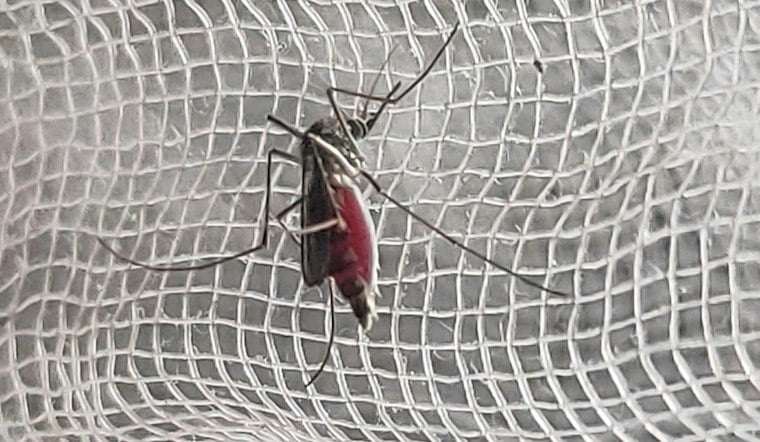
Sarasota County says it has recorded no locally acquired dengue cases in 2026, even though Jerri Goodlin, a 63-year-old North Port hospice nurse, was hospitalized for five days in September with dengue fever. Goodlin believes she was infected while mowing a neighbor’s lawn, but the information made public does not establish where she was exposed.
Goodlin’s case and the questions around its classification were first reported by Suncoast Searchlight. In an account to WUSF, Goodlin said mosquitoes swarmed her while she mowed a neighbor’s lawn. About four days later, she woke with chills, diarrhea and severe bone pain. She also had a rash and a fever of 102.2 degrees; a physician suspected dengue fever or chikungunya.
Goodlin had attended a wedding in Hillsborough County the week before she became ill. She told WUSF she did not recall mosquito bites or symptoms afterward and associates her illness with the lawn-mowing episode in North Port. Both of Florida’s primary dengue-carrying mosquito species, Aedes aegypti and Aedes albopictus, are present there, according to the report.
A Hospital Stay That Turned Dire
WUSF reported that Goodlin developed acute colitis during her five-day hospitalization, lost a quarter of her blood volume and dropped 17 pounds in four days, later regaining two.
Goodlin’s case was reported to the Florida Department of Health twice, and a communicable disease reporting form was dated Sept. 23, 2026. According to Suncoast Searchlight, Sarasota County Mosquito Management Services came to her home hours after doctors reported the case, treated the property with sprays and pellets in ditch water to kill mosquito larvae, and notified neighbors of the suspected infection. The publication reported that the county’s response did not address questions specific to Goodlin’s case.
County Says It Has No Local Cases On the Books
Gerald Huard, a spokesperson for the Florida Department of Health in Sarasota County, said the county had no active dengue transmission and no locally acquired human cases, according to Suncoast Searchlight. The state health department declined to explain how it determined where Goodlin contracted dengue, citing patient privacy laws, and did not detail its investigation. The information made public does not establish where she was exposed.
How Florida Investigates Dengue Cases
Florida Department of Health guidance directs dengue investigators to ask about travel, outdoor activities and mosquito bites in the two weeks before symptoms begin. When needed, investigators should send specimens to the department’s Bureau of Public Health Laboratories for confirmatory testing, according to the Florida Department of Health’s surveillance guide. The guide outlines evidence investigators may review, but it does not show what evidence was considered or what conclusion officials reached in Goodlin’s case.
Dengue is a reportable disease in Florida, and medical providers are legally required to report potential cases to the state health department for investigation and confirmatory testing. Under Florida Statute 381.0031, covered health practitioners, hospitals and certified laboratories must immediately report diseases of public health significance to the state.
Florida's Worst Dengue Outbreak in Decades
Goodlin's case lands amid what officials describe as Florida's largest dengue outbreak in decades, with hundreds of infections reported statewide, most concentrated in nearby Hillsborough County. Statewide totals vary by source and date: Hillsborough County continues to lead the state with 310 cases, and the Tampa Bay region had 352 confirmed cases across Pinellas, Pasco, Polk and Hillsborough counties, according to a separate WUSF report. Pinellas County has also seen recent spikes in local cases, while Citrus, Manatee and Brevard counties have reported new infections too, according to WFLA, which put the statewide total of locally acquired cases at 425 since the year began. A Florida Department of Health arbovirus surveillance report put the year's locally acquired total at 368 cases across eight counties, as reported by Florida Department of Health. CDC data updated in late September listed 177 cases in Hillsborough County and 132 in Miami-Dade, with Pinellas and Lee counties each showing eight, according to My Suncoast. Sarasota and Manatee counties did not appear in that CDC table at all, because the agency does not display counties with fewer than three cases, and the agency cautions that its county totals reflect where patients live, not necessarily where they were exposed.
Hillsborough County reported 36 new cases in its most recent week tallied, down from 79 the week before, per WFLA's report. The county has extended its state of local emergency to Oct. 29 as it works to control mosquito populations and protect residents from dengue, as noted by Hillsborough County.
How the 2026 count compares
Florida Department of Health’s Week 42 arbovirus report, covering Oct. 13-19, 2024, recorded 50 locally acquired dengue cases from eight counties. The 2026 reports cited above give substantially higher statewide totals, though they differ by source and reporting date. The available figures show cases across eight counties in the department’s 2026 report, but do not provide enough detail to compare county-by-county distribution with 2024. Florida Department of Health’s 2024 report provides the earlier-year comparison. Neighboring counties have also taken separate actions. WWSB reported on Oct. 23, 2026, that health officials had confirmed a locally acquired human dengue case in Manatee County. Pinellas County’s Resolution 26-84 extended its state of local emergency for mosquito-borne illness through 3 p.m. Oct. 15, 2026; that county-level action does not establish a dengue case there or determine where Goodlin was exposed. WWSB reported the Manatee case, and Pinellas County’s resolution documents its emergency extension.
Why Florida Has Become a Dengue Hotspot
Dengue is transmitted through the bite of female Aedes aegypti and Aedes albopictus mosquitoes, and while the disease is common worldwide, it is generally rare in the United States, per WUSF. Eric Caragata, a mosquito-microbe interactions assistant professor at the University of Florida, described the state as a dengue hotspot in the continental U.S. because of its warm, wet climate. He recommends using repellent, wearing long sleeves and pants, installing screens, and removing standing water to cut down on mosquito bites and breeding activity.
Most dengue cases are asymptomatic, but the virus has four distinct serotypes, and infection with one builds immunity only to that specific strain. A subsequent infection with a different serotype actually raises the risk of more severe symptoms, and no dengue vaccine is currently available in the United States, per a report from Suncoast Searchlight.
Mounting Bills and a Month Away From Work
Goodlin missed roughly a month of work recovering from the illness, estimating her lost wages at nearly $10,000. Her medical bills have already exceeded $35,000, and she expects to pay nearly $5,000 of that out of pocket. Despite the toll, she remains upbeat about her recovery. “Every day is a better day,” Goodlin said.





