

























































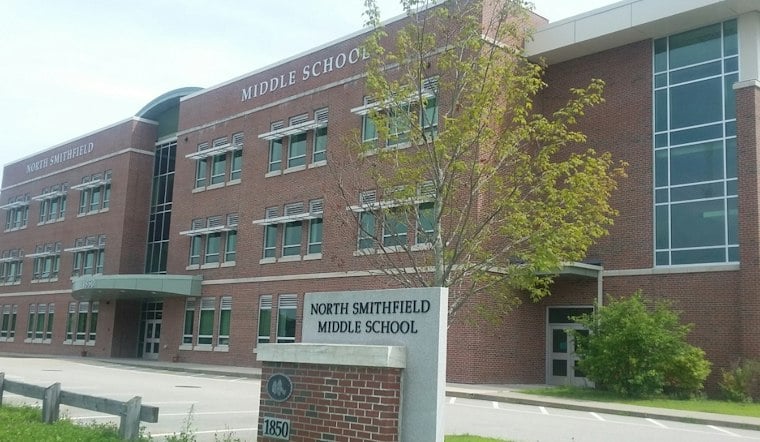
Terri Bartomioli wants North Smithfield kids putting down their Chromebooks and picking up books, pencils and each other's company instead. The current School Committee member, now running for another term, says she already helped make that happen for hundreds of students in grades 3 through 8, who she says no longer bring district-issued Chromebooks home.
Bartomioli, a candidate for the North Smithfield School Committee, told The Valley Breeze that she spearheaded the reduction of student screen time over the past year, resulting in take-home Chromebooks no longer being issued to students in grades 3-8. The change concerns take-home Chromebook access for students in those grades.
Bartomioli's case against heavy classroom screen use centers on what she describes as cognitive and attention costs for young learners. She said numerous studies have shown significant negative impacts on cognitive development and literacy when students type or read on screens instead of using paper and pencil, and she argued that children also have shorter attention spans and difficulty focusing on quiet activities as a result.
What Bartomioli Says She Wants Instead
Rather than screens, Bartomioli said she wants children to read books, write stories by hand, learn from both failures and wins, discuss ideas with classmates and teachers, solve problems together, practice patience with others, and experience boredom as a path to creativity. She said she does not believe learning from screens in elementary or middle school is the appropriate way to a better education. The School Committee, on which Bartomioli has served since being elected in December 2022, meets.
A Broader Pullback on Classroom Devices
North Smithfield is not alone in rethinking how much screen time belongs in elementary and middle school classrooms. Public school districts across the Philadelphia region are placing more limits on technology use, according to The Philadelphia Inquirer, which reported that the Tredyffrin/Easttown School District has stopped assigning iPads to kindergartners and that elementary students there will no longer take tablets home. The Phoenixville Area School District has gone further, ending its one-to-one device program for kindergarten through third grade entirely, while the Colonial School District now caps screen time at 20 to 30 minutes for its youngest students and up to three hours for grades six through 12, per the same report.
The trend extends well beyond Pennsylvania. In Virginia, Chesterfield and Henrico school districts adopted new policies this year limiting how much time their youngest students spend on school-issued Chromebooks and iPads, according to Axios. Those policies call for elementary device use to be selective and intentional, used only to enhance traditional teaching rather than serve as the primary method, and Chesterfield's K-2 students will no longer take Chromebooks home at all under the new rules. Henrico's digital wellness guide similarly calls for no digital homework for K-5 students and for devices to stay at school, with recommended daily screen-time targets ranging from just 15 minutes for pre-K students up to 90 minutes for grades 3-5.
Even California's Largest Districts Are Pulling Back
Los Angeles Unified, the country's second-largest school district, banned student digital devices in early education through first-grade classrooms starting this fall and put strict minute caps on older students' screen time, according to KQED. The district also rolled back its one-to-one device program so that issuing students personal tablets or laptops is no longer the automatic default. KQED notes that one-to-one device programs still exist in 88% of public schools nationwide, even as standardized reading scores were lower in 2025 than in 2015 in 83% of U.S. school districts, with math scores down in 70%.
In Pennsylvania's Canon-McMillan School District, officials are eliminating regular access to school-issued laptops and tablets for grades K-2 and limiting Chromebook access for grades 3-8 to shared carts that stay at school, as detailed by Education Week. District leadership there said kids learn best when they are looking at things on actual paper, not on a forever-scrolling space, though the superintendent was careful to frame the change as a rebalancing rather than an outright ban, telling the outlet it is not meant to remove technology from classrooms altogether.
What the Research Actually Shows
The science behind these policy shifts is still developing. Education Week has reported that early exposure to electronic devices may affect children's ability to engage with and understand what they read, though the outlet cautioned that the findings to date, though limited, create cause for concern rather than settled proof. Researchers cited in that reporting found that children with higher reported screen-time engagement showed lower connectivity between brain regions involved in reading and cognition, while time spent reading was positively correlated with that same connectivity.
Neurobiologist Tzipi Horowitz-Kraus, cited in the Education Week piece, said what researchers and society really need is a longitudinal study tracking children's screen exposure and what they actually do on screens from birth through age 18 — a gap that current research has not closed. Separate findings referenced in the same reporting show that both young children and college-age students seem to remember fewer concrete details when reading online text compared to reading on paper, a pattern echoed in a meta-analysis that reviewed 39 studies involving 1,812 children comparing story comprehension and vocabulary learning on paper versus on-screen.



