

























































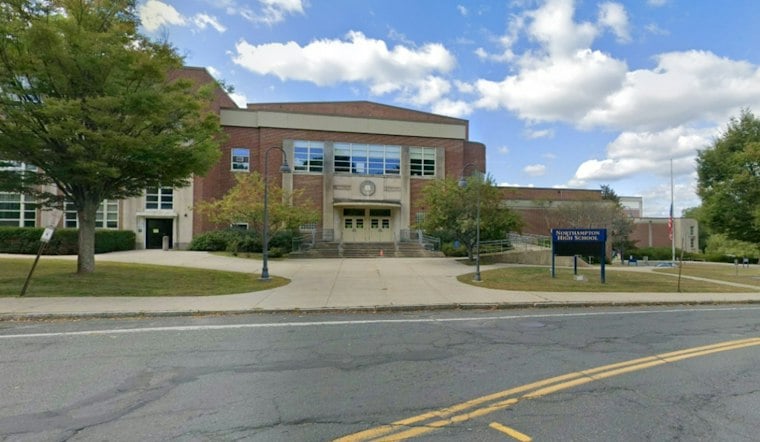
Northampton officials gathered outside Northampton High School on Oct. 15 to break ground on an $11.6 million geothermal heating and cooling system, one that will reach 850 feet beneath the school's parking lot to replace chillers and boilers that are already past or nearing the end of their useful lives. The project swaps out the building's conventional heating and cooling for a ground-source heat pump, using water circulated through pipes sunk deep into the earth.
According to The Reminder, Mayor Gina-Louise Sciarra told the crowd that, “by this time next year, we will have cut our carbon emissions by more than half at high school.” The high school alone accounts for roughly 10% of Northampton's total carbon emissions, per the same outlet, which makes the building an outsized target for the city's broader climate goals. As reported by the Daily Hampshire Gazette, Sciarra described the project as having the lowest life cycle cost and best return on investment among the options the city considered, and said it's funded through a mix of stabilization funds, utility incentives, grant funding, tax incentives and borrowing.
Savings Baked Into the Contract
The Reminder's report notes the project carries a guaranteed maximum price that cannot inflate, alongside contractually guaranteed annual operating savings. Earlier estimates cited in the same report projected the system would cut the building's total energy use by 68%, trim energy costs by 17%, and reduce maintenance costs by up to 50%. Sciarra said the new system is expected to last at least 100 years, and the city intends to keep pushing toward zero emissions as the electric grid gets cleaner and Northampton continues investing in renewable energy.
Ben Weil, Northampton's director of climate action and project administration, has described ground-source heat pumps as the most efficient way to provide heating and cooling, and said the system is expected to save approximately 4.7 billion British Thermal Units of energy annually while shaving roughly $39,000 off yearly energy costs. The Gazette's earlier coverage, citing the project at roughly $11.16 million, reported similar figures: projected savings of $39,000 in annual utility costs and the same 4.7 billion BTU reduction, or about 68% of the school's energy use. The Reminder's groundbreaking coverage pegged the overall project at $11.6 million, compared with the Gazette's earlier figure of roughly $11.16 million.
Who's Building It, and Who's Paying
Construction is being handled by Brightcore Energy Services, according to WWLP. The Daily Hampshire Gazette describes Brightcore Energy Services, based in Armonk, New York, as a company specializing in clean energy projects for large institutions. Northampton finalized its contract with Brightcore in August 2026. The project also received a $4 million boost through the Mass. Clean Energy Center's Green School Works program, per The Reminder's report. Jamie Scott, climate policy and program manager for the Massachusetts Clean Energy Center, said the funding helps create more comfortable learning environments in schools.
Sara Ross, who co-founded the nonprofit UndauntedK12, a partner in the project, called Northampton Public Schools a leader in efficient and environmentally friendly infrastructure, and said the project is eligible to claim federal energy tax credits. Construction is expected to be completed sometime in 2027, though the dossier does not offer a more specific completion date.
Part of a Statewide Push
Northampton's project fits into a larger pattern across Massachusetts, where roughly 1,800 public school buildings are responsible for about 880,000 metric tons of carbon every year, according to the Massachusetts Clean Energy Center. The state's School Building Authority reports that twelve Massachusetts schools with geothermal systems have already been completed, per the Massachusetts School Building Authority. Fifteen additional school districts have been invited to develop heat-pump retrofit projects that would substantially electrify HVAC systems across 25 buildings covering more than 2.8 million square feet, serving over 13,400 students, according to UndauntedK12.
Nearby, Hopkins Academy in Hadley is considering a similar upgrade, weighing whether to replace its aging oil-burning heating system with a ground-source heat pump that could lower annual energy consumption from 4,851 MMBtu to 1,500 MMBtu and cut greenhouse gas emissions from 338 metric tons to 71 metric tons per year, according to a case study from Harvard's Center for Climate, Health, and the Global Environment. For context on project scale, the Gazette has reported that Smith College's own geothermal renovation was estimated to cost more than $220 million, while the proposed Hopkins Academy project carried a $9.5 million estimate. Northampton's $11.6 million investment falls between those two project estimates.





