

























































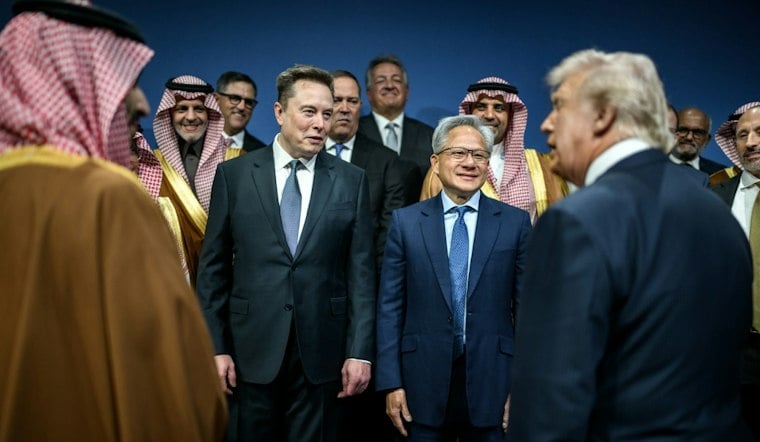
A Singapore-based executive identified as Alice Huang, also known as Huang Le, allegedly had a close professional and social relationship with Nvidia CEO Jensen Huang while secretly funneling commercial information to Beijing, according to a new report. U.S. officials reportedly determined that Alice Huang, who has no family relation to the Nvidia chief, was acting as a Chinese intelligence asset even as she rose to become a top executive at the Nvidia customer and cloud partner Megaspeed.
According to the New York Post, which has sought comment from the White House and Megaspeed, American officials placed Alice Huang under secret electronic surveillance after she was previously suspected of smuggling Nvidia chips to China. That surveillance reportedly identified Jensen Huang as one of her contacts and, per Yahoo News, unveiled her close professional and social relationship with him. The Guardian reports that officials have determined she was passing commercial information to Beijing, and that she had previously been suspected of smuggling Nvidia chips to China, prompting American officials to surveil and monitor her, as detailed by The Guardian.
Photographs reportedly show the pair together on multiple occasions in Taiwan. Alice Huang and Jensen Huang were photographed drinking whiskey at a Taipei bar in June 2024, and the two were seen together again in May 2025 following a business dinner with AI suppliers, according to the dossier's sourcing. Tom's Hardware reports she was photographed sitting beside Jensen Huang alongside other executives in an informal event around Computex 2024, and that around the same time as Computex 2025, she was once again seen with him leaving a restaurant in Taipei. The outlet's reporting does not establish what information Alice Huang allegedly passed to Chinese authorities or its value, nor does it address whether the relationship was romantic.
Nvidia Pushes Back on the Allegations
Nvidia has strongly disputed any suggestion of wrongdoing tied to the relationship or to Megaspeed's business. A company spokesperson said Jensen Huang's interactions with Alice Huang were not unusual or unexpected, noting that the Nvidia CEO talks with thousands of customer executives every year. The company told Tom's Hardware that its regional cloud customers receive ordinary business information — not sensitive Nvidia trade secrets — and zero information relevant to national security.
Nvidia described Megaspeed as a typical regional cloud customer and said it had conducted an inquiry without finding any reason to believe its products had been diverted. The company has said it receives government updates about potentially problematic individuals and companies and takes appropriate action in response. Nvidia has also argued that China has blocked American AI chips outright rather than sought them through regional cloud providers like Megaspeed — a framing that reflects the company's own position on the dispute.
Megaspeed's Role in the US-China Chip Pipeline
Megaspeed, based in Singapore, provides AI computing power to Chinese companies including Alibaba by renting out capacity from Southeast Asian data centers. The firm reportedly committed to buying roughly $2 billion worth of Nvidia chips, according to The Straits Times, and purchases Nvidia hardware through the U.S. arm of Inspur — whose parent company was blacklisted by Washington for funneling technology to China's military, even though the American subsidiary itself remains free of sanctions.
Both Singapore and U.S. authorities have Megaspeed under investigation. Singapore officials have said investigations are ongoing into Megaspeed for suspected breaches of domestic law, while the U.S. Commerce Department is separately probing possible export-control evasion, according to CNBC. CNBC's reporting also notes that Megaspeed's chips turned up in data centers in Malaysia and Indonesia that appeared to be remotely serving customers in China. The U.S. government has reportedly been investigating Megaspeed since 2024.
The Political Backdrop in Washington
The intelligence findings reportedly reached the highest levels of government well before becoming public. President Trump was briefed on the findings roughly a year before this report's publication but chose not to act on them, reportedly wary of disrupting Nvidia's chip sales and complicating trade relations with China. Some senior Trump administration officials have since expressed doubt that Jensen Huang could have remained unaware of Alice Huang's alleged intelligence-gathering role, though it remains unclear whether officials have changed or updated their assessment of his awareness.
Jensen Huang has cultivated close ties with the president, attending a high-dollar donors' dinner at Mar-a-Lago with his wife, Lori Mills Huang — whom he met while studying electrical engineering at Oregon State University. The couple's two children, Spencer and Madison, both work at Nvidia. Huang has reportedly lobbied Trump to allow continued chip sales to Beijing and pressed the administration to loosen restrictions on AI exports to China, while Nvidia has donated at least $20 million to Trump's White House ballroom fund and pledged $500 billion in U.S. manufacturing investment.
China Rejects the Spy Characterization
Beijing has firmly denied the allegations. The Chinese embassy in Washington called them groundless smears and slanders, while spokesperson Liu Chang called them groundless smears.
A Broader Fight Over Chip Access
The episode lands amid a wider U.S. effort to close what officials see as a loophole: Chinese firms renting Nvidia computing power remotely through third-country data centers rather than physically importing banned chips. The Commerce Department has reportedly been drafting a rule targeting that remote access, according to Forbes, though the outlet notes the agency likely lacks clear legal authority to do so. A related bill, the Remote Access Security Act, passed the House 369–22 in January but has since stalled in the Senate Banking Committee.
Nvidia has also tightened its own compliance, reportedly dropping more than half of its existing Asian customers from its approved-buyer list and sending employees to visit customer data centers in person to verify facilities and end users. Forbes reports that China's response to the squeeze on compute access has emphasized efficient, open-source models rather than chasing more chips, even as its Ministry of Commerce consults domestic firms like Alibaba, ByteDance and Zhipu about restricting exports of AI model weights and chip designs.
Nvidia's chips remain the backbone of the broader artificial intelligence boom even as the U.S. government has banned it from selling its most advanced chips to Chinese companies for years. Enforcement actions elsewhere underscore the stakes: Taiwanese prosecutors have indicted nine people, including an Nvidia employee, over servers falsely declared for use in Taiwan, 74 of which reached China before the rest were intercepted, while California prosecutors separately charged operators of ALX Solutions with buying more than 200 H100 GPUs using fictitious end customers in Singapore and Japan.




