

























































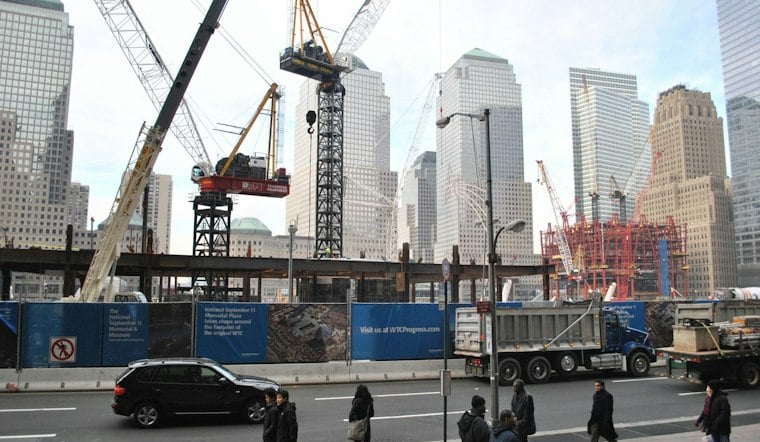
New York City's construction industry is bracing for a record-setting run, with spending projected to climb to $79.8 billion in 2026 — a $10 billion jump from 2025 once adjusted for inflation. The forecast comes from the New York Building Congress's newly released 2026-2028 outlook, which points to housing construction as the primary engine behind the growth spurt.
The figures, laid out in the group's 26th annual outlook report, were detailed by New York Real Estate Journal, which covers the New York Building Congress's full three-year projection. Spending is expected to keep climbing after 2026, reaching $81 billion in 2027 and $82 billion in 2028, for a combined $242.9 billion in inflation-adjusted spending over the three-year stretch — a 16% increase over the prior three-year period, according to the outlook.
Carlo Scissura, president and CEO of the Building Congress, framed the numbers as evidence of real momentum in the industry but cautioned that the gains aren't guaranteed to hold. “To keep New York building, we need to cut through red tape, invest in our workforce, and secure the federal funding our infrastructure depends on,” Scissura said, according to the outlet's report.
Housing Permits Expected to Rise About 59% From 2025
Housing is doing much of the heavy lifting in the new forecast. Building permits are projected for 31,442 new housing units in 2026, up sharply from the 19,724 units permitted in 2025, per the report cited by New York Real Estate Journal. That pace is expected to keep accelerating, with permits projected for 32,803 units in 2027 and 34,904 units in 2028.
Residential construction spending is expected to reach nearly $27 billion in 2026, accounting for 34% of all construction spending citywide — up from 30% in 2025, the outlet reports. Over the full three-year window, inflation-adjusted residential spending is projected to outpace the previous three-year period by 64%, a swing the Building Congress attributes partly to policy shifts reshaping where and how fast housing can get built. Large-scale rezonings, the City of Yes for Housing Opportunity initiative, and office-to-residential conversions are all cited as factors accelerating housing production, according to the report.
That housing-driven momentum tracks with what developers were already doing on the ground earlier this year. In the first quarter of 2026, developers filed permits for 21.2 million square feet across 577 new projects — a 74% year-over-year jump, according to Bisnow. Multifamily projects made up nearly half of those proposed buildings, with permits filed for more than 16,800 units across 281 developments, the outlet reported. Fourteen large projects with more than 150 units apiece are set to deliver nearly 5,500 units combined, 28% above the historical average recorded since 2008, per the same Bisnow analysis — though the publication cautioned that the quarter's filing data is not yet proof of a sustained return to record construction highs.
Jobs and Floorspace Also on the Rise
The employment picture is brightening too. Private construction employment is expected to reach 142,855 jobs in 2026, an increase of more than 2,700 jobs from 2025, New York Real Estate Journal reports, with continued modest growth projected through 2028. New construction floorspace is projected to exceed 57 million gross square feet in 2026, and government construction spending is projected to total $23.8 billion that same year.
Transit investment is layered into the broader picture as well. The MTA is expected to invest approximately $27 billion within the five boroughs from 2026 through 2028, according to the Building Congress figures reported by New York Real Estate Journal. That spending sits alongside the agency's separately proposed 2025-2029 capital plan, a $68.4 billion investment covering the region's subways, buses, railroads, bridges and tunnels that the Metropolitan Transportation Authority says devotes more than 90% of its funding to bringing the system to a state of good repair, including at least 60 additional stations slated to become ADA-accessible.
Earlier Forecasts Used a Different Basis
The group's 2025-2027 report had forecast New York City construction spending reaching $74 billion by the end of 2025 and projected total spending rising from $73 billion in 2026 to $83 billion in 2027. The prior outlook's 2026 figure was nominal, while the newly released $79.8 billion estimate is inflation-adjusted, according to the New York Building Congress. That earlier outlook had also projected nominal residential investment of $31 billion in 2026 and $38 billion in 2027, along with private-sector employment holding at 140,000 jobs in both years and floorspace reaching 55 million square feet in 2026 and 66 million in 2027.
New York City's construction sector has seen plenty of volatility in recent years to explain the recalibrated projections. Spending in the city reached a record $68.2 billion in 2023, while government construction spending hit its own record of $28.1 billion in 2024, according to a report from cicbca.org. That same report noted the number of construction businesses in the city fell 3%, or 479 firms, in 2024 — a reminder that the industry's growth hasn't been uniform even as overall dollar figures climbed.


