

























































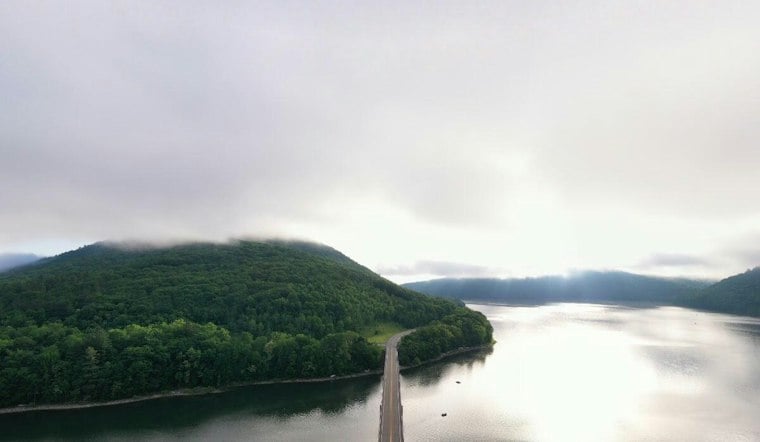
New York City's third-largest source of drinking water could soon get a whole lot bigger. The Delaware River Basin Commission and the city's Department of Environmental Protection are evaluating whether to raise the dam at Cannonsville Reservoir by eight feet, a move that would add 13 billion gallons of storage and expand the reservoir's footprint by roughly 760 acres.
The proposal is one of four options under review as part of a broader push to find new ways to store water across the Delaware River Basin, which supplies drinking water to New York, Delaware, Pennsylvania and New Jersey, according to Gothamist. The commission manages a 13,539-square-mile watershed, and New York City is the basin's largest single water consumer, drawing about half its drinking water from the system. Cannonsville is especially attractive to planners because it is a gravity-based storage facility with existing infrastructure already in place, as Radio Catskill reported.
At full capacity, Cannonsville holds 95.7 billion gallons, making it the newest and largest reservoir built for the city's water system and one of four reservoirs in its Delaware watershed network, which also includes Pepacton and Neversink, both owned by New York City. The Delaware Aqueduct carries water from Cannonsville into the five boroughs, but that tunnel leaks an estimated 35 million gallons a day, a long-running problem that has shaped the city's recent water-supply decisions.
A Drought That Forced the City's Hand
The push to expand Cannonsville follows a rough stretch for the region's water supply. New York City declared its first drought warning in more than 20 years in 2024, and the station's report notes that citywide reservoir levels, which normally sit in the mid-70s to low 80s percent range, fell to roughly 60 percent that year. Cannonsville itself hit a record low of 3.4 percent capacity more than two decades ago, a benchmark officials are keenly aware of as they plan for the future.
The 2024 drought was severe enough that the city delayed a planned $2 billion repair project on the Delaware Aqueduct, halting a shutdown after sudden drought conditions developed, per Radio Catskill. That repair work isn't canceled, just pushed back — New York City still plans to take the aqueduct offline for six to nine months in 2031-32 to finish connecting a bypass tunnel. Making matters more urgent, Radio Catskill's reporting found that from June 2024 through June 2026, 18 of the 24 months saw significantly less precipitation than historical averages.
Why Sea-Level Rise Is Part of the Equation
Drought isn't the only threat regulators are weighing. The commission is also evaluating increasing the basin's roughly 96-billion-gallon water supply to prepare for future flooding and saltwater creeping into drinking-water intakes as sea levels climb, according to Gothamist. Sea level near Philadelphia rose 6.7 millimeters a year between 2000 and 2023, more than double the long-term rate, per Inside Climate News.
That matters because the commission's existing strategy — releasing water from upstream reservoirs to push back encroaching saltwater — may not hold up as seas keep rising and droughts become more frequent, Inside Climate News reported. The outlet notes the commission projects that a one-meter rise in sea level would push the salt front to River Mile 104.4, leaving it just six miles from drinking-water intakes. Kristen Bowman Kavanagh, speaking on the commission's planning, said dry conditions in the basin can develop and shift quickly, and that officials need to understand how climate change and sea-level rise could reshape the region's water future, according to Gothamist.
Not the First Time Expansion Has Been Floated
New York actually considered enlarging Cannonsville back in the 1980s, an idea that was eventually shelved amid community pushback along with financial and environmental concerns, Radio Catskill reported. A 1986 state study at the time found the expansion technically feasible but flagged those same financial and environmental hurdles as major obstacles. Bowman Kavanagh noted that reservoir projects like this typically take decades to materialize because of engineering, social, economic, safety and flood-related considerations, per the same account.
The current effort traces back to 2020, when the commission began weighing climate change, sustainability and resilience more directly in its freshwater planning and studied more than 2,500 potential water-storage options. By 2023, that list had been narrowed to 14 candidates — a mix of 12 quarries and two reservoirs — before settling on the current shortlist of four: three quarries in Pennsylvania and New Jersey, plus the Cannonsville expansion, according to Delaware Currents. The quarry options, which include sites at Penns Park, Evansville and Moores Station/Trap Rock, would need water pumped in and out since their narrow shape wouldn't let them fill like a conventional reservoir, Delaware Currents reported.
What Happens Next
The commission has agreed to contract with engineering firm Mott MacDonald to study all four projects, examining facilities, land ownership, operations, geology, structural issues, environmental restrictions, permitting and costs, per Radio Catskill's reporting. For Cannonsville specifically, Gothamist reports the commission is conducting an 18-month feasibility study covering potential volume, cost, necessary permitting, hydrology and geology, with the DRBC and city DEP working to finalize an intergovernmental agreement before the study can formally begin.
That work could start as early as late 2026 or early 2027 and wrap up by June 2028, according to Radio Catskill. Robert Wolejsza wrote that the feasibility study is part of a broader effort to identify additional water storage across the Delaware Basin, Gothamist reported, with officials framing extra capacity as a way to support river ecology and basin communities during extreme drought. Any expansion would also require some roads around the reservoir to be elevated or relocated to accommodate the larger footprint, Radio Catskill noted — though whether the project ultimately moves forward remains far from settled.





