

























































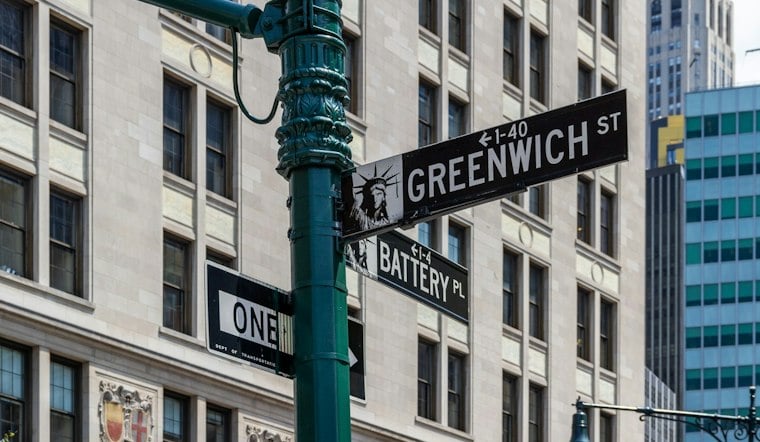
The Financial District could see some of its streets closed to private cars for good, as the Mamdani administration looks for ways to stop government workers and other drivers from abusing parking placards throughout the historic downtown core. A senior city transportation official says the agency is actively studying the neighborhood's parking problem, with both street closures and automated camera enforcement on the table.
Eric Beaton, the Department of Transportation's deputy commissioner for transportation planning and management, said the agency is studying the problem and weighing a mix of fixes, according to Streetsblog New York City. “Some of it is going to be about technology,” Beaton said, suggesting FiDi's parking system needs active management and may ultimately require banning vehicles outright from certain blocks. Beaton made the remarks while speaking at Transportation Alternatives' Vision Zero Cities conference on October 28.
A Placard Problem the City Can't Police Itself
Much of the dysfunction, Beaton said, traces back to the city's own workforce. Drivers use real or fake parking placards to park for free throughout the Financial District, and government employees parking both government and private vehicles with placards have made the area especially hard to manage. “There's a tremendous amount of parking by government vehicles,” Beaton said, describing an enforcement challenge the city has yet to solve.
Officials previously tried handing enforcement duties to the NYPD's Internal Affairs Bureau, the unit tasked with policing other officers, but according to the same report, that effort stalled because the bureau had little appetite for scrutinizing fellow city workers. “They didn't even want to get into this,” Beaton said of the assignment.
Why Cameras Appeal to DOT
Beaton framed automated enforcement as a way to sidestep that dynamic entirely. Unlike a human officer who might be talked out of writing a ticket, a camera doesn't negotiate. “There's no discretion,” Beaton said, arguing that removing an officer's judgment call could create more consistent traffic management in a congested area like FiDi. He said the broader goal is to move the agency away from in-person monitoring and toward enforcement, data collection, or general street management handled by technology instead of personnel.
That ambition runs into a legal wall, however. New York State law constrains how the city can deploy automated systems for parking, speeding, and red-light violations, limiting how far DOT can go without state lawmakers' sign-off, per the agency's own account relayed to the outlet.
A Neighborhood Built for Walking, Not Driving
The push for restrictions isn't new. Plans to limit cars in the Financial District date back to the 1960s, and advocates, business groups, lawmakers, and urban planning experts have pushed for decades to limit or ban vehicles in the area, Streetsblog reports. Mayor Zohran Mamdani himself said during his campaign that he wanted to reclaim space for pedestrianization in and around Times Square and the Financial District.
The numbers back up the case for change. Nearly nine in ten people who work in FiDi walk or take transit to get there, and only 12 percent of neighborhood households have access to a car, according to the same Streetsblog report. The district also has direct access to nearly all New York City subway lines, PATH trains, the Staten Island Ferry, and NYC Ferry, along with many express buses serving downtown from the outer boroughs — yet it still functions with largely unfettered car access on its streets.
Catherine Hughes, a member of the Financial District Neighborhood Association, has urged the city to take action. Downtown residents and her association have pressed the city to convert most local roads east of Broadway and south of the Brooklyn Bridge into pedestrian-priority streets with 5-mile-per-hour speed limits, Streetsblog reports.
Empty Storefronts Add Urgency
The area's retail struggles add another layer to the debate. A city comptroller's report found FiDi had a 21 percent storefront vacancy rate, the highest in New York City — a finding the Comptroller's office separately described as nearly one in four storefronts, or 21.1 percent, sitting vacant in the Financial District–Battery Park City area. Streetsblog notes the neighborhood has the city's highest pedestrian traffic alongside its highest retail vacancy rate, a combination that has fueled arguments for reclaiming street space from cars.
Placard Abuse Tied to Dangerous Driving Citywide
The placard issue extends well beyond FiDi's borders. A separate Streetsblog analysis found that vehicles with city-issued nonprofit parking placards were 88 percent more likely than vehicles with any speed-camera violations generally to rack up at least 16 school-zone speed-camera violations over a recent 12-month stretch. DOT has found that vehicles hitting that 16-violation threshold are twice as likely to be involved in a crash resulting in death or serious injury, and the same analysis identified 101 placarded vehicles that exceeded 16 speed-camera violations during the study period.
How Other Cities Are Testing Camera Enforcement
New York isn't alone in experimenting with automated curb management. On the Upper West Side, the company Automotus recently wrapped a six-month pilot using two AI-powered CurbSight cameras along Broadway between West 74th and 75th streets, as reported by West Side Rag. No tickets or fines were issued during that trial, since the city does not yet have authorization to implement the technology beyond data collection, pending state legislation. DOT separately piloted 12 computer-vision sensors from VivaCity in 2023 and expanded the program to 80 additional locations in June, according to the same outlet, while a case study of Automotus smart loading zones in Fort Lee, New Jersey, reported a 43 percent decline in double-parking after automated billing began.
Chicago offers another model. Its Smart Streets pilot uses cameras mounted on city vehicles and CTA buses to automatically ticket drivers blocking bus and bike lanes, according to Block Club Chicago. Since 2024, the program has issued more than 140,000 citations, though 75 percent were warnings rather than fines, and city officials estimate an expanded version could generate roughly $6.1 million in net revenue in 2027.
Whether New York follows a similar path for FiDi remains an open question tied to Albany's willingness to loosen state restrictions on automated enforcement. For now, Beaton's comments mark the clearest signal yet that the Mamdani administration is treating the Financial District's car problem as a priority worth solving, even if the specific streets, timeline, and technology have yet to be decided.





