

























































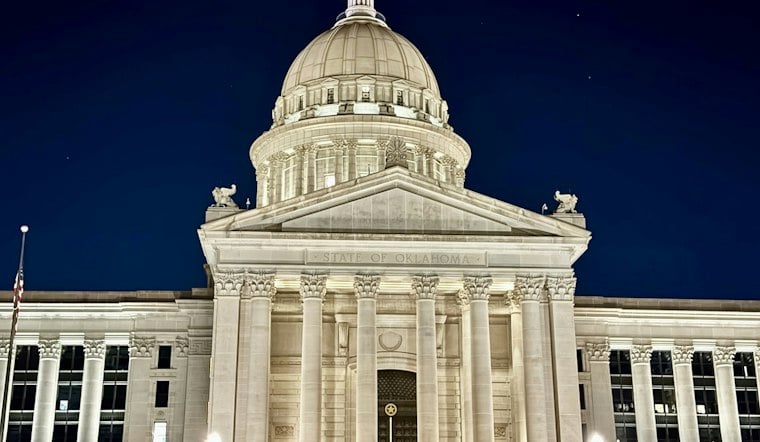
With three weeks until Election Day, a new Cross Timbers Poll puts Republican Mike Mazzei at 39% and Democrat Cyndi Munson at 36% among likely voters. The narrow difference is smaller than the survey’s uncertainty, while results among registered voters show a large share still undecided. The poll offers a snapshot of a contest that has not yet produced a clear leader.
A Tightening Race With a Lot of Undecideds
The Cross Timbers Poll, conducted Oct. 7-12, found Mazzei at 33% and Munson at 30% among registered voters, according to The Journal Record. Another 32% of registered voters were undecided, compared with 27% in the survey two weeks earlier. These registered-voter figures are distinct from the poll’s likely-voter results, and the change between surveys does not by itself establish a trend.
When the poll asked undecided likely voters which candidate they leaned toward, Mazzei led Munson 50% to 40%. Among the broader pool of likely voters, other respondents backed independent candidates Orlando Lynn Bush, Robert E. Brooks Sr. and Jerry Griffin, or remained undecided, the survey found.
Party Loyalty Looks Lopsided
The survey also points to differences in how firmly each party’s voters have chosen a nominee. Across the two Cross Timbers polls combined, 87% of registered Democrats backed Munson, while 55% of registered Republicans backed Mazzei; 31% of Republicans remained undecided, according to the poll. Those figures suggest Mazzei has not yet secured the same level of support among Republicans that Munson has among Democrats.
The poll’s authors said undecided Republicans tend to lean toward Mazzei and often say they are not yet paying attention to the race. That finding indicates possible room for movement, but it does not establish how those voters will ultimately vote. The survey’s broad uncertainty also cautions against treating the candidates’ current percentages as a settled outcome.
A Small Sample With Wide Margins
The survey included 128 registered voters recruited through the Prolific opt-in panel, short of its planned 250 responses, and was weighted to party registration and the 2024 presidential vote, according to The Journal Record. The reported credibility intervals are plus or minus 12 points for registered voters and plus or minus 15 points for likely voters. Cross Timbers Poll describes itself as a nonpartisan, member-funded project that accepts no money from candidates, campaigns or parties.
Those intervals are central to interpreting the close topline results: the poll does not distinguish a clear leader. The Cook Political Report has said Mazzei will be favored against Munson, while noting that national Democrats remain bullish on her candidacy. Mazzei advanced to the general election after defeating Oklahoma Attorney General Gentner Drummond in the Aug. 25 GOP primary runoff, per Cook Political Report.
Stitt and Trump Numbers Offer Context
The same poll found Gov. Kevin Stitt’s job performance underwater: 32% of registered voters approved and 55% disapproved. A separate Tulsa World report from 2024 cited a Morning Consult survey that put Stitt’s net approval at plus-13, roughly the middle of the pack nationally, but that older figure is not a current benchmark, according to Tulsa World.
President Donald Trump's approval among those surveyed stood at 41%, with 58% disapproving — notably lower than the Civiqs daily tracker's Oklahoma figures of 47% approval and 44% disapproval, the poll noted. Mazzei and Munson are the Republican and Democratic nominees in the race, running alongside three independent candidates ahead of the Nov. 3 election, according to News on 6.
Registration figures and an open-seat precedent
The poll’s candidate-preference percentages are not statewide party-registration totals. The Oklahoma State Election Board reports voter-registration statistics by county and political affiliation on Jan. 15 and Nov. 1 each year; the poll does not supply October totals or a multi-year registration comparison, according to the Oklahoma State Election Board. A past open-seat contest offers historical context: in 2010, Gov. Brad Henry was stepping down after two four-year terms because of term limits, and Mary Fallin defeated Jari Askins, The New York Times reported. That result is a precedent, not a guide to the outcome of the 2026 race, according to The New York Times.





