

























































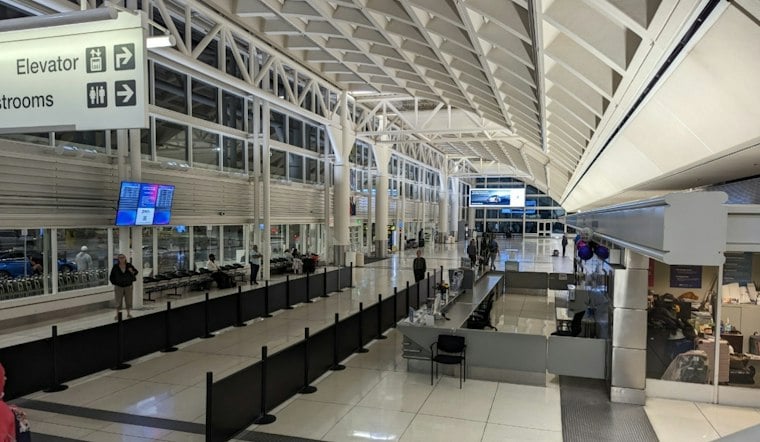
Ontario International Airport’s return to local control will reach its 10-year mark in 2026. The transfer ended a dispute that had stretched across years; the airport itself has a much longer history, beginning with an aviation venture founded in 1923. Its story also extends beyond aviation: ONT has served as a location for productions including Argo and Ford v Ferrari.
From Orange Groves to an Aircraft Corporation
Aviation pioneers Waldo Waterman and Archie Mitchell established the Ontario Aircraft Corporation in 1923, according to flyontario.com. The airfield was first called Latimer Field, after an orange packing company beside the strip, the Daily Bulletin reports. In 1929, Ontario bought 30 acres in the southwest corner of today’s airport for $12,000, according to the paper.
World War II transformed the airfield into a military training ground. Ontario Municipal Airport was dedicated as an Army Air Corps P-38 training base and P-59 operating base, flyontario.com's history fact sheet notes. The airport added a new terminal building in 1950 and took delivery of its first airmail shipment that same year, the Daily Bulletin reports. By 1946, the airport had earned a new name entirely — Ontario International Airport — because transpacific cargo flights were originating from its runways, according to flyontario.com.
A Regional Airport Under Los Angeles Control
A 1967 joint powers agreement between Ontario and the Los Angeles City Department of Airports brought ONT into Los Angeles’ regional airport system, according to flyontario.com. Los Angeles took title in 1985. Ontario’s airport therefore remained under Los Angeles control for decades, the Daily Bulletin reports, even though ONT predates LAX by five years.
A major expansion opened in 1998: two terminals totaling about 530,000 square feet, with 26 gates and capacity for 10 million passengers a year, according to flyontario.com. The Daily Bulletin reports that the project finished four months early and $26 million under budget; the new terminals began serving passengers on September 27, 1998. Terminal 1, which had been built and modernized from the 1950s through the 1980s, closed to the public when the complex opened. A USO facility later opened there in 2006, the paper reports.
Passenger Declines Spark a Decade-Long Fight
By 2008, airport leaders had noticed what the Daily Bulletin calls unprecedented declines in passenger activity. The numbers back up the alarm: passenger loads fell 40 percent, from 7.2 million to 3.9 million annually, since 2007, according to CBS News. A separate flyontario.com figure put annual volume at 7 million in 2005, falling to 3.9 million by 2013 — different baseline years attributed to different sources, but both pointing toward the same steep drop. The airport was also renamed LA/Ontario International Airport in 2006, a change the Daily Bulletin says aimed to associate the airport with a familiar geographic destination and attract travelers from outside California.
In December 2010, Ontario’s City Council voted unanimously to direct staff to pursue regaining local control, including through litigation if needed, according to the Daily Bulletin’s 2015 coverage. Ontario offered $250 million for the airport in 2012; Los Angeles sought $474 million, the paper reported. After talks stalled, Ontario sued in Riverside Superior Court in 2013. A trial was scheduled to begin on August 17, 2015.
Settlement, Transfer and a Decade of Local Control
The lawsuit was settled before the scheduled trial. In August 2015, Los Angeles officials agreed to transfer the airport to the newly formed Ontario International Airport Authority in a $250 million deal, according to the Daily Bulletin. The transfer took effect November 1, 2016, after the Federal Aviation Administration issued an Airport Operating Certificate and the authority defeased $55.5 million in outstanding bonds issued by Los Angeles World Airports, according to flyontario.com’s announcement. The Daily Bulletin reported that the 10-year local-control milestone would arrive in 2026.
After the transfer, ONT added international and domestic service milestones. China Airlines began the airport’s first nonstop transpacific passenger service, from Taiwan Taoyuan International Airport, in March 2018, flyontario.com reports. Hawaiian Airlines returned in March 2021 with an inaugural Honolulu flight scheduled five times a week, according to the airport’s fact sheet. Passenger volume reached 5.5 million in 2019, its highest level in more than a decade. Earlier, an airport-authority-commissioned study had projected that passenger numbers could fall below 2 million by 2024 if trends from the lean years continued, CBS News reported. A traveler-information radio station also began broadcasting at 620 AM in November 2017, the Daily Bulletin reports.
Traffic, Freight and Regional Role
The latest figures offer a snapshot of ONT’s passenger and cargo activity: the Ontario International Airport Authority reported 7.1 million passengers in 2025, up 0.4% from 2024. The authority said total air cargo tonnage rose 5.3% that year, with mail shipments doubling while commercial freight declined 3.6%, according to its 2025 report. ONT is also part of a wider regional airport network. The Southern California Association of Governments’ regional commercial-airport map lists Ontario alongside Burbank, John Wayne, Long Beach, Los Angeles International and Palm Springs airports.
A Quiet Favorite for Hollywood Productions
ONT’s terminals have provided settings for airport scenes representing places around the world, the Daily Bulletin reports. For Ford v Ferrari, the airport’s former National Guard hangar was used as Carroll Shelby’s car-development shop. The 2019 film starred Matt Damon and Christian Bale, and the production also used a Boeing 727 kept at the airport for filming, according to the Daily Bulletin’s 2019 report. Crews also filmed at Fontana’s Auto Club Speedway and Cal Poly Pomona’s former Lanterman property to depict Daytona.
Other productions have used ONT to portray different airports. Steven Spielberg’s Catch Me If You Can, starring Tom Hanks and Leonardo DiCaprio, used it as Miami International Airport; Argo used it for an airport in Iran during a hostage-exit scene. The Redlands Community News reports that A League of Their Own and Up In The Air are among the other films shot at the airport. The Daily Bulletin has cited lower crowds and less traffic than at LAX as practical advantages for production crews.





