

























































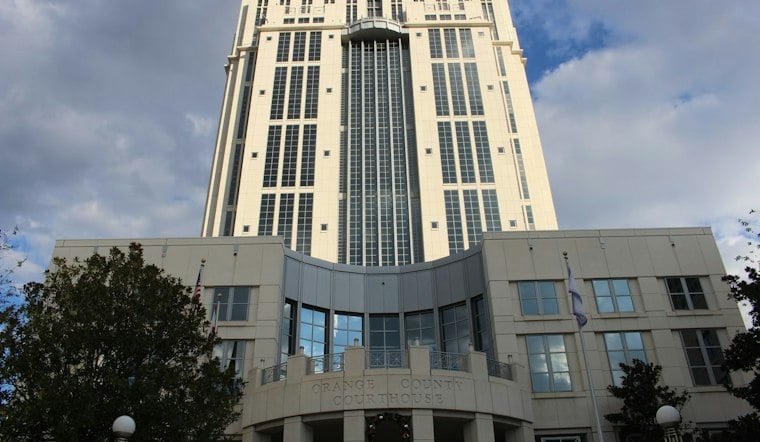
An Orange County jury's decision to convict a South Carolina native of filing a fraudulent $50 million lien against two circuit judges has ended with a 71.5-year sentence. Jareca T. Sumter, 38, stood before the court and declared her conviction unconstitutional, insisting she would not accept or comply with whatever sentence came next.
A $50 Million Claim Against the People Who Jailed Her
Sumter filed the fraudulent lien claim against the property of two Orange County circuit court judges, according to the Office of the State Attorney for the Ninth Judicial Circuit. A lien typically functions as a legal claim against property, forcing an owner to resolve the underlying debt before a sale or refinance can go through — a tool Sumter is accused of weaponizing against the judges rather than using it for any legitimate financial dispute. Prosecutors say she identified herself as an authorized representative of the entity Jareca Sumter when she carried out the scheme, and claimed she filed the lien after a judge had barred her from making further motions while she represented herself in a separate Orange County court case.
She was arrested in August 2025 after admitting to Orange County Sheriff's Agent Aaron Blankenship that she had filed the lien claim online through a state website and paid the filing fee with her own credit card, per the state attorney's office. A Central Florida jury convicted her in September of two counts of fraudulent use of personal identification information involving fraud exceeding $100,000, along with two counts of unlawful filing of false documents against real or personal property. According to the state attorney's office, the case was specially assigned to prosecutors Stacey Salmons, Domenick Leo and Jennie Hayes, with a Polk County circuit judge, Catherine Combee, presiding.
Consecutive Sentences Stack Into Decades
Prosecutors pushed for consecutive prison terms across all four counts, and Combee largely obliged. She handed down two consecutive 30-year sentences for the fraudulent use of personal identification information charges, a first-degree felony under Florida law. On top of that, Combee imposed two 11.5-year sentences for unlawful filing of false documents, a second-degree felony — those ran concurrently with each other but consecutively to the fraud terms, pushing the total to 71.5 years.
Sumter was credited with 295 days already spent in custody awaiting trial, the state attorney's office said. Combee also moved to shut down any repeat performance: she enjoined Sumter from filing any future documents without prior judicial review and approval, and declared the lien-related filings against the two judges null and void.
Defiant to the End
Before sentencing, Sumter repeatedly told the court her conviction was unconstitutional and that she would not accept or comply with any sentence the judge imposed, according to the state attorney's office. During questioning by investigators, she reportedly said, “the courthouse is a bank” — a phrase that echoes the kind of commercial-law theories the office says adherents of the so-called sovereign citizen movement use to justify their filings.
Such adherents generally believe the U.S. government and legal system were secretly replaced by an illegitimate, corporate-run government, and that public laws, criminal statutes and court jurisdictions amount to corporate contracts governed by the Uniform Commercial Code, per the state attorney's office. Believers think they can exploit loopholes in commercial law to erase personal debts or extort public officials for money, the office said — and the FBI reports that adherents often keep up the activity even after they are convicted and sent to prison.
What Florida Law Says About Fake Liens
Florida law makes it a crime to file an instrument — a term that covers judgments, mortgages, liens, financing statements, deeds, leases and notices of claim of lien — containing a materially false or fraudulent statement with intent to defraud or harass, according to the Florida Legislature. That conduct is normally a third-degree felony, but the statute bumps it up to a second-degree felony when the targeted property owner is a public officer or employee, as was the case with the two judges. Separately, state law classifies fraudulent use of personal identification information involving $100,000 or more as a first-degree felony carrying a mandatory minimum of 10 years in prison.
The statute also gives sentencing courts teeth beyond prison time: judges must declare a fraudulent instrument null and void and may bar the filer from submitting future instruments without judicial review, which is exactly the combination Combee applied in Sumter's case. West Orlando News covered the case as part of its crime coverage out of Orlando and Orange County.
Not an Isolated Tactic
Sumter's case fits a pattern federal prosecutors have pursued elsewhere involving sovereign-citizen defendants targeting judges and government officials with bogus paperwork. A federal jury in Omaha convicted a Pelham, Georgia, man in February 2025 on seven counts tied to conspiring to file and filing false liens against two U.S. District Court judges and other federal officials, according to the Department of Justice. In a separate Jacksonville case, a federal judge sentenced a defendant over a tax-fraud scheme that also involved filing a false lien and absconding while on bond, per the Department of Justice.





