

























































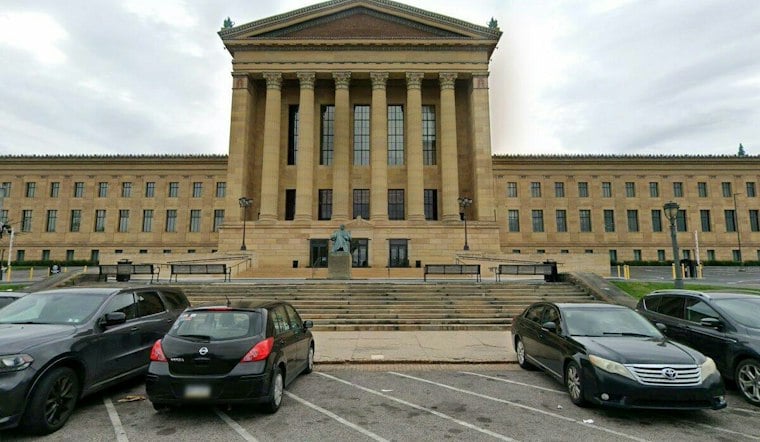
More than 300 works by Marcel Duchamp, from readymade urinals and bottle racks to his sprawling glass-and-wire masterwork, have taken over the Philadelphia Museum of Art, marking the first major U.S. retrospective devoted to the artist in more than 50 years. The exhibition opened to the public Saturday, October 10, 2026, and runs through January 31, 2027, inside the Main Building's Dorrance Galleries and Galleries 281 through 283.
The show arrives in Philadelphia fresh from a run at New York's Museum of Modern Art, where it was on view from April 12 through August 22, 2026, according to the Philadelphia Museum of Art. That MoMA presentation drew more than 611,000 visitors, making it the New York museum's highest-attended exhibition of 2026 to date, as reported by The New York Times. The retrospective is organized by the Museum of Modern Art and the Philadelphia Museum of Art with the Centre Pompidou's collaboration, per MoMA's press materials.
Philadelphia is a fitting final stop. The museum is home to the world's largest Duchamp collection, with a permanent display of 200 works and extensive archives, as the Inquirer reported. Tickets run $35 and include general museum admission, per the museum's exhibition page.
Readymades, a Nude on the Stairs, and a Glass Masterwork
The exhibition traces Duchamp's full career across painting, sculpture, film, photography, drawings and printed matter, spanning roughly six decades, according to MoMA. Visitors will find Nude Descending a Staircase (No. 2), the 1912 painting that scandalized American audiences, alongside Fountain, the artist's provocative readymade urinal. Readymades, the museum notes, were manufactured objects Duchamp purchased and only slightly altered before presenting them as art.
Also on view is The Bride Stripped Bare by Her Bachelors, Even, commonly known as The Large Glass, a work made between 1915 and 1923 that hangs in Galleries 281 through 283. The piece joins L.H.O.O.Q., Duchamp's altered reproduction of the Mona Lisa, and Box in a Valise, a 1935-41 portable museum containing miniature replicas of his own creations in miniature, according to the Philadelphia Museum of Art.
Curator Matthew Affron, the Muriel and Philip Berman Curator of Modern Art at the Philadelphia Museum of Art, said the chronological layout is meant to be disorienting by design. Visitors, he said, “are supposed to start getting a little bit dizzy.” Co-organizer Michelle Kuo, MoMA's chief curator-at-large and publisher, echoed that sense of estrangement, saying the chronology makes what seems normal become very strange.
Étant Donnés and a Secret Final Work
Perhaps the exhibition's most haunting inclusion is Étant donnés, a piece Duchamp created secretly toward the end of his life. Visitors experience the work by peering through two peepholes, with the piece also installed in Galleries 281 through 283 alongside The Large Glass.
The exhibition also traces Duchamp's playful alter ego, Rrose Sélavy, a female persona he created in the early 1920s. The artist Man Ray photographed Duchamp in costume as Rrose around 1920, according to The New Yorker. That same account notes the retrospective is the first of Duchamp's work to appear in North America since a 1973 exhibition at MoMA.
A Collection Rooted in Philadelphia History
Duchamp's ties to the Philadelphia Museum of Art run deep: he personally installed The Large Glass at the museum in 1954, cementing a relationship between the artist and the institution that now anchors this retrospective. The museum's current exhibition draws on that decades-long connection, pairing its own extensive holdings with loans that toured from MoMA.





