

























































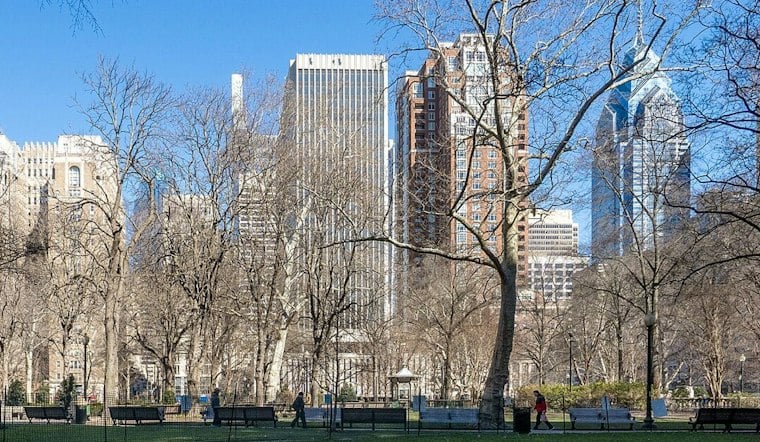
A bicycle protest planned for Rittenhouse Square called on six Jewish-owned Philadelphia businesses to shut down, with organizers scheduling the rally for the eve of the anniversary of Kristallnacht, the 1938 Nazi-led pogrom that devastated Jewish communities across Germany and Austria. Flyers for the event named Mac Mart, Dizengoff, Goldie, K'Far Cafe, Huda and Schlesinger's as targets, declaring that “these Zionist establishments must go.” The businesses' owners say they have no intention of closing or backing down.
The so-called Boycott Ride was organized by Philly Bike On Your Left alongside Philly Writers Against the War on Gaza, Boycott CookNSolo and the Philly Solidarity Calendar, according to the Philadelphia Jewish Exponent, which reported the ride was scheduled for Nov. 8 at Rittenhouse Square. Organizers told City & State Pennsylvania that the targeted eateries were chosen for their biking proximity to Rittenhouse Square, effectively mapping a route past Jewish-owned storefronts. The New York Post reported that boycott organizers described the campaign as a way to show Jewish business owners they were viewed as disgusting.
Business Owners Say They Won't Be Driven Out
Mac Mart co-owner Marti Lieberman, 37, told Jewish Insider she was stunned to learn her business had been singled out, saying the antisemitic messaging was scary. Per the New York Post, Lieberman said her business has no connection to Israel or Judaism and suspects protesters assumed she supported Israel simply because she wears a Star of David necklace openly. Despite the pressure, Lieberman told the outlet, “I refuse not to wear my Magen David.”
Huda Burger co-founder Yehuda Sichel, 40, said the protest and boycott recalled the horrors his Jewish grandparents experienced, according to the New York Post. As the grandson of Holocaust survivors, Sichel said boycotts of Jewish-owned businesses were painfully familiar to him, adding that his business would not be intimidated and had received strong community support. Allan Domb, whose Center City Jewish deli Schlesinger's was among the named businesses, said it had been singled out for harassment, the same City & State Pennsylvania report noted.
Officials and Jewish Groups Push Back
Four Philadelphia-area Jewish organizations jointly condemned the rally, warning that marking businesses for removal amounted to an attempt to intimidate, marginalize and exclude members of the Jewish community from the city's economic and civic life, the Jewish Exponent reported. The Anti-Defamation League's Philadelphia office joined StandWithUs and other local Jewish groups in that condemnation, according to the New York Post, with the groups describing the boycott as jew-hatred aimed at pushing Jewish people out of civic and economic life.
Pennsylvania Attorney General Dave Sunday called the boycott deeply unsettling, warning that violence has no place in the city and said targeting businesses because their owners are Jewish amounts to discrimination rooted in longstanding antisemitic tropes, per the New York Post. Sunday said the protest targets Pennsylvanians for their Jewish identity rather than Israeli government policies. The Philadelphia Commission on Human Relations said it would never stand by and allow businesses, individuals or jobs to be run out of the city, City & State Pennsylvania reported. The Philadelphia Police Department said it was aware of the planned rally and would take appropriate measures to ensure the safety of everyone involved, according to the same outlet.
A Date Chosen Near a Dark Anniversary
The rally's timing drew particular scrutiny because it fell on the eve of the anniversary of Kristallnacht, literally “Crystal Night,” a reference to the shattered glass of Jewish-owned storefronts smashed during the Nov. 9-10, 1938 pogroms. City & State Pennsylvania reported that more than 7,000 Jewish businesses were damaged or destroyed during Kristallnacht, while the New York Post reported the violence resulted in the deaths of at least 91 Jews over those two days.
The Rittenhouse Square boycott campaign has drawn attention to concerns about antisemitism.




