

























































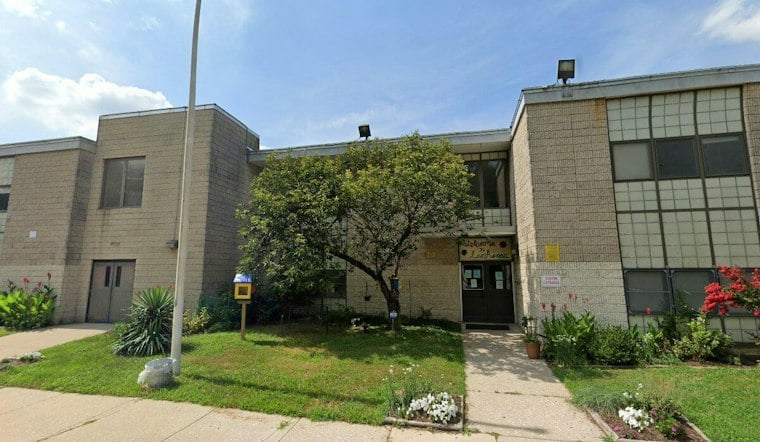
The Philadelphia Board of Education approved the district’s Accelerating Opportunity facilities plan by a 6-3 vote in April 2026. For Lankenau and Saul, the central change is scheduled for the 2027-28 school year: Lankenau High School will close and its program will join Saul High School as a career and technical education honors program. The district’s announcement says the final plan totals $3 billion and schedules modernization at 169 campuses. Earlier recommendations paired Lankenau with Roxborough High School; the final version instead pairs it with Saul, as reported by NBC10 Philadelphia. The approved plan also keeps the Lankenau property under district ownership for use as an environmental education center, according to the district.
What the district has scheduled
The work scheduled at Saul is limited for now: the plan includes a new fire alarm system. More extensive upgrades—including replacing windows and flooring, painting and providing furniture—depend on funding and are not expected to start before the 2033 school year, according to WHYY’s reporting. WHYY also reported that district spokesperson Monique Braxton said transition committees for affected schools would be announced soon. She said district leaders had recently visited Saul and Lankenau six times and were in weekly contact with both principals.
A separate districtwide process is intended to address some practical questions, but it does not provide school-specific transition plans. The Philadelphia Inquirer reported that the district opened applications in September for transition teams covering 50 schools affected by closures, phase-outs or incoming students. The teams are intended to consider issues such as safety, transportation and space.
Questions about combining two programs
Saul’s campus covers more than 100 acres and has agricultural facilities including barns, greenhouses, an industrial kitchen, aquaponics labs and an orchard, according to WHYY. The outlet reported that Saul enrolls just over 400 students and Lankenau more than 200, while the district has assessed Lankenau’s facilities as severely underused. Saul’s majors include animal science, food processing science and horticulture; Lankenau’s program focuses on agriculture, food and natural resources.
The wider workforce context
The statewide figures offer context for the field shared by the programs, though they do not forecast employment for specific school programs or occupations. The Pennsylvania Department of Agriculture, citing Team Pennsylvania’s 2021 Economic Impact Study, says nearly 580,000 Pennsylvanians—or one in 10 jobs—were in the agriculture and food industry. Separately, Pennsylvania Department of Labor & Industry projections estimate that statewide employment in Agriculture, Forestry, Fishing & Hunting will grow from 67,730 in 2024 to 69,410 in 2034, a projected increase of 2.5%.
The merger’s operational questions include how to combine staff, courses, class sizes and schedules while fitting programs into available rooms, WHYY reported. Some teaching roles cover multiple subjects, and some rooms serve several purposes during the day. Christina Puntel, a Saul Spanish teacher who has worked for the district since 1998, told WHYY that staff support preserving Lankenau but have not yet seen a clear plan for combining the schools. These are concerns reported by WHYY, not findings from new interviews for this article.
Lankenau’s distinct role and student input
The programs also have distinct features that the merger will need to account for. Lankenau is the district’s only environmental magnet school; about 250 students attend it on its 17-acre campus, according to The Triangle. WHYY has reported a 100% graduation rate and described Lankenau’s three-year Agriculture, Food and Natural Resources career and technical program. The outlet also reported that a Lankenau teacher described its GIS mapping course as unlike similar coursework at Saul.
Student questions are another part of the implementation picture. WHYY reported that Saul’s student newspaper, The Cultivator, grouped questions from students under topics including staffing, classes, space, funding and timing. Ava Badstubner, an 11th-grade horticulture student and newspaper editor, told WHYY that students felt excluded from the process, saw possible benefits if the merger brought more funding, and wanted clearer information about what would change. The newspaper team planned to take its questions to the principal and district. This account comes from WHYY, not from independent interviews for this article.





