

























































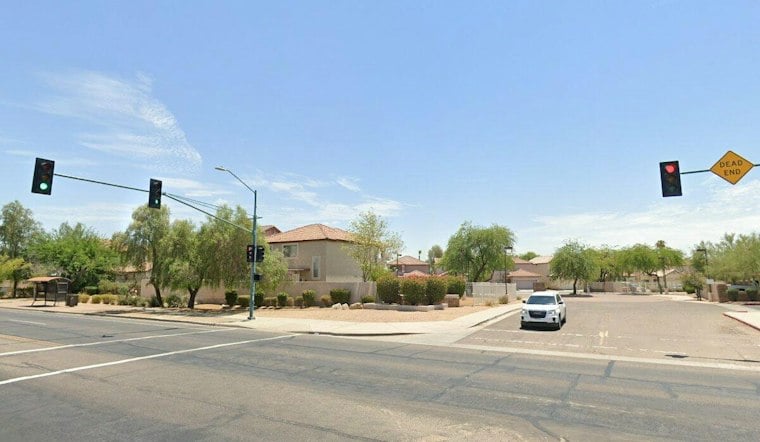
Authorities issued a SAFE Alert for 60-year-old Sakina Azimi, a Phoenix woman who did not return home Saturday after leaving her home near 103rd Avenue and Camelback Road to catch a bus to a doctor's appointment. Authorities said she has a medical condition that could cause her to become easily confused or lost. She was last seen wearing a blue headscarf and a black dress. Glendale police later found Azimi at a gas station; she was well and reunited with family, and authorities canceled the alert.
The alert was first reported by KTAR News 92.3 FM, which cited the Department of Public Safety in detailing Azimi's planned route.
Azimi's case unfolded under Arizona's SAFE Alert system, which replaced the state's Silver Alert framework. The SAFE Alert, short for Seek and Find Alert, was created under House Bill 2894 during the 2025 legislative session and officially took effect on September 26, 2025, amending Arizona Revised Statutes § 41-1728, per the Arizona Legislature.
Why a 60-Year-Old Qualifies for the Alert
Unlike the old Silver Alert system, which generally applied to adults 65 and older, the SAFE Alert framework expanded eligibility to include individuals of any age diagnosed with a cognitive or developmental disability. The law also explicitly bars law enforcement agencies from delaying or denying an alert request over administrative procedures or a person's past missing episodes, according to the Arizona Legislature's bill summary. The expanded eligibility rules allow alerts for some people under 65.
Before issuing a SAFE Alert, investigating officers are required to confirm that a person vanished under unexplained or suspicious circumstances, that they face peril from health or environmental factors, and that local search steps — including NCIC database entries, hospital checks, and contacting family — have already been exhausted, per guidelines described by KJZZ. The statute requires training at hire and biannually for employees directly involved in missing-person cases, including supervisors and communications dispatchers.
How the Alert Spreads Across the State
Once a SAFE Alert is activated, the Arizona Department of Public Safety coordinates broadcasts through the Emergency Alert System, Wireless Emergency Alerts, digital channels, and 193 ADOT highway messaging boards statewide, including 108 across the Valley. The alert's location determines how many signs display it, according to the Arizona Department of Public Safety. Azimi had set out to take a bus, while the alert network also includes digital and highway notifications.
The SAFE Alert program sits alongside several other targeted notification systems in Arizona, including the Turquoise Alert, which launched in July 2025 for missing and endangered individuals under 65 with a particular emphasis on tribal communities, as well as AMBER and Blue alerts, the Arizona Department of Public Safety has said. Before the SAFE Alert system took over, the former Silver Alert framework had a 98% success rate, with most missing individuals located safely within 18 hours, according to statistics reported by Axios Phoenix.
How to Help and Local Safety Resources
Phoenix Police's Missing and Unidentified Persons Unit, part of the Family Investigations Bureau, is located at 2120 North Central Avenue. The unit can be reached during regular desk hours at 602-534-2121 or after hours at 602-262-6141, according to the City of Phoenix.
Phoenix also offers a voluntary Smart Notifications for 1st Responders program, which lets residents register family members who have cognitive or developmental conditions so that emergency personnel have access to critical medical and communication details if that person ever goes missing, according to the Autism Society of Greater Phoenix. Azimi's case is an example of the relatively new SAFE Alert system being used to help locate a vulnerable adult.





