

























































Stick two metal forks into a pickle, plug it into an outlet, and watch it glow orange like a tiny streetlight. The classroom demonstration has puzzled scientists for decades. After more than 100 burnt-pickle experiments, Portland State University researcher Josh Méndez has offered evidence for a hybrid explanation of the glow.
A Downtown Portland Lab Tackles a Decades-Old Puzzle
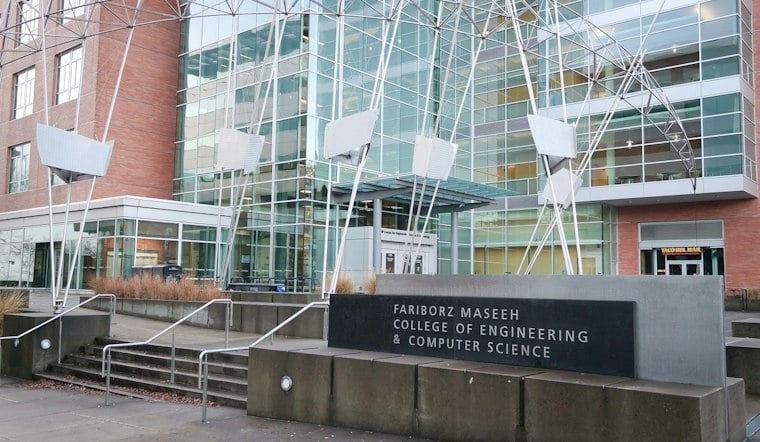
Josh Méndez, an assistant professor in Portland State University's Department of Electrical and Computer Engineering, investigated the demonstration through a series of experiments, according to Portland State University. The university announced his findings on September 30, describing the glow as a longstanding electrostatics puzzle. Méndez conducted the work within the university's Maseeh College of Engineering and Computer Science at its downtown Portland campus, the university said.
A pickle's salty brine conducts electricity, and the current heats the pickle, as reported by KOIN.com. The glow's explanation has centered on what happens at the negative electrode: whether sparks alone are responsible, or whether electrolysis also produces the gas involved.
Two Competing Theories, One Hybrid Answer
The debate involved two explanations. One focused on electrical discharges, but, as KOIN.com reported, that account did not explain why the pickle glows at only one end. Another pointed to electrolysis: hydrogen forms at the negative electrode, potentially accounting for the one-sided glow. Researchers also disagreed over whether the gas was ignited by heat or by an electrical spark.
Méndez's findings bring the two ideas together. He concluded that electrical arcing ignites hydrogen produced by electrolysis at the negative electrode, according to Gizmodo. Portland State University likewise described the proposed mechanism as arcs igniting the hydrogen and producing localized bursts that excite sodium ions in the brine.
“Hydrogen is involved, but heat is not what ignites it,” Méndez said, per KOIN.com.
Why the Glow Turns Orange
The signature orange-yellow color is not a coincidence of cooking — it is physics tied directly to table salt. The glow corresponds to the 589-nanometer sodium D-line emission spectrum, produced when excited sodium ions in the brine return to their ground state, according to the University of Arizona Optical Sciences Outreach program. That exact wavelength is identical to the light given off by commercial sodium-vapor streetlights, the same source notes. Because it is the pickle salt that determines the glow's color, a different salt would produce a hue unique to its own elements, KOIN.com reported.
That is not just theoretical. A study published in the Journal of Chemical Education in April 2005 found that soaking cucumbers in alternative chloride salts — lithium, potassium, strontium, or barium — produced pink, purple, red, and yellow glows respectively. Researchers in that study first bleached the cucumbers with hydrogen peroxide before re-pickling them in the custom salt solutions to isolate each distinct color.
A Science-Fair Classic With a Surprisingly Long Paper Trail
The glowing pickle demo has a stranger pedigree than most classroom tricks. Its earliest documented technical write-up was an April Fools' Day spoof published by Digital Equipment Corporation on April 1, 1989, titled “Characterization of Organic Illumination Systems,” according to Wikipedia. The joke eventually became real science: the experiment entered peer-reviewed literature in March 1993, when a Journal of Chemical Education study analyzed the sodium D-line spectrum in electrified dill pickles, with its authors recommending dill over sweet pickles for their higher sodium content and less unpleasant odor during current flow.
Researchers later discovered pickles are not even necessary. A May 1996 study in the same journal showed the glow could be reproduced in onions, cabbage, potatoes, and grapefruit, after submerging the produce in a 15 percent salt brine for 10 days to make it conductive, per Wikipedia.
An Unusual Fit for Méndez's Broader Research
The pickle project is an outlier detour for Méndez only in subject matter, not in spirit. His broader research portfolio covers obscure electrostatics, triboelectricity, volcanic plume lightning, and even the physics of coffee grinding, according to Portland State University's profile of the professor. Portland State University noted the research examines an unsolved electrostatics problem that fits naturally within the Maseeh College of Engineering and Computer Science, which also conducts research spanning electromagnetics, acoustics, power engineering, and materials science.
A Classic Demo Comes With Real Hazards
Despite its popularity as a classroom spectacle, the experiment should not be treated as a casual kitchen-table trick. An electric-pickle demonstration guide hosted on Scribd describes the setup; general laboratory guidance also emphasizes briefing participants on equipment hazards and potential problems.
What the Safety Evidence Says
General laboratory guidance in NCBI Bookshelf says participants using electrical equipment should be briefed on applicable safety issues and potential problems. That guidance supports careful preparation, but it does not specifically assess a pickle demonstration combining household mains electricity, exposed conductors and conductive liquid.
A Federal Motor Carrier Safety Administration safety plan discussing hydrogen in commercial vehicles says an explosion is possible when enough hydrogen is trapped in a confined area and an ignition source is present. That general guidance does not establish how much gas a pickle produces or the level of hazard in this experiment; the available information here provides no measurements to determine either.





