

























































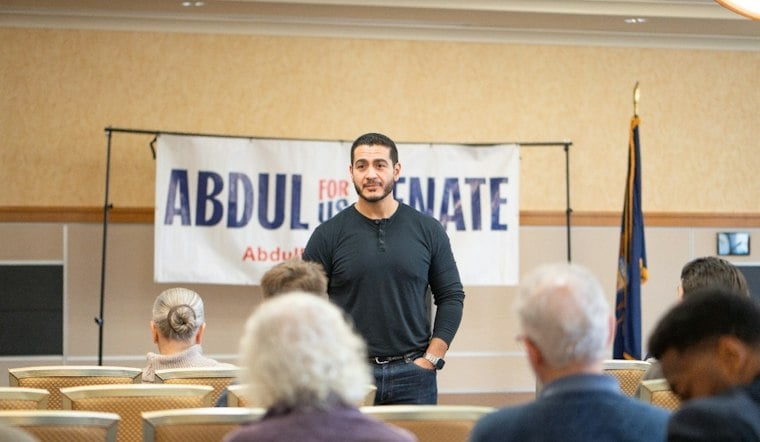
A political ad boosting Michigan Democratic Senate nominee Abdul El-Sayed has reignited a bitter fight over Israel, antisemitism and affordability just as voters head toward Election Day. The spot, which resurfaced on Michigan television after first appearing online in 2024, shows a couple in a grocery store blaming U.S. aid to Israel for the rising cost of eggs and bananas, and it has triggered swift condemnation from Jewish organizations and commentators across the political spectrum.
The advertisement was released by Rebellion PAC, according to Al Jazeera. Cenk Uygur, a Young Turks co-founder, founded the group, The Jewish Chronicle reported. In it, a woman tells her husband that American families cannot afford groceries because their tax dollars fund Israel's military and healthcare, a claim reported by JNS. The same woman says the family has to set aside $7 for killing Palestinians, referencing the cost of bombing Gaza, per the JNS account of the ad's dialogue.
The spot also claims the United States already sends Israel $4 billion a year and is now adding another $14 billion on top of that, framing the sum as roughly $85 per American taxpayer, according to The Jewish Chronicle. At another point, the ad suggests Americans may also be footing the bill for Israel's universal healthcare system, with the woman remarking, “We're paying for that too probably,” the outlet reported. The ad carries a disclaimer stating it was not authorized by any candidate, JNS noted, and the video more broadly highlights U.S. foreign aid to Israel against a backdrop of Americans struggling with rising living costs, as Al Jazeera's video report put it.
A Tight Race Gets Even Tighter
The ad landed in the middle of one of the most closely watched Senate contests in the country. El-Sayed, a former Detroit health director who could become the first Muslim U.S. senator, is locked in a competitive race against former congressman Mike Rogers that could help decide control of the Senate, according to Reuters, republished by Yahoo News. A RealClearPolitics average cited by Reuters gave El-Sayed a narrow two-point edge over Rogers, 48% to 46%.
Reuters found that Jewish, Muslim and Black voters in Detroit have often prioritized affordability over disputes involving Israel and Gaza. Still, some Jewish voters in the city expressed reservations about El-Sayed tied to his positions on Israel and his response to a March attack on a suburban synagogue, the outlet reported. After winning the Democratic primary, El-Sayed pledged that his commitment to Jewish safety was the same commitment he has to the safety of his own daughters, Reuters noted, a line meant to reassure wary constituents. The same Reuters report traced broader frustration among Arab American and Muslim Michigan voters in 2024 over the Biden-Harris administration's support for Israel's war in Gaza, which drove some away from the Democratic ticket.
Cenk Uygur Pushes Back on Antisemitism Claims
Uygur rejected the accusations head-on, arguing that opposition to American funding for Israel should not be conflated with hostility toward Jews, according to The Jewish Chronicle. He has framed the ad as a critique of policy rather than people, insisting that criticizing a foreign government's conduct is not the same as hatred toward an entire religious or ethnic group.
Outside Money Already Flooding the Race
The controversy comes as outside spending on Michigan's Senate contest has reached staggering levels. United Democracy Project, the AIPAC-aligned super PAC, spent $95,000 on mailers opposing El-Sayed in the general election, according to NBC News, on top of the $33 million it had already poured into opposing him and backing Rep. Haley Stevens during the Democratic primary. By comparison, Al Jazeera reported that AIPAC's election arm had spent more than $30.6 million on the race as of a single Saturday evening during the primary, part of over $54 million in combined PAC spending to help Stevens — a total that topped $60 million once the Center for Democratic Priorities' spending was folded in. El-Sayed, by contrast, received only about $3.5 million in independent-expenditure support during that stretch, a fraction of what Stevens benefited from, while a newly formed group called A Stronger Michigan separately spent more than $17 million in the race.
Rebellion PAC is registered with the Federal Election Commission as an active quarterly hybrid PAC with a non-contribution account, classified as an unauthorized committee, according to Federal Election Commission records. That designation underscores that the ad was produced independently of El-Sayed's own campaign operation, consistent with the disclaimer attached to the spot.
El-Sayed's campaign did not immediately respond to a request for comment on the advertisement, according to the New York Post, amid condemnation from Jewish leaders and commentators over the spot. With early voting underway and the Senate race still within the margin described by Reuters, the ad's resurfacing has added another flashpoint to a campaign already shaped by deep divisions over Israel, Gaza and the rising cost of living in Michigan.



