

























































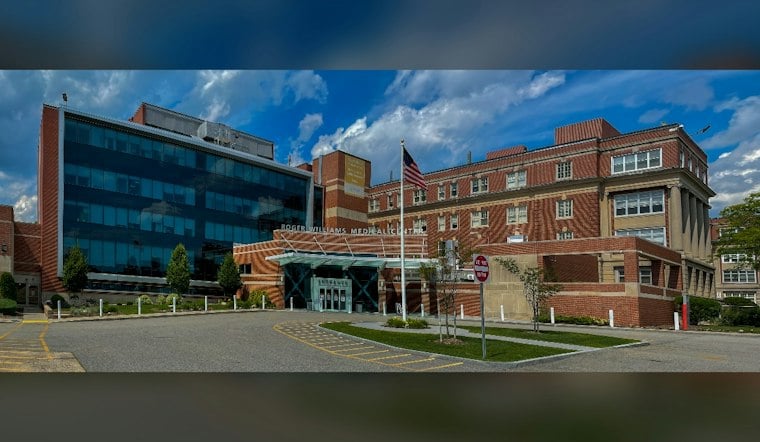
Providence doctors are using a new robotic arm designed to help visualize and access patient airways during lung-cancer procedures. CharterCARE Health of Rhode Island says it is using a robotic-assisted platform to support the early detection and treatment of lung cancer.
CharterCARE is the nonprofit entity that manages Roger Williams Medical Center in Providence and Our Lady of Fatima Hospital in North Providence, according to Providence Business News. The system in question, known as the Galaxy System, was developed by California-based Noah Medical and uses advanced imaging to locate lung tumors with precision, enabling more exact targeting for diagnosis and, when needed, surgical intervention. Noah Medical describes the Galaxy System as a robotic navigated bronchoscopy platform intended to give doctors visualization of and access to patient airways for both diagnostic and therapeutic procedures, and the company says its FDA clearance dates to March 2023.
CharterCARE described itself as the first health provider in Rhode Island to use the Galaxy System when it announced the implementation on October 21. Providence Business News later reported that Roger Williams' clinical team had completed its initial cases, and the hospital's team is now actively using the device.
Meet the Team Behind the Machine
The clinical team using the Galaxy System at Roger Williams includes Dr. Rabih El-Bizri, director of pulmonary and critical care medicine; Dr. Mohammad Abdallat, a thoracic surgeon; and Dr. Leandro Ramirez, a pulmonary and critical care medicine clinician, per the same account. El-Bizri said lung cancer affects many individuals and families in the community, and he described conventional bronchoscopic techniques as having made it challenging to identify and biopsy small pulmonary lesions.
“This advancement brings greater confidence for physicians and new hope to patients across Rhode Island,” El-Bizri said, according to the report. The National Cancer Institute has reported that lung and bronchus cancer is among the most diagnosed cancers in the country, and that it represented the highest percentage of cancer deaths in 2026, according to the agency's figures as cited in the report.
Rhode Island's Mixed Lung-Cancer Picture
The push toward earlier detection lands in a state with an unusual story to tell about lung cancer. Rhode Island's incidence rate sits at 59.1 cases per 100,000 people, notably higher than the national rate of 52.8, according to the American Lung Association. Yet the state also posts a five-year survival rate of 37.6%, well above the national average of 29.7%, and catches 35.5% of cases at an early stage compared with 28.1% nationally.
That early-detection edge tracks with another distinction: the American Lung Association ranks Rhode Island first among states for lung-cancer screening, with 31.0% of eligible high-risk residents getting screened. Robotic bronchoscopy platforms like the Galaxy System are part of a broader trend the industry is watching closely, with Cleveland Clinic Consult QD describing the approach as an emerging alternative to CT-guided needle biopsy for diagnosing early-stage disease.
What the Data Says About Robotic Bronchoscopy
A multicenter randomized trial cited by Cleveland Clinic found navigational bronchoscopy achieved 79% diagnostic accuracy, statistically not inferior to the 73.6% accuracy of transthoracic needle biopsy, while recording a pneumothorax rate of just 3.3% compared with 28.3% for the needle-biopsy group. A separate preliminary multicenter study, known as CONFIRM, found robotic bronchoscopy achieved tool-in-nodule success in 99.4% of cases and a strict diagnostic yield of 89%, with no pneumothoraces reported, per the same outlet.
CharterCARE has also pointed to a Cleveland Clinic study it says found the Galaxy System established a diagnosis in 90% of 100 evaluated patient cases, as reported by Providence Business News.
For now, Roger Williams Medical Center's experience with the Galaxy System remains its own early chapter in that broader story, with El-Bizri casting the technology as a tool that streamlines the diagnosis and treatment process for patients navigating a disease that touches so many families across the state.





