

























































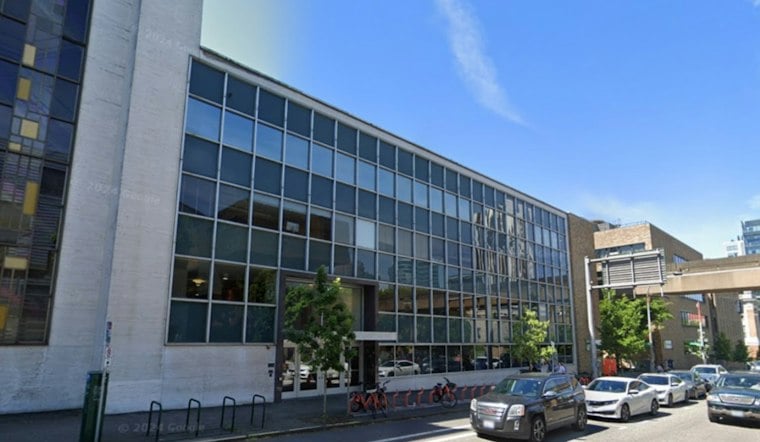
A former downtown Portland parking lot and skate park has been transformed into a 106,000-square-foot mass-timber landmark for Portland State University's art students, part of a $90 million investment the school unveiled this week that consolidates programs long scattered across four dilapidated buildings.
The new Jordan Schnitzer School of Art + Art History + Design building, as reported by KOIN, brings roughly 1,200 art students under one roof for the first time. According to the PSU Foundation, the university's Art Practice, Art History, and Graphic Design programs had been spread across five separate campus locations, leaving faculty and students without shared studio space or unified technology labs.
State Bonds and a Landmark Donor Gift
Most of the project's funding came from the state, with additional support from outside donors, KOIN notes. Oregon lawmakers financed the bulk of the $90 million project through $81.6 million in public bonds, according to Portland State University.
Real estate developer Jordan Schnitzer, described by KOIN as PSU's biggest benefactor, has seen his family donate more than $26 million to the university over time. His April 2024 gift of $10 million was split three ways, per OPB: $5 million went directly to building construction, $4 million went to the on-campus Jordan Schnitzer Museum of Art, and $1 million supported outdoor campus art and lighting improvements. OPB reported the gift responded directly to state leadership calls for private investment in central Portland's recovery.
A Mass-Timber Structure Rooted in Tribal Forests
General contractor Swinerton and project designer Lever Architecture broke ground on the four-story facility in September 2024 and reached substantial completion in mid-2026, according to Swinerton's project documentation, on a site that had been a surface parking lot and skate park, bounded by SW Jackson and SW Broadway. The building relies on mass timber sourced from the Pacific Northwest, KOIN reports, and 50 percent of its Douglas fir glulam structural timber came from regional Tribal forests or Tribal enterprises, per project documentation from Timberlab. Project managers toured a Yakama forest and mills to arrange the sustainable supply chain, the same documentation notes.
The building's success helped push Portland State's board to require mass-timber construction for all future campus new construction, after a feasibility study demonstrated its viability over traditional concrete and steel, according to Timberlab. It stands as the first building constructed with mass timber on PSU's campus.
Student Voices Shaped the Design
Equity consultant Dr. Amara Perez led a research project with 15 Black, Indigenous, and People of Color art students using what is described as a Critical Race Spatial Lens, according to LEVER Architecture, work that directly produced design requirements for a student-curated gallery and a secure outdoor work yard. More than 40 percent of students enrolled in PSU's visual arts programs identify as BIPOC, according to the PSU Foundation.
Student Tiffany Nguyen told KOIN the new building reflects support for PSU's art program, saying she feels confident about leaving with community and connections. Students are embracing hands-on creativity, including analog photography and VHS, even in an era of AI-generated art, the outlet reported. Lis Sherman told KOIN that students still want to create meaningful work connected to their communities and culture.
Green Features and a Proposed Performance Venue
Designed to achieve LEED Gold standards, the building features an all-electric mechanical system, a 25-foot sliding glass door connecting common spaces to an outdoor work yard, and a planted rooftop cultivated for textile dye plants that supply natural organic dyes for student textile and fashion design studios, according to the Portland Business Journal. LEVER Architecture says the facility activates a segment of Portland's Green Loop on College Street.
In September, the Portland City Council passed Resolution 37752 advancing plans for a proposed 3,000-seat Broadway-capable performing arts venue at PSU, according to the City of Portland.





