

























































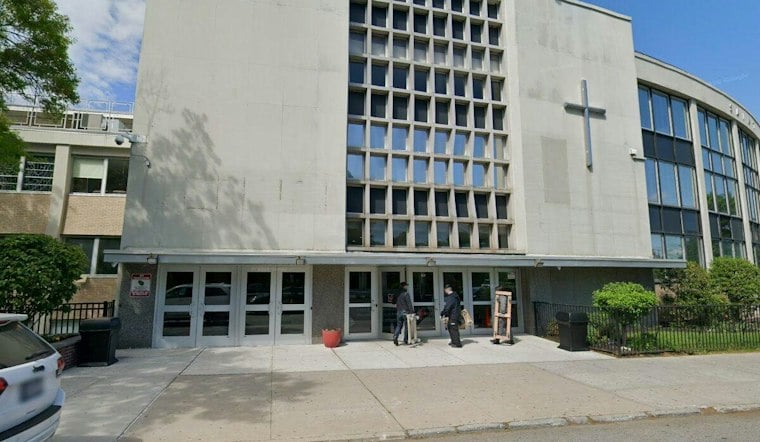
Fourteen-year-old Kevin Daly was arriving for class at St. Francis Preparatory School in Fresh Meadows on September 28 when he was overcome by intense dizziness. A school nurse called 911 at 8:47 a.m., but ten minutes passed with no ambulance in sight, and staff placed several more calls before 9:30 a.m. still got no response. With emergency help nowhere to be found, Kevin's parents decided not to wait any longer and drove him to the hospital themselves.
The ordeal, first reported by amNewYork, began when Kevin's older sisters stayed by his side while the family waited for an ambulance that never came. His sisters, who had completed a CPR and defibrillation course at St. Francis Prep, gave him aspirin as they waited — a step Kevin's doctors later said made a difference, even though the American Stroke Association does not generally advise aspirin during a stroke. When it became clear EMS wasn't arriving, Kevin's father, retired FDNY firefighter Brian Daly, and his wife — the family lives in Franklin Square on Long Island — loaded Kevin into the car. Brian Daly's wife drove Kevin to NewYork-Presbyterian Queens hospital in Flushing while Brian followed behind.
Doctors diagnosed Kevin with a stroke in the left thalamus of his brain, according to amNewYork. He was later transferred to NewYork-Presbyterian Irving Medical Center in Washington Heights, where he underwent treatment for several days. As of the Friday before the story published, Kevin remained hospitalized undergoing tests; he is now home recovering, though the cause of his stroke remains unclear.
A Teen With No Prior Restrictions
Brian Daly told amNewYork that Kevin had been perfectly fine and had no restrictions before the stroke, despite having undergone multiple open-heart surgeries as a newborn and younger child. He had been playing sports right up until the incident. Brian Daly said he told 911 operators he suspected his son was having a stroke, and that operators told him help was on the way — but according to the family's account, an ambulance never arrived despite their calls.
Childhood stroke is rare, occurring in roughly 1 to 2 cases per 100,000 children each year according to researchers cited by amNewYork, a figure broadly consistent with the wider range of 1.2 to 13 cases per 100,000 children annually documented in clinical research published by the American Heart Association. That research also notes pediatric stroke diagnoses are frequently delayed by more than 24 hours because of low initial clinical suspicion in young patients, and the condition remains among the top 10 causes of death in children. The American Heart Association states that optimal stroke care relies on timely recognition and rapid transport by emergency medical services.
FDNY spokesperson Amanda Farinacci confirmed the department is investigating the 911 response at St. Francis Prep, including how the calls were handled, classified, and dispatched. The department aims to determine what caused the delay and what operational changes are needed, Farinacci said, adding that FDNY hopes for Kevin's full recovery. Calls like the Dalys' are triaged through the FDNY's Computerized Triage Software, a system built into its Computer-Aided Dispatch setup that uses structured questioning to categorize medical urgency and assign Basic Life Support or Advanced Life Support units — though it remains unclear how Kevin's case was coded that morning.
Citywide Response Times Keep Climbing
The incident lands amid a broader, well-documented crisis in FDNY ambulance response. Citywide, the average response time for life-threatening medical emergencies rose from 11 minutes 21 seconds in Fiscal Year 2025 to 13 minutes 9 seconds in Fiscal Year 2026, per city data cited by amNewYork — a jump that, according to the Mayor's Management Report as detailed by The Chief, marks the fifth consecutive annual rise and a climb from just 9 minutes 34 seconds in Fiscal Year 2021. FDNY EMS responded to 1,613,282 medical emergencies in 2025 alone.
The Chief's reporting traces the slowdown to a 4% drop in total ambulance in-service hours, the removal of 11 hospital-operated ambulances from the city's 911 network, and a wave of EMTs leaving for the fire academy through firefighter promotional exams — FDNY projected losing more than 190 EMTs and paramedics to those promotions in October 2026 alone. Queens Council Member Joann Ariola, who chairs the Council Committee on Fire and Emergency Management, described the EMS system as being in a state of emergency and said 911 help is not guaranteed to arrive as quickly as needed.
Pay Gap Fuels EMT Exodus, Union Says
Michael Greco, president of FDNY EMS Local 2507, said experienced EMTs and paramedics are leaving the department because of low pay and poor workplace conditions, and that those departures directly result in longer response times. Union testimony at a March City Council budget hearing, reported by Labor Press, showed starting FDNY EMTs earn $39,486 annually, capping at $59,000 after five years, while starting firefighters earn $54,122 and grow to $105,146 after 5.5 years — a disparity the union links to a 70% attrition rate for EMS personnel within five years. FDNY EMS personnel have been working under an expired collective bargaining agreement since June 2022, the outlet reported.
Greco called for proper support, valuation, and pay for first responders, saying EMTs are experiencing burnout from the job while working at near-minimum-wage levels in dangerous environments. Ariola has called on City Hall to address the ambulance response crisis and said the city needs a plan addressing EMS staffing, retention, pay, and support.
New Transparency Rules, Proposed Alerts
City lawmakers have begun responding with new oversight tools. Local Law 30 of 2026, sponsored by Ariola and enacted in August, now requires the FDNY to submit public monthly reports detailing daily EMS unit availability by borough and the operational causes behind ambulance shortfalls, according to the New York City Council. Hoodline has previously reported on EMS promotion reforms tied to the same wave of staffing scrutiny.
Ariola also introduced the Minutes Matter Bill in August, which would require NYC Emergency Management to broadcast Notify NYC public alerts whenever the FDNY's emergency medical dispatch system accumulates a queue of more than 25 pending ambulance calls, as reported by The Chief. Union leaders have said call backlogs occasionally reach hundreds of delayed calls at once. Separately, the Council's Committee on Fire and Emergency Management held an oversight hearing on September 30 focused specifically on response times and ambulance allocation in outer-borough communities, where response times have consistently lagged behind citywide averages.
Citywide response time reporting itself stems from Local Law 119 of 2013, known as the Ariel Russo Response Time Reporting Act, which requires measuring total end-to-end response times from the moment a 911 call is placed to the moment a unit arrives on scene, according to NYC.gov. The law was named for a 4-year-old girl who died in 2013 after a delayed emergency response. St. Francis Prep, founded in 1858 and now the largest private Catholic high school in the country with roughly 2,400 students, has not been named as a party to any investigation beyond FDNY's internal review of the dispatch response.





