

























































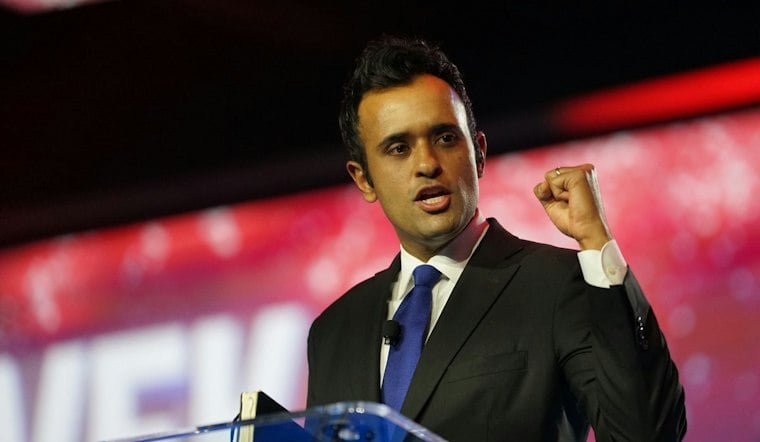
More than 100 people packed into K's Hamburger Shop in Troy on Thursday to hear Republican gubernatorial candidate Vivek Ramaswamy promise what he called Ohio history's largest property tax relief package, just days before the November 3 election. The stop was one of three the Ohio Republican bus tour made through the Miami Valley that day, following a morning visit to Sidney and ahead of an afternoon rally at a Vandalia business.
The Troy event, scheduled for noon at 117 E Main St, was part of a statewide bus tour that the Ohio Republican Party ran from October 23 through November 2 in the campaign's final stretch. Ramaswamy, who has running mate state Senate President Rob McColley and faces Democrat Amy Acton and Libertarian Don Kissick in the governor's race, was joined in Troy by attorney general candidate Keith Faber, secretary of state candidate Robert Sprague, auditor candidate Frank LaRose — currently Ohio's secretary of state — and treasurer candidate Jay Edwards, according to the Springfield News-Sun. Speakers across the ticket emphasized government accountability, public safety and election security.
Ramaswamy's Property Tax Promises
Ramaswamy's campaign had announced on Thursday a proposal to investigate government spending and property appraisals, though the announcement did not specify how those investigations would be conducted, per the same report. At the Troy stop, he said he would sign an executive order on his first day as governor directing an investigation into localities where property taxes have doubled since the pandemic. “You deserve transparency for how your taxpayer dollars are being spent,” he told the crowd.
Ramaswamy framed the message in populist terms, telling supporters, “It is your home, not the government's,” and, “You should not pay unjust rent to the government.” He also promised efforts to prosecute Medicaid fraud and end sanctuary cities, and he criticized Amy Acton's tenure as Ohio health director during the Covid-19 pandemic, framing the election as a choice between what he called “communism versus common sense.”
In an interview published separately, Ramaswamy told ABC 6 he wants to reset property taxes to pre-pandemic levels and cap future growth, saying, “I'm hoping that people feel net impact by this time next year.” He added that eliminating the state income tax would take eight to 10 years, while property tax relief could begin as soon as 2027. He also said data centers should pay property taxes that provide rebates to homeowners.
Why Troy Homeowners Are Listening
The pitch lands against a backdrop of sharply rising local property values. Miami County property values were expected to increase by an average of 28% in 2026, according to the Dayton Daily News. Statewide, residential and agricultural owners were charged about $3.78 billion more in property taxes in 2025 than in 2020, as total collections rose from $20.1 billion to $25.2 billion, per Signal Ohio.
Estimates of the fiscal impact of Ramaswamy's rollback plan diverge. Innovation Ohio researchers cited by Signal Ohio put the annual revenue reduction at around $4 billion, while Cleveland.com reported an estimate of at least $2.4 billion annually. About 60% of Ohio property taxes fund local schools, meaning K-12 districts would absorb most of any cuts, Signal Ohio reported.
Acton's Competing Tax Plan
Acton, who pledged a tax cut for working families and efforts to lower electric bills — with the average Ohio residential bill reaching $189.19 a month in September for 900 kilowatt-hours of usage, per Signal Ohio — has proposed expanding the homestead exemption to help seniors with property taxes. Her plan would raise the exemption's income limit from $41,000 to $50,000 per year, extending eligibility to 55,000 additional homeowners, Cleveland.com reported. She has also proposed rebates of up to $1,000 for qualifying homeowners facing annual tax increases exceeding 4%, subject to income and home-value limits, according to a Cleveland.com fact-check of a Ramaswamy campaign ad.
Acton additionally wants to fully fund the 2021 Fair School Funding Plan, per State News. Policy Matters Ohio estimates that fully funding the plan would require $2.75 billion beyond what lawmakers approved in the current two-year budget. She has also proposed using state money to buy and forgive unpaid medical debt, while Ramaswamy has said he would increase Medicaid anti-fraud initiatives to help curb health costs.
Voters Weigh In at the Hamburger Shop
Among those in the crowd were Carlas and Donna McFarland, longtime Republican voters who said they had already cast their ballots after stopping at K's Hamburger Shop for a meal. Donna McFarland said Donald Trump's endorsement of Ramaswamy helped persuade her to back him. Carlas McFarland, who served four years on active duty in the Navy including three tours in Vietnam, said he opposes communism.
Janie Hummel, an independent voter from Tipp City who said she does not vote a straight-party ticket, said she is supporting mostly Republicans this election and views Ramaswamy as receptive to new ideas and willing to meet with voters. But Hummel raised concerns about data center development and its possible effects on land and water resources, questioning whether residents have received enough information about such projects. “Your job... is not to insult, but to influence people, and you do that through positive action,” she said, adding that elected officials should be accessible beyond campaign season rather than just showing up for events. “You should be visible all the time, not a photo op,” she said.
Data Centers and the Water Question
Hummel's concerns echo broader findings about the strain data centers could place on Ohio's water systems. A report cited by WYSO projected that by 2030, data centers will account for 8% of Central Ohio's human water consumption and up to half a percent of its total available water resources, compared with 1% of consumption and less than 0.1% of total availability in the Cincinnati-Dayton region. The report found the largest source of water demand tied to data centers will likely come from the energy generation needed to power them, not cooling, and concluded that the near-term challenge is planning, infrastructure and watershed protection rather than outright water scarcity.
Closing Argument Before Election Day
Ramaswamy urged supporters to spend the campaign's final days making phone calls, displaying yard signs and encouraging others to vote, and to keep campaigning through Election Day. “You're going to vote, but we need you to get the people in Miami County who are not in this room today out to vote as well,” he said. He promised to return to Miami County and told the crowd, “If you fight for us in those five days, we will fight for you for the next four years.”
Under Ohio law, the county auditor is responsible for assessing real estate at its taxable value, per the Ohio Revised Code, a process at the center of the debate over rising valuations. Voters across Miami County and the rest of the state will decide the race on Tuesday, November 3.





