

























































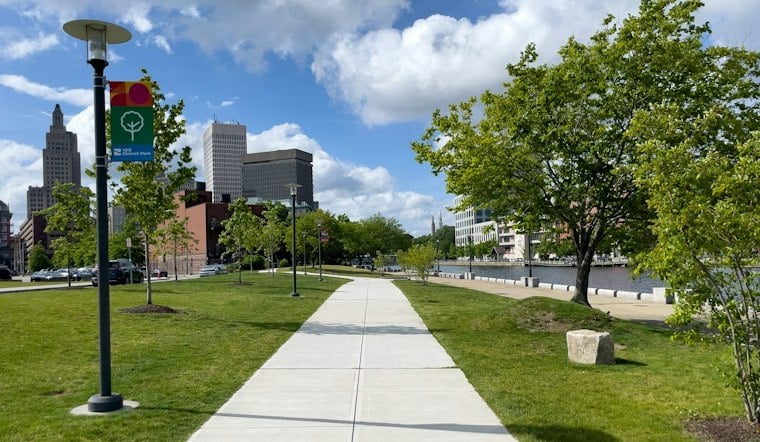
Rhode Island voters will soon decide whether the state should borrow $100 million to fund economic development projects across the state, with large-scale site work planned at locations like Quonset Business Park in North Kingstown and the I-195 District in Providence. Question 3 splits the money into two pots: $55 million for site development and $45 million aimed at infrastructure for ocean, defense, life sciences, data analytics and cybersecurity industries.
The measure does not earmark specific projects, instead establishing broad eligibility categories that could direct funds toward either hub, according to Rhode Island Current. The outlet reports that the $55 million bucket could cover land acquisition, environmental cleanup, utilities and infrastructure installation, while improvements to Quonset Business Park and acquisition and investment in the I-195 District are both included in the underlying legislation. As WJAR notes, the funding would not be tied to a line item already baked into the state budget.
Bob Cormier, CEO of the Rhode Island Life Science Hub — which is located in the I-195 District — said the funding would build places where businesses can locate and work, and would support programs and incentives meant to accelerate the state's targeted industries. He argued the money could help keep Rhode Island competitive, pointing to Massachusetts, which established a 10-year, $1 billion investment in its life sciences sector in 2008, according to the Massachusetts budget office. Cormier said Rhode Island has not made a comparable investment of its own.
Backers Point to Quonset's Growth Record
Kareen Columbe, founder of Ocean State Labs, said funding for life sciences is critical for developing new technologies, medicines and healthcare in the state. Supporters of the bond frequently point to Quonset Business Park's track record as evidence the state's site-development dollars pay off: between 2005 and 2025, the park developed 685 acres, added 5.2 million square feet of new facilities and drew more than $2.5 billion in inflation-adjusted private investment, according to the Quonset Business Park Economic Impact Report.
The same report found Quonset's total employment impact climbed 32% between 2018 and 2025, rising from 22,300 to 29,455 jobs, with 15,309 of those counted as direct positions. The park generated roughly $7.0 billion in economic output in 2025 — about 8.4% of Rhode Island's entire GDP — and supported $191.5 million in state and local tax revenue that year, the report states.
Critics Call It Borrowing Rhode Island Doesn't Need
Not everyone is sold. Mike Stenhouse, CEO of the Rhode Island Center for Freedom and Prosperity, argued that competitive tax rates and regulatory codes could generate an economic boost without the state taking on new debt. He described the proposed spending as handouts and, pointing to Quonset's own reported $7 billion in economic output last year, said the park should not need government assistance. Stenhouse called the bond a money grab that hurts Rhode Island.
The price tag has become part of the debate. Rhode Island Current reports that with roughly 5% interest repaid over 20 years, the bond's total estimated cost would swell to about $160.5 million, while WJAR cites an estimated eventual cost of $160 million over the same 20-year period — both pointing to the state effectively repaying around $1.60 for every dollar borrowed, per WJAR's reporting.
How Question 3 Reached the Ballot
The bond question has already been through one round of negotiation at the State House. Gov. Dan McKee's initial proposal was priced at $115 million, with $70 million set aside for site development and $45 million for growth-industry infrastructure, according to Rhode Island Current. Lawmakers on Smith Hill later trimmed the site-development portion by $15 million, producing the $100 million question now headed to voters.
Per the Rhode Island Department of State's voter guide, the ballot language asks whether the act passed by the General Assembly during its January 2026 session — authorizing the state to issue bonds, refunding bonds and temporary notes for the listed projects — should be approved. Bill text from the Rhode Island General Assembly specifies that the governor's signature must be endorsed on each bond issued under the measure.
If approved, projects financed through the bond are expected to begin in the latter half of 2027, with many undertaken within the following five years, according to Rhode Island Current. Question 3 would echo a smaller, similar measure Rhode Island voters approved in 2021: a $60 million industrial facilities bond that included $40 million for industrial site development and $20 million for the Port of Davisville at Quonset. Rhode Islanders have historically been receptive to such borrowing, approving 52 of 58 bond measures placed on statewide ballots between 2000 and 2025, according to Ballotpedia News. Question 3 is one of five bond measures on this year's ballot, which together would authorize $600 million in general obligation borrowing, per the same source.





