

























































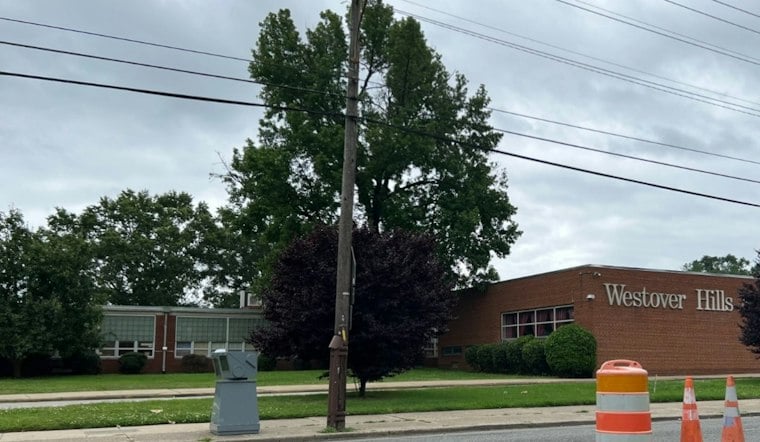
Parents near Westover Hills Elementary School say they can't wait until 2028 for safer sidewalks and crossings, and they've put numbers behind their worry: a petition gathered 187 responses describing crumbling sidewalks, dangerous turns and close calls between drivers and the children, pedestrians and cyclists who move through the Jahnke Road and Forest Hill Avenue intersection every school day.
The petition was organized by Paula Ogston-Nobile, a parent of two Westover Hills students, who told Axios she submitted it to Mayor Avula and the city's Department of Public Works on Tuesday. The petition ran from September 27 through October 15, and nearly 78 percent of respondents said they had personally witnessed safety concerns at the intersection. Almost 98 percent backed temporary road and sidewalk repairs, 88 percent wanted an urgent traffic safety assessment, and 85 percent supported a no-turn-on-red restriction, according to the same report.
Ogston-Nobile said she worries someone will be hit by a car, and the accounts she's collected from neighbors describe deteriorating sidewalks that force wheelchair users and parents pushing strollers into the street. Residents also reported that drivers turning from Jahnke Road onto Forest Hill Avenue veer onto the damaged sidewalk, and that reported safety concerns included drivers failing to yield, near misses, and aggressive behavior toward the school's crossing guard — who is able to stop traffic in all directions during arrival and dismissal, though Ogston-Nobile said some drivers proceed anyway even when told to stop.
A $42 Million Project With a Timeline That Keeps Shifting
The frustration is unfolding against the backdrop of a $42 million overhaul of Jahnke Road that broke ground earlier in 2026 and includes improved sidewalks, protected bike infrastructure and speed tables near the elementary school. Richmond's own project page has said completion is expected by City of Richmond spring 2028, while Axios reports the timeline has since been pushed to summer 2028 — a discrepancy that leaves families uncertain exactly how long they'll be waiting.
Whichever date holds, the improvements closest to Forest Hill Avenue are expected late in the project, according to Ogston-Nobile. Richmond has not committed to temporary sidewalk and pavement repairs in the meantime, the same report notes, which is why so many petition respondents are asking for stopgap measures rather than waiting on the full build-out.
The Turning Conflict at the Heart of the Intersection
City spokesperson Jensen Gavulic said Richmond has evaluated the intersection and confirmed the core problem: drivers can turn right on green while pedestrians are still crossing. Gavulic said that overlap persists even when pedestrians are given a head start to enter the crosswalk first, a conflict Axios identifies as central to the complaints pouring in from families.
Richmond transportation officials have said a no-turn-on-red restriction — the fix nearly 85 percent of petition respondents want — would not actually address that primary conflict, since the danger comes from right turns made on a green light rather than a red one. A broader Forest Hill Avenue safety assessment that includes the Jahnke Road intersection is scheduled for winter 2027, per the same reporting, though the article does not say what specific changes that review might recommend.
Under Virginia law, pedestrians crossing at intersections already have the right of way over vehicles turning into the road they're crossing, according to Virginia Code § 46.2-924. Ogston-Nobile said the safety issues at Westover Hills cannot wait another two years, a sentiment that echoes the urgency driving nearly every response in the petition.
Part of a Citywide Pattern
The Westover Hills concerns land amid a tougher citywide picture: Richmond's pedestrian death rate per capita was the highest in Virginia in 2025, when the city recorded 13 pedestrian deaths, according to WRIC ABC 8News. Three out of four of the city's most severe crashes happen on just a fraction of its roads, which transportation experts have classified as part of Richmond's high-injury network — and speed, not any single driver behavior, remains the strongest indicator of whether a crash turns fatal, per the same report.
Richmond's transportation department has roughly $1.2 billion budgeted for safety projects over the next five or six years, not counting expanded car infrastructure, WRIC reports. Other local institutions have experimented with lower-cost interim fixes while bigger projects move forward — VCU installed modular curbs at four on-campus intersections in 2025 specifically to slow left turns and stop corner-cutting, a tactic that offers one example of what a stopgap measure can look like while a larger overhaul is still years away.
For now, the scope of Richmond's Jahnke Road project remains sweeping on paper: ADA-compliant sidewalks, an ADA-compliant shared-use path, a new traffic signal, storm drainage improvements, pavement markings and a raised landscaped median, according to city procurement documents tied to the Jahnke Road Improvements project. Whether any of that reaches Westover Hills families before 2028 remains the open question driving their petition.





